
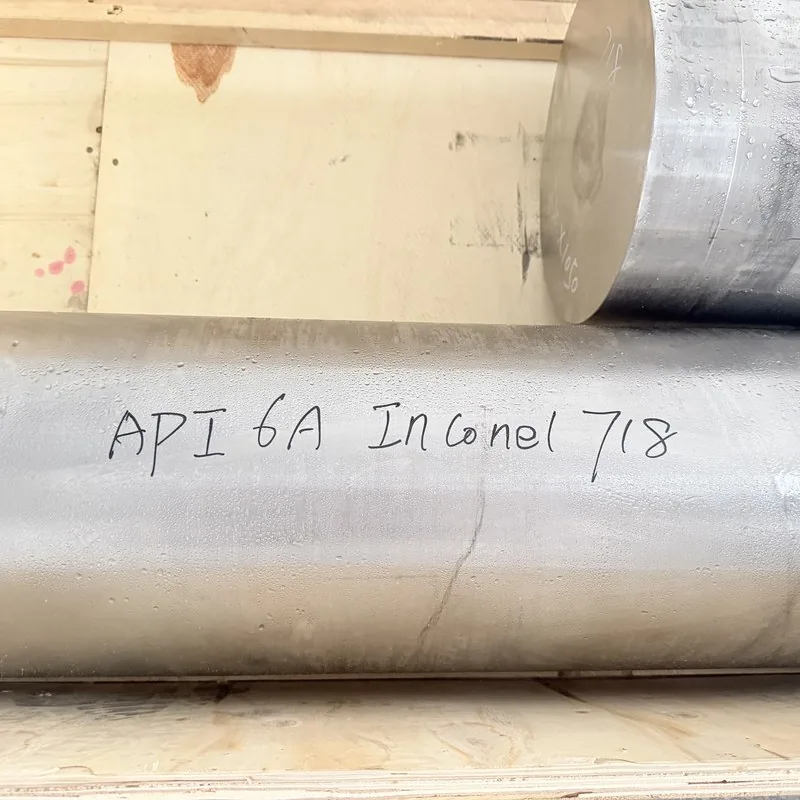
Inconel 718 (UNS N07718) is the standard material for API 6A wellhead and Christmas tree components that must hold pressure at elevated temperature while staying inside the hardness limits for sour service, and Incoloy 925 (UNS N09925) is the usual choice for studs and nuts in the same equipment. The selection is not made directly from alloy data sheets: API 6A first fixes the product specification level (PSL) and the temperature class, and those two decisions determine which alloy, which heat treatment and which test package are acceptable. A 718 component ordered for PSL 2 and the same component ordered for PSL 4 are the same alloy on paper and completely different products in the mill.
This guide sets out how the API 6A framework narrows the alloy choice, which alloy is used for which component, and how the hardness and heat treatment requirements interact for sour service. For the sour service limits themselves, see NACE MR0175 Alloys for Sour Service.
What do PSL and temperature class actually fix?
API 6A (adopted as ISO 10423) rates equipment by two independent parameters before any material is discussed.
**Product specification level (PSL)** sets how much verification the equipment carries:
| PSL | Design verification | Material verification | NDE | Typical use |
|---|---|---|---|---|
| PSL 1 | Basic | Certificate of compliance | Minimal | Low-risk surface equipment |
| PSL 2 | Design validated, documented | Traceable material certificates | Specified NDE on critical parts | Standard surface wellheads |
| PSL 3 | PSL 2 plus documented design methodology | Full material certification, hardness survey, impact testing where specified | Full volumetric NDE on pressure-containing parts | High-pressure and critical service |
| PSL 4 | PSL 3 plus the purchaser's own specification | Witnessed testing, extended documentation | Full NDE plus additional purchaser-specified inspection | Sour, subsea and safety-critical service |
**Temperature class** sets the operating window:
| Class | Range (°C) | Range (°F) |
|---|---|---|
| K | −60 to 82 | −75 to 180 |
| L | −46 to 82 | −50 to 180 |
| N | −46 to 60 | −50 to 140 |
| P | −29 to 82 | −20 to 180 |
| Q | −29 to 121 | −20 to 250 |
| S | −18 to 121 | 0 to 250 |
| T | −18 to 177 | 0 to 350 |
| U | −18 to 121 | 0 to 250 |
| V | 2 to 121 | 35 to 250 |
The practical effect is that the top of the temperature class decides whether a carbon or low-alloy body material is admissible at all. Classes P and Q sit comfortably inside the range of 4130/4140 and F6a, and those grades are still the correct answer for a large share of 6A equipment. Once the class reaches T, or once the partial pressure of H₂S puts the equipment under NACE MR0175, the body and internals move to a corrosion-resistant alloy and the nickel grades enter the picture. Confirm the current edition of API 6A before fixing a class — the tables are revised with the standard.
Which alloy is used for which API 6A component?
The equipment is designed as a set of components with different loads, exposure and hardness requirements, and the alloy choice differs across them:
| Component | Typical alloy | UNS | Material standard | Why |
|---|---|---|---|---|
| Body, bonnet, valve block | Inconel 718 | N07718 | ASTM B637, forged to ASTM B564 | Strength to 177 °C, fatigue resistance, hardness controllable for sour service |
| Valve gate and seat | Inconel 718, 625 overlay | N07718 / N06625 | ASTM B637, ASTM B443 | Galling and erosion resistance on the sealing faces |
| Studs and nuts | Incoloy 925, Inconel 718 | N09925 / N07718 | ASTM B805, ASTM B637 | High strength fastener grades with predictable relaxation |
| Ring gaskets and seals | 316L, Monel 400, nickel 200, soft iron | varying | ASTM B127, B162 | Controlled deformation without galling the sealing groove |
| Choke trim, cage, stem | Inconel 718, 625, tungsten carbide | — | ASTM B637, B443 | Erosion resistance at high differential pressure |
| Cladding and overlays | Inconel 625 | N06625 | ASTM B443, weld overlay | Corrosion barrier on a lower-cost body where the design permits |
| Tubing and casing hangers | 4130/4140, 718, 925 | — | ASTM A29, B637, B805 | Load-bearing with CRA where the seal is dynamic |
Two points on that table are frequently misunderstood. First, **625 is a solid-solution alloy and 718 is precipitation-hardenable**. Substituting 625 for 718 in a pressure-containing body loses roughly half the yield strength, so it is only valid where the wall thickness is increased or the cladding route is taken. Second, **Incoloy 925 and 718 are not interchangeable as studs** even though both are precipitation-hardenable: 925 has lower strength but better stress relaxation behaviour at temperature, and it is easier to keep inside the hardness limit.
How do the mechanical properties compare?
The three alloys most often quoted against each other in a 6A enquiry differ substantially, and the difference is what drives the component-level choice:
| Property | Inconel 718 (aged) | Incoloy 925 (aged) | Inconel 625 (annealed) |
|---|---|---|---|
| UNS number | N07718 | N09925 | N06625 |
| Tensile strength, min | 1241 MPa (180 ksi) | 1034 MPa (150 ksi) | 830 MPa (120 ksi) typical |
| Yield strength, min | 1034 MPa (150 ksi) | 758 MPa (110 ksi) | 415 MPa (60 ksi) typical |
| Elongation, min | 12 % | 15 % | 30 % |
| Hardness limit under NACE MR0175 | 40 HRC max | 40 HRC max | Not hardness limited |
| Useful temperature range | −253 to 700 °C | −60 to 650 °C | −196 to 980 °C |
| Strengthening mechanism | γ″ precipitation (Nb) | γ′ precipitation (Ti, Al) | Solid solution (Mo, Nb) |
| Relative cost | High | Medium | High |
The 718 numbers come from AMS 5662, which requires a minimum tensile strength of 1241 MPa and a minimum yield strength of 1034 MPa in the aged condition, with the grain flow controlled by the forging practice. Where a purchaser quotes a 6A part as "Inconel 718" without a material standard, the missing information is almost always the heat treatment and the acceptance level — and that omission is how a component arrives with the right alloy name and the wrong properties.
Why is the ageing treatment the decisive step for 718?
718 reaches its strength through a two-step ageing treatment after solution annealing, and the same treatment has to satisfy three separate masters at once: the mechanical property minimums, the NACE MR0175 hardness limit, and the dimensional stability of the finished part.
The standard ageing cycle for 718 is:
- 1. Solution anneal at 954–982 °C, hold, then rapid cool (water or air depending on section).
- 2. Age at 720 °C ± 5 for 8 hours.
- 3. Furnace cool at a controlled rate, typically 55 °C per hour, to 620 °C.
- 4. Hold at 620 °C for a further 8 hours.
- 5. Air cool to room temperature.
Three things go wrong in practice:
- **Ageing before final machining.** The ageing treatment moves the part, and a component finish-machined before ageing will not hold the sealing-groove tolerance afterwards. The sequence normally used is rough machine, age, then finish machine.
- **Hardness drift.** The hardness limit for 718 under NACE MR0175 is 40 HRC, and the useful window between the mechanical property minimum and the hardness maximum is narrower than it looks on a large forging where the cooling rate varies with section. A hardness survey across the part — not a single reading — is what proves compliance.
- **Cold work after ageing.** Any cold work applied after ageing, including straightening, changes the hardness locally and can put the part outside the NACE envelope. Where straightening is unavoidable it must be done before the ageing treatment and the part must be re-tested.
What does the test and documentation package contain?
For PSL 3 and PSL 4 equipment, the material package is a substantial document set and it is the part of the order most often under-specified on the enquiry:
| Item | Applies to | Reference |
|---|---|---|
| Chemical analysis, product analysis | All | ASTM B637 or AMS 5662 / 5663 / 5664 |
| Tensile test at room temperature | All | ASTM E8 |
| Hardness survey, multiple locations | All sour service | NACE MR0175, ASTM E18 |
| Ultrasonic examination of bar and forgings | PSL 3 and above | ASTM A388 |
| Magnetic particle or dye penetrant examination | PSL 3 and above | ASTM E709 / E165 as applicable |
| Grain size | Where specified | ASTM E112 |
| Impact testing | Where the temperature class requires it | ASTM E23 |
| Corrosion testing | Where specified for the CRA grade | ASTM G48 |
| Heat treatment charts | PSL 3 and above | Furnace record, traceable to the load |
| Material test report | All | EN 10204 3.1, with third-party inspection available on request |
| Traceability | All | Heat number transferred to the part, with the transfer method recorded |
The traceability clause deserves attention. On a 6A part the heat number has to survive machining, and the two accepted methods are hard stamping in a non-critical area or a low-stress dot-peen marking. Electric-etch marking on a nickel alloy is acceptable where the procedure has been qualified; a hand-written number in marker pen on a 718 forging is not traceability, and it is rejected at witness.
API 6A materials and forgings from Hangbo Alloy
Hangbo Alloy supplies Inconel 718 bar, billet and open-die forged stock to ASTM B637 and AMS 5662 / 5663 / 5664, Inconel 625 to ASTM B446 and ASTM B443, and Incoloy 925 to ASTM B805 — with the matching ageing treatment, hardness survey and NDE package applied before despatch rather than left to the machining shop.
Material is supplied with EN 10204 3.1 certification as standard, with third-party inspection available on request and dimension and traceability records matched to the part number.
Send us the PSL, the temperature class, the sour service status and the drawing, and we will confirm the alloy, the heat treatment route and the inspection package before the order is released.
Continue reading
- Which Alloy for a High-Temperature Furnace? 600 °C to 1250 °CFurnace alloy selection by service temperature and atmosphere — oxidation, carburisation and sulphidation — wi
- Which Alloys Comply with NACE MR0175 for Sour Service?NACE MR0175 / ISO 15156 sour service alloy selection — what counts as sour, which nickel alloys are pre-qualif
- Which Alloy Resists Seawater Best? 316L to TitaniumSeawater corrosion alloy selection ranked by pitting resistance equivalent number and critical pitting tempera
- All 4 Corrosion & Grade Selection guides
Frequently asked questions
Can Inconel 625 replace Inconel 718 in an API 6A body?
Only where the design allows for the loss of strength. 625 is a solid-solution alloy with roughly 415 MPa yield in the annealed condition against 1034 MPa for aged 718, so a direct substitution in a pressure-containing body requires a wall thickness increase. It is routinely correct as an overlay or cladding on a lower-cost body, and as an internal component where loads are low and corrosion resistance is the governing requirement.
What is the hardness limit for 718 in sour service?
NACE MR0175 limits precipitation-hardenable nickel alloys including 718 to 40 HRC. The limit is a material requirement, not a design stress: a component that is inside the hardness limit but exposed to an environment outside the standard's scope still needs a separate fitness-for-service assessment.
Does API 6A require impact testing on Inconel 718?
Not as a blanket requirement. Impact testing is invoked by the temperature class and by the purchaser's specification rather than by the alloy. For low-temperature classes below about −46 °C, impact test requirements are normally stated explicitly on the purchase order, together with the test temperature and the acceptance energy.
How long does a 718 forging take to produce?
Counting from a released order with an approved drawing, the sequence is melt and forge, solution anneal, rough machine, age, finish machine, NDE, and then the witness and documentation stage for PSL 3 and 4. The ageing and NDE stages are the ones that cannot be compressed, and a forged and aged 718 component with a full PSL 3 package is a project item rather than a stock item. Ordering against a stock programme is the usual way to keep a wellhead build on schedule.