
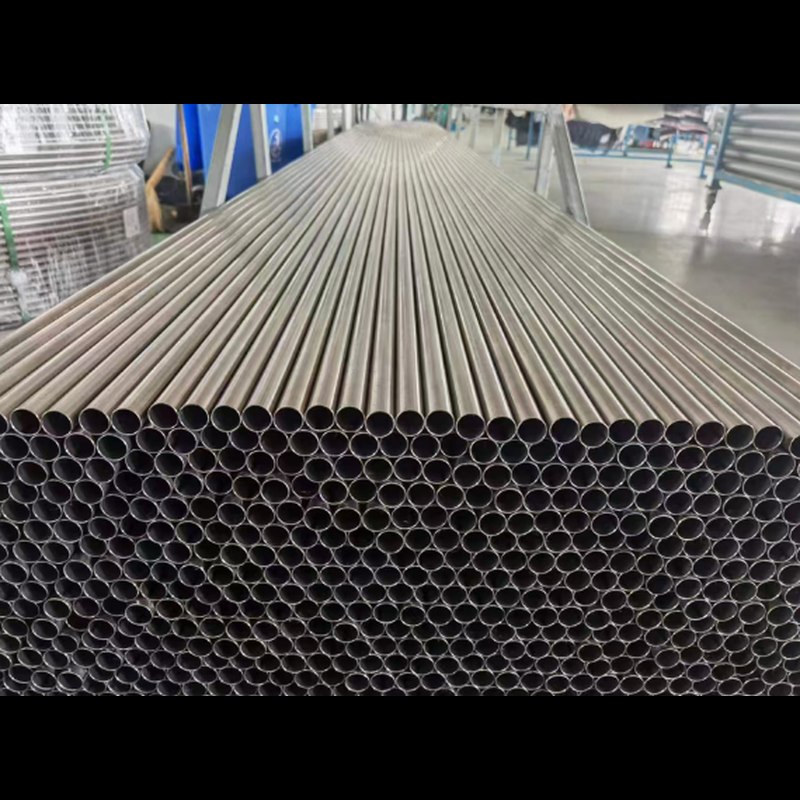
Hastelloy C-276 (UNS N10276) is the most widely used 'universal' corrosion resistant alloy in the Ni-Cr-Mo-W family. Its low carbon and silicon design prevents carbide and intermetallic precipitation in the weld heat-affected zone, so it handles mixed oxidising and reducing media, wet chlorine, hypochlorite and many mineral acids.
As a manufacturer and global exporter of special alloys since 2012, Shanghai Hangbo Alloy Group Co., Ltd. supplies Hastelloy C-276 as round bars (φ2–600 mm, up to 12 m), plates & sheets (0.5–100 mm thick, up to 2500 mm wide), seamless tubes & pipes (φ6–630 mm OD, 0.5–40 mm wall), precision strip (0.02–3.0 mm, ±0.005 mm tolerance), welding wire & coils (1.0–5.0 mm), forgings & rolled rings (up to 7500 kg, 3500 mm OD), flanges & pipe fittings (Class 150–2500, DN15–DN1200) — all with EN 10204 3.1 certified material test reports.
Hastelloy C-276 Chemical Composition (wt%)
| Element | Content (wt%) | Element | Content (wt%) |
|---|---|---|---|
| Ni (镍) | Balance | V (钒) | ≤ 0.35 |
| Mo (钼) | 15.0–17.0 | C (碳) | ≤ 0.01 |
| Cr (铬) | 14.5–16.5 | Si (硅) | ≤ 0.08 |
| Fe (铁) | 4.0–7.0 | Mn (锰) | ≤ 1.00 |
| W (钨) | 3.0–4.5 | P (磷) | ≤ 0.040 |
| Co (钴) | ≤ 2.50 | S (硫) | ≤ 0.030 |
Hastelloy C-276 Mechanical Properties
| Property | Value |
|---|---|
| Tensile strength (Rm) | ≥ 690 MPa |
| Yield strength (Rp0.2) | ≥ 283 MPa |
| Elongation (A) | ≥ 40 % |
| Hardness | ≤ 200 HB |
| Density | 8.89 g/cm³ |
| Melting range | 1325–1370 °C |
| Thermal conductivity | 9.8 W/m·K |
| Young's modulus | 205 GPa |
| Max service temperature | 1040 °C |
Key Advantages
- Handles both oxidising and reducing corrosion — among the most versatile alloys available
- Low carbon (≤0.01%) and silicon (≤0.08%); no post-weld heat treatment needed
- Resists pitting, crevice corrosion and chloride stress-corrosion cracking
- Withstands wet chlorine, hypochlorite, chlorine dioxide and oxidising chlorides
Relevant Standards
- ASTM B574
- ASTM B575
- ASTM B622
- ASTM B564
- NACE MR0175 / ISO 15156
- UNS N10276
Typical Applications
- FGD absorbers and stack liners
- Chemical reactors, heat exchangers and distillation columns
- Pulp bleaching and chlorine dioxide generation
- Sour (H₂S/CO₂) oil and gas production
- Pharmaceutical and agrochemical synthesis plant
- Waste incineration and effluent treatment
Why Buy from Hangbo Alloy?
- Factory-direct manufacturer — founded 2012, headquartered in Shanghai Qingpu
- Full product range — bar, plate, sheet, strip, tube, forging, welding wire, flanges and machined parts
- Certified quality — ISO 9001:2015, GB/T 19001-2016, GJB 9001C-2017, EN 10204 3.1 mill test certificates with third-party inspection (SGS / BV / TUV) available on request
- Complete mill documentation — chemical analysis, mechanical test, ultrasonic test (UT), hardness and grain-size reports with every shipment
Contact Us — Shanghai Hangbo Alloy Group Co., Ltd.
Shanghai Hangbo Alloy Group Co., Ltd.
📍 No. 388 Songhuang Road, Qingpu District, Shanghai, China
📞 Tel / WhatsApp: +86 15618279078
✉️ Email: demi@nickel-alloy.com
🕒 Available 24 hours a day, 7 days a week — enquiries answered around the clock.
Send your drawing or enquiry (grade, form, size, quantity, standard) for a same-day quotation.
Frequently asked questions
How do I choose between Hastelloy C-276 and C-22?
C-22 (UNS N06022) has more chromium (20–22.5%), slightly less molybdenum and tungsten, giving better resistance and thermal stability in oxidising media and mixed acids with a marginally higher PREN. C-276 is more cost-effective in strong reducing acids such as hydrochloric acid and in chlorinated oxidising service. Choose C-22 when the medium swings oxidising or runs hot; choose C-276 when reducing acids dominate and cost matters.
Does C-276 require post-weld heat treatment?
Normally not. With carbon ≤ 0.01% and silicon ≤ 0.08%, the heat-affected zone does not sensitise in the as-welded condition — the key improvement over earlier C-family alloys. A 1120 °C solution anneal and rapid quench is only considered for extremely aggressive media or where stress-corrosion risk from residual stress exists.
Why is Hastelloy C-276 far more expensive than 316L?
It comes down to alloy content: C-276 carries about 16% molybdenum, 15.5% chromium and 3–4.5% tungsten, whereas 316L has only 2–3% molybdenum on an iron base. Molybdenum, nickel and tungsten cost far more than iron and chromium, and melting (usually VIM plus ESR) plus difficult hot working lowers yield, so unit price typically runs 8–15 times that of 316L.
What forms and sizes are available?
We supply Hastelloy C-276 as round bars (φ2–600 mm, up to 12 m), plates & sheets (0.5–100 mm thick, up to 2500 mm wide), seamless tubes & pipes (φ6–630 mm OD, 0.5–40 mm wall), precision strip (0.02–3.0 mm, ±0.005 mm tolerance), welding wire & coils (1.0–5.0 mm), forgings & rolled rings (up to 7500 kg, 3500 mm OD), flanges & pipe fittings (Class 150–2500, DN15–DN1200). Custom lengths, tolerances and machining to drawing are available on request.
What is the MOQ and lead time?
MOQ is flexible — trial orders from a single piece are welcome. Stock sizes ship in 3–7 days; custom forgings and machined parts typically 15–35 days depending on quantity and process.
Can you provide third-party inspection and shipping to my port?
Yes. SGS / BV / TUV or your nominated inspector can witness all tests before shipment. Full export documentation is provided, and we ship worldwide by sea or air on FOB, CIF or DDP terms.