
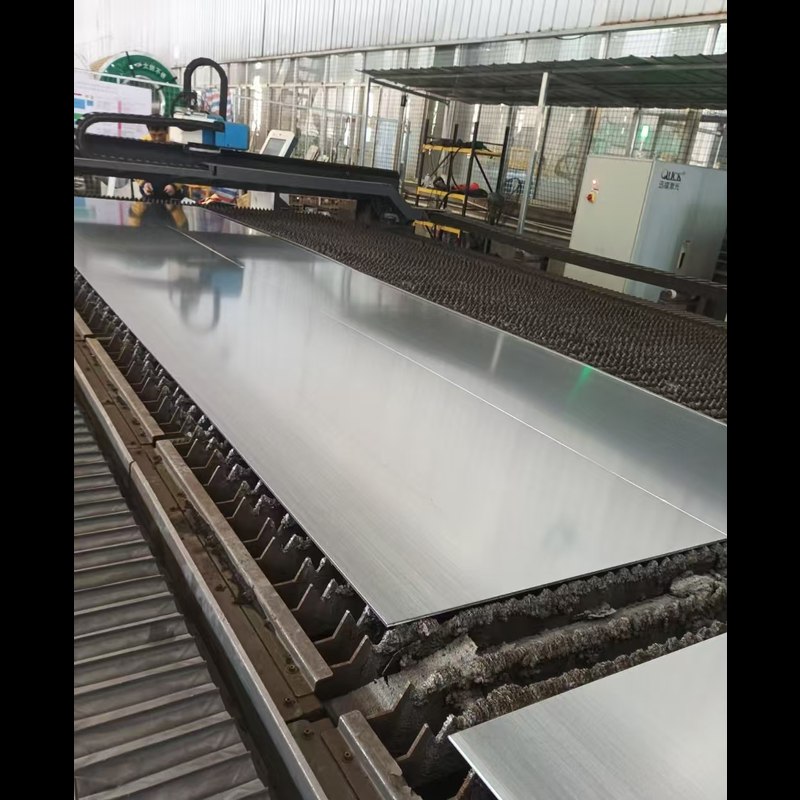
316L (UNS S31603) is a low-carbon austenitic stainless with 2–3% molybdenum, offering better pitting and intergranular corrosion resistance than 304. Low carbon (≤0.03%) removes weld sensitisation risk, making it the general-purpose choice for chemical, food, pharmaceutical and marine service.
As a manufacturer and global exporter of special alloys since 2012, Shanghai Hangbo Alloy Group Co., Ltd. supplies Stainless Steel 316L as round bars (φ2–600 mm, up to 12 m), plates & sheets (0.5–100 mm thick, up to 2500 mm wide), seamless tubes & pipes (φ6–630 mm OD, 0.5–40 mm wall), precision strip (0.02–3.0 mm, ±0.005 mm tolerance), welding wire & coils (1.0–5.0 mm), flanges & pipe fittings (Class 150–2500, DN15–DN1200) — all with EN 10204 3.1 certified material test reports.
Stainless Steel 316L Chemical Composition (wt%)
| Element | Content (wt%) | Element | Content (wt%) |
|---|---|---|---|
| Fe (铁) | Balance | Si (硅) | ≤ 0.75 |
| Cr (铬) | 16.0–18.0 | C (碳) | ≤ 0.030 |
| Ni (镍) | 10.0–14.0 | P (磷) | ≤ 0.045 |
| Mo (钼) | 2.00–3.00 | S (硫) | ≤ 0.030 |
| Mn (锰) | ≤ 2.00 |
Stainless Steel 316L Mechanical Properties
| Property | Value |
|---|---|
| Tensile strength (Rm) | ≥ 485 MPa |
| Yield strength (Rp0.2) | ≥ 170 MPa |
| Elongation (A) | ≥ 40 % |
| Hardness | ≤ 217 HB |
| Density | 8.00 g/cm³ |
| Melting range | 1375–1400 °C |
| Thermal conductivity | 16.3 W/m·K |
| Young's modulus | 193 GPa |
| Max service temperature | 800 °C |
Key Advantages
- 2–3% molybdenum gives better pitting resistance than 304
- Carbon ≤ 0.03% eliminates weld sensitisation
- Good cryogenic toughness and formability
- Far cheaper than nickel alloys or titanium
Relevant Standards
- ASTM A276
- ASTM A240
- ASTM A312
- ASTM A182
- UNS S31603
Typical Applications
- Chemical piping, vessels and heat exchangers
- Food and pharmaceutical clean equipment
- Marine engineering and coastal architecture
- Medical instruments and devices
- Architectural cladding and decoration
Why Buy from Hangbo Alloy?
- Factory-direct manufacturer — founded 2012, headquartered in Shanghai Qingpu
- Full product range — bar, plate, sheet, strip, tube, forging, welding wire, flanges and machined parts
- Certified quality — ISO 9001:2015, GB/T 19001-2016, GJB 9001C-2017, EN 10204 3.1 mill test certificates with third-party inspection (SGS / BV / TUV) available on request
- Complete mill documentation — chemical analysis, mechanical test, ultrasonic test (UT), hardness and grain-size reports with every shipment
Contact Us — Shanghai Hangbo Alloy Group Co., Ltd.
Shanghai Hangbo Alloy Group Co., Ltd.
📍 No. 388 Songhuang Road, Qingpu District, Shanghai, China
📞 Tel / WhatsApp: +86 15618279078
✉️ Email: demi@nickel-alloy.com
🕒 Available 24 hours a day, 7 days a week — enquiries answered around the clock.
Send your drawing or enquiry (grade, form, size, quantity, standard) for a same-day quotation.
Frequently asked questions
How long does 316L last in seawater?
316L performs acceptably in flowing seawater, but is prone to pitting and crevice corrosion in stagnant seawater, crevices or hot (>60 °C) chloride service. With PREN around 26 it is a mid-range pitting grade. For higher reliability move to superaustenitic (904L / 254SMO), duplex 2205 or Inconel 625.
What is the difference between 316 and 316L?
316L limits carbon to 0.03% versus 0.08% for 316, so chromium carbides do not precipitate at grain boundaries during welding or high-temperature service. It therefore resists intergranular corrosion and normally needs no post-weld anneal. Strength is slightly lower, which can be offset by nitrogen alloying (316LN). Prefer 316L for pressure equipment and welded structures.
What forms and sizes are available?
We supply Stainless Steel 316L as round bars (φ2–600 mm, up to 12 m), plates & sheets (0.5–100 mm thick, up to 2500 mm wide), seamless tubes & pipes (φ6–630 mm OD, 0.5–40 mm wall), precision strip (0.02–3.0 mm, ±0.005 mm tolerance), welding wire & coils (1.0–5.0 mm), flanges & pipe fittings (Class 150–2500, DN15–DN1200). Custom lengths, tolerances and machining to drawing are available on request.
What is the MOQ and lead time?
MOQ is flexible — trial orders from a single piece are welcome. Stock sizes ship in 3–7 days; custom forgings and machined parts typically 15–35 days depending on quantity and process.
Can you provide third-party inspection and shipping to my port?
Yes. SGS / BV / TUV or your nominated inspector can witness all tests before shipment. Full export documentation is provided, and we ship worldwide by sea or air on FOB, CIF or DDP terms.