
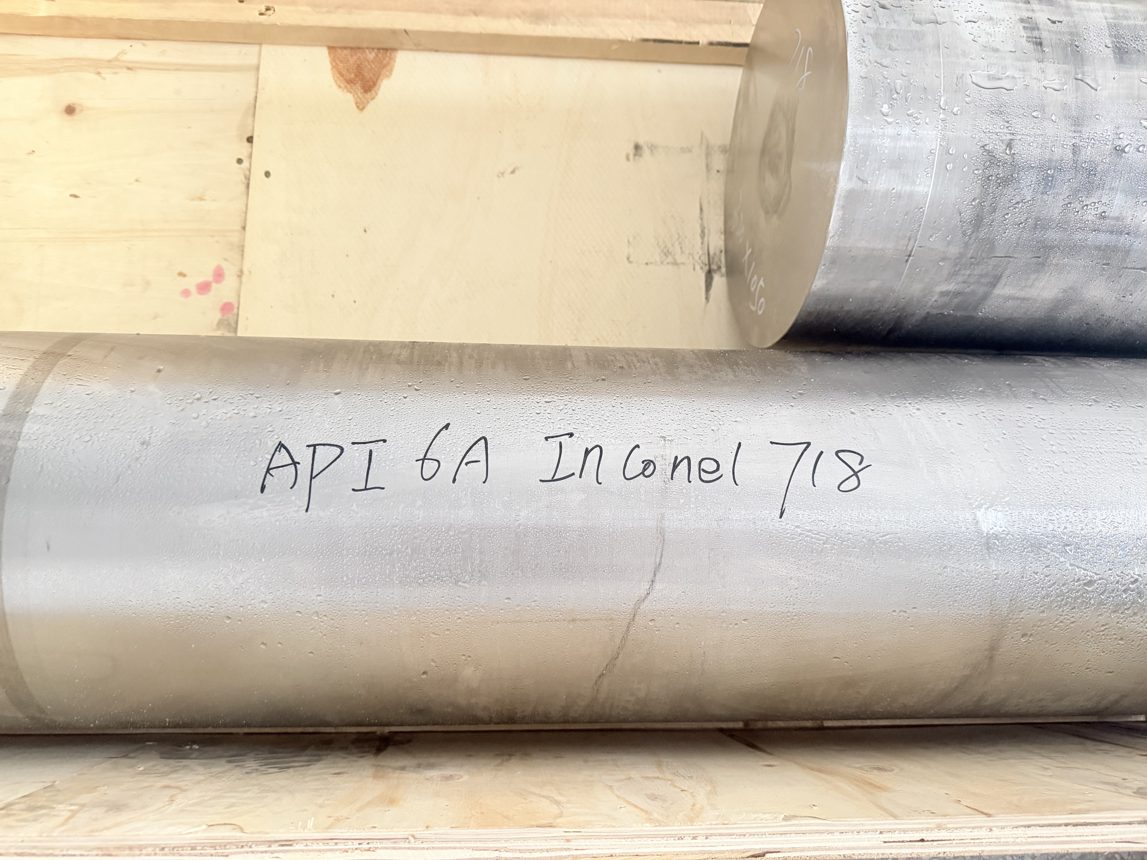
Inconel 625 and Inconel 718 are the two nickel alloys most often compared. They share a family name, look identical and come from the same alloy system, yet they were designed for different goals: 625 for corrosion resistance plus weldability, 718 for very high strength plus fatigue resistance. Choosing the wrong one costs either several times the purchase price or an unplanned shutdown.
1. Strengthening mechanism — the root of every difference
Inconel 625 is solid-solution strengthened. Molybdenum (8–10%) and niobium (3.15–4.15%) dissolve in the nickel matrix and distort the lattice, raising strength. Because no precipitate is involved, the weld heat-affected zone does not soften through over-ageing and no post-weld heat treatment is needed to restore properties.
Inconel 718 is precipitation hardened. After solution treatment and double ageing, nanoscale γ″ (Ni₃Nb, the main strengthener) and γ′ (Ni₃(Al,Ti)) particles precipitate and block dislocation motion, lifting yield strength above 1035 MPa. The trade-off: above 650 °C γ″ coarsens quickly and transforms to the stable δ phase, and the strengthening disappears.
2. Mechanical properties (typical, room temperature)
| Property | Inconel 625 (annealed) | Inconel 718 (solution + aged) |
|---|---|---|
| Tensile strength | ≥ 830 MPa | ≥ 1275 MPa |
| Yield strength (0.2%) | ≥ 414 MPa | ≥ 1035 MPa |
| Elongation | ≥ 30 % | ≥ 12 % |
| Hardness | ≤ 200 HB | ≥ 36 HRC |
| Density | 8.44 g/cm³ | 8.19 g/cm³ |
| Max service temperature | ≈ 980 °C (oxidation) | ≈ 650 °C (load bearing) |
The conclusion is direct: 718 yields about 2.5 times more than 625. Where the design is strength-controlled — turbine discs, high-strength bolting, springs — 718 is almost irreplaceable. Where corrosion life controls the design, extra strength buys no extra life.
3. Corrosion resistance
The pitting resistance equivalent number, PREN = %Cr + 3.3×%Mo + 16×%N, is the common yardstick. On typical chemistry, 625 gives PREN around 45–52 and 718 about 30. The gap comes mainly from molybdenum: 625 carries 8–10% Mo versus 2.8–3.3% in 718.
- Seawater, salt spray, chlorides: 625 is clearly superior
- Sour service (H₂S/CO₂): both meet NACE MR0175, but 625 has more margin
- Oxidising acids (nitric): neither is the first choice — consider C-22 or C-2000
- High-temperature oxidation above 700 °C: 625 is better; 718 is limited to 650 °C under load
4. Welding and machining
625 is weldment-friendly. Welded with ERNiCrMo-3 filler, the weld and HAZ retain corrosion resistance close to the parent metal and most services need no post-weld heat treatment — which is why it dominates piping, vessels and seawater systems.
718 is weldable, which is unusual for a precipitation-hardening superalloy, but welding destroys the aged structure in the HAZ and full solution plus ageing is normally required afterwards to restore properties. For large welded structures that means expensive furnace heat treatment.
Both are difficult to machine. The standard route for 718 is to machine in the solution-annealed condition and age afterwards. 625 work-hardens more strongly, so use low cutting speeds, generous feed, sharp tools and plenty of coolant.
5. Cost
Raw material costs are similar since both are nickel- and chromium-based, but 718 needs solution treatment plus double ageing (about 18 hours in total) and tighter control of forging and rolling, so finished product typically runs 10–25% above 625.
6. Selection decision tree
- Corrosion dominant and welding required → Inconel 625
- Strength or fatigue dominant below 650 °C → Inconel 718
- NACE MR0175 sour compliance plus 718-class strength → Inconel 725
- Long-term load above 650 °C → Inconel 625, 617 or Nimonic 80A
- High strength at cryogenic temperature (−253 °C) → Inconel 718
Frequently asked questions
Can Inconel 625 and 718 be substituted for one another?
Generally not. They are strengthened differently: 625 needs no post-weld heat treatment and resists corrosion better, while 718 is about 2.5 times stronger but weaker in corrosion and high-temperature load carrying. Use 625 where corrosion governs life and 718 where strength governs design.
Which is better for seawater service?
Inconel 625. With PREN around 45–52 it resists pitting and crevice corrosion far better than 718 (PREN about 30) and its corrosion resistance survives welding, making it standard for seawater piping, pump shafts and heat exchangers.
What is the maximum service temperature of 718?
Load-bearing parts are usually limited to 650 °C because the γ″ strengthener coarsens rapidly above that. Where only oxidation resistance matters and load is low, 718 can go higher for short periods; for long-term hot load use 625, 617 or Nimonic 80A.
How much do they differ in machinability?
Both are difficult but in different ways. 718 is usually machined in the solution-annealed state and aged afterwards, which is comparatively easier. 625 work-hardens more, demanding low cutting speeds, generous feed, sharp tooling and heavy coolant.