
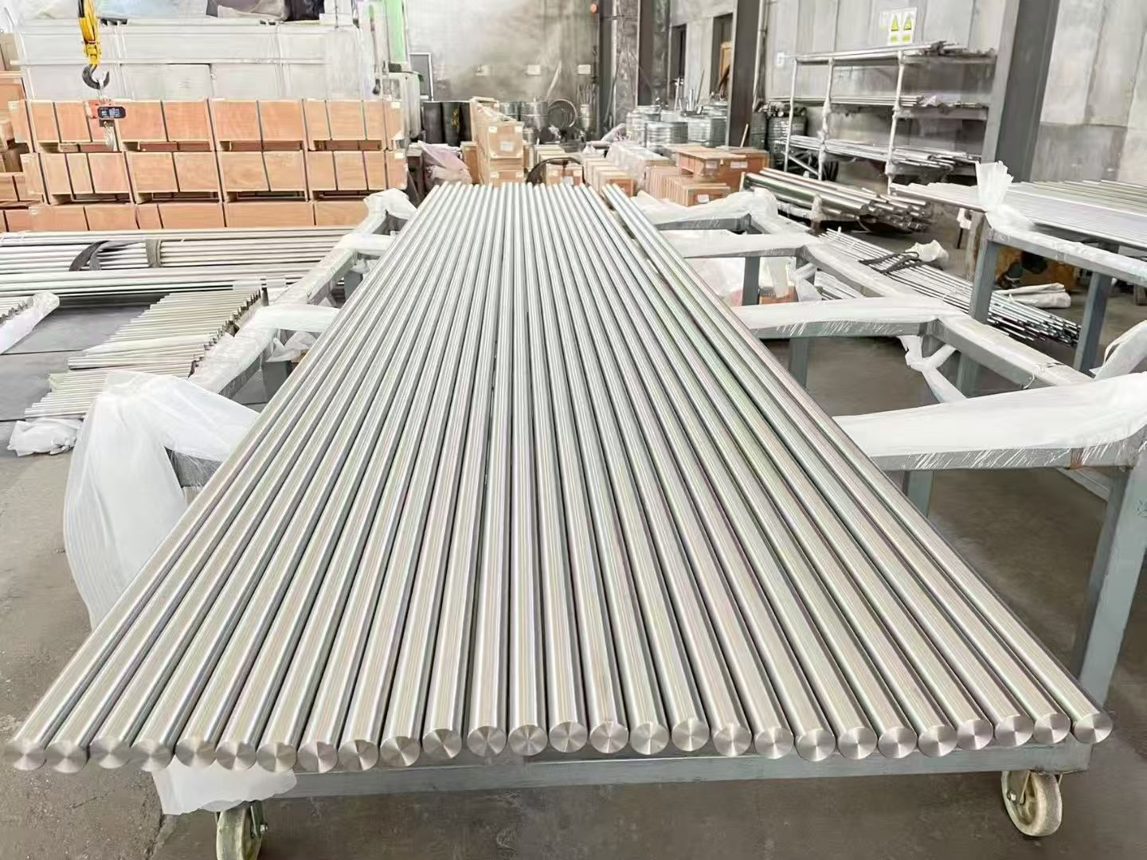
Monel 400 and K-500 belong to the same nickel-copper system (Ni ≥ 63%, Cu 27–34%) with excellent seawater resistance. The key difference: K-500 adds 2.3–3.15% aluminium and 0.35–0.85% titanium, enabling γ′ ageing for a large strength increase.
1. Mechanical properties
| Property | Monel 400 (annealed) | Monel K-500 (aged) |
|---|---|---|
| Tensile strength | ≥ 480 MPa | ≥ 965 MPa |
| Yield strength (0.2%) | ≥ 195 MPa | ≥ 690 MPa |
| Elongation | ≥ 35 % | ≥ 20 % |
| Hardness | ≤ 170 HB | ≥ 27 HRC |
| Density | 8.80 g/cm³ | 8.44 g/cm³ |
| Magnetic | Slightly magnetic (annealed) | Non-magnetic (aged) |
2. Corrosion differences
Both resist seawater, salt spray, hydrofluoric acid and alkalis similarly and are traditional materials for seawater piping and pump shafts. Subtle differences: K-500's Al/Ti additions and precipitates make it slightly less resistant than 400 in some reducing acids, and aged K-500 is somewhat more susceptible to hydrogen embrittlement and stress-corrosion cracking, managed through controlled ageing and stress relief.
3. Heat treatment
- Monel 400: used after annealing at 760–980 °C; cannot be hardened by heat treatment
- Monel K-500: 980 °C solution plus ageing at 593–607 °C for 16 h, furnace cool to 482 °C, air cool
- K-500 stress relief is normally at 552–593 °C to reduce stress-corrosion susceptibility
- K-500 can be machined in the solution-annealed state and aged to final properties afterwards
4. Selection guidance
- Seawater piping, pump shafts, valves and heat exchangers → Monel 400
- Non-magnetic drill collars and MWD/LWD housings → Monel K-500 (non-magnetic)
- High-strength marine shafts, scrapers and fasteners → Monel K-500
- Hydrofluoric acid equipment → Monel 400 (more corrosion margin)
- Doctor blades and wear parts → Monel K-500 (higher hardness)
Frequently asked questions
Does K-500 resist seawater as well as 400?
Broadly yes — K-500 retains the main corrosion characteristics of 400. In sulphide-contaminated or stagnant seawater, however, aged K-500 is slightly more susceptible to stress corrosion and hydrogen embrittlement, so control the ageing cycle, apply stress relief and avoid long stagnation.
Why is K-500 non-magnetic?
After solution treatment and ageing, K-500 has a stable structure with very low permeability (typically below 1.005), whereas annealed Monel 400 is still slightly magnetic. That low permeability suits non-magnetic drill collars and MWD housings where the magnetic compass and measurement signals must not be disturbed.