
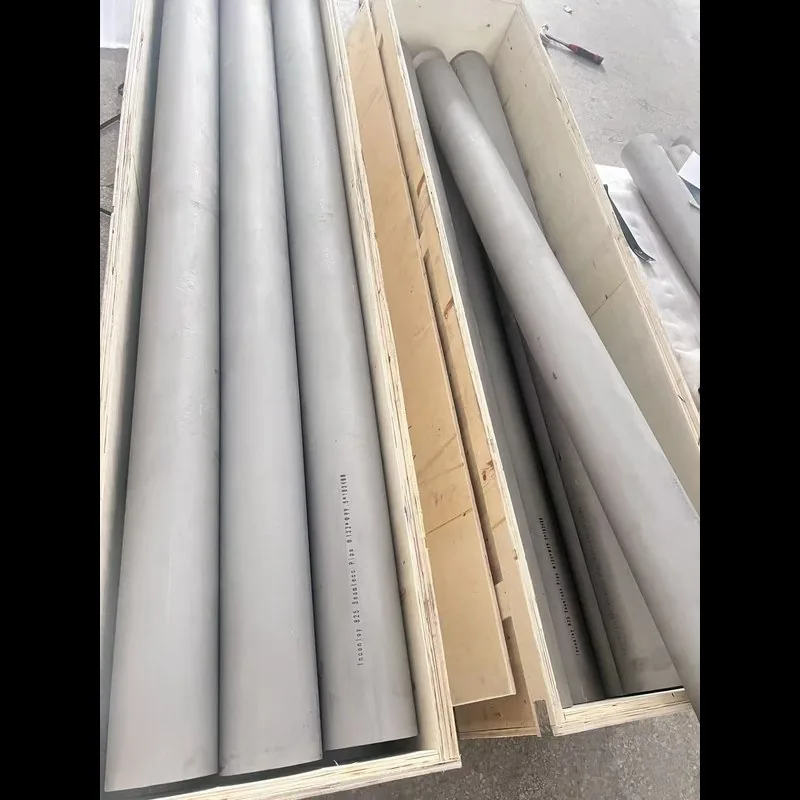
Incoloy 825 (UNS N08825) is a molybdenum- and copper-bearing nickel-iron-chromium alloy, titanium stabilised. It combines resistance to sulphuric and phosphoric acid, seawater and stress-corrosion cracking, making it a workhorse for sour oil and gas, chemical heat exchangers and nuclear fuel reprocessing.
As a manufacturer and global exporter of special alloys since 2012, Shanghai Hangbo Alloy Group Co., Ltd. supplies Incoloy 825 as round bars (dia 2-600 mm, up to 12 m), plates & sheets (0.5-100 mm thick, up to 2500 mm wide), seamless tubes & pipes (dia 6-630 mm OD, 0.5-40 mm wall), precision strip (0.02-3.0 mm, +/-0.005 mm tolerance), welding wire & coils (1.0-5.0 mm), forgings & rolled rings (up to 7500 kg, 3500 mm OD), flanges & pipe fittings (Class 150-2500, DN15-DN1200) - all with EN 10204 3.1 certified material test reports.
Equivalent designations for Incoloy 825
| System | Designation |
|---|---|
| UNS | N08825 |
| Werkstoffnummer (DIN / EN) | 2.4858 |
| EN chemical symbol | NiCr21Mo |
| Chinese GB | NS1402 (0Cr21Ni42Mo3Cu2Ti) |
| Trade name | Incoloy 825 |
Quoting only the trade name is the most common source of mismatched quotations. The UNS number together with the product standard defines what is actually being bought; the trade name alone does not, because mills use it loosely and several near-neighbour alloys are sold under similar descriptions.
Incoloy 825 Chemical Composition (wt%)
| Element | Content (wt%) | Element | Content (wt%) |
|---|---|---|---|
| Ni (nickel) | 38.0-46.0 | Ti (titanium) | 0.60-1.20 |
| Cr (chromium) | 19.5-23.5 | Al (aluminium) | <= 0.20 |
| Fe (iron) | >= 22.0 | C (carbon) | <= 0.05 |
| Mo (molybdenum) | 2.5-3.5 | Mn (manganese) | <= 1.00 |
| Cu (copper) | 1.50-3.00 | Si (silicon) | <= 0.50 |
Incoloy 825 Mechanical Properties
| Property | Value |
|---|---|
| Tensile strength (Rm) | >= 586 MPa |
| Yield strength (Rp0.2) | >= 241 MPa |
| Elongation (A) | >= 30 % |
| Hardness | <= 190 HB |
| Density | 8.14 g/cm3 |
| Melting range | 1370-1400 C |
| Thermal conductivity | 11.1 W/m.K |
| Young's modulus | 196 GPa |
| Maximum service temperature (oxidation) | 1000 C |
The 1000 C figure is an oxidation-resistance limit for non-load-bearing service. Pressure-retaining design limits are set by the applicable construction code and are far lower, so a pressure part must be specified against the code allowable stress, not against this number.
Why does Incoloy 825 contain copper, molybdenum and titanium?
The three additions each do a separate job, and the alloy only works because all three are present. Copper, at 1.5-3.0%, is what separates 825 from a plain nickel-iron-chromium alloy: it is the element that lifts resistance to sulphuric and phosphoric acid well above what the chromium content alone would deliver. Molybdenum, at 2.5-3.5%, supplies pitting and crevice resistance in chlorides. Titanium, at 0.6-1.2%, is a stabiliser - it combines with carbon preferentially so chromium carbide does not precipitate at grain boundaries during welding or service, which is what keeps the alloy free of intergranular attack in the as-welded condition. Remove any one of the three and the alloy stops behaving like 825.
How does Incoloy 825 perform in different environments?
| Environment | Performance | Practical note |
|---|---|---|
| Sulphuric acid, dilute to medium strength | Excellent | The reason the alloy exists; standard for pickling lines and acid recovery |
| Phosphoric acid | Excellent | Handles the fluoride and chloride impurities of wet-process acid |
| Nitric acid | Moderate | Oxidising acid - a chromium-rich grade such as C-22 is usually better |
| Seawater and brackish cooling water | Good | Avoid stagnant conditions, crevices and heavy fouling |
| Chloride stress-corrosion cracking | Good | Far better than 304L or 316L; below 625 and C-276 |
| Sour service (H2S) | Qualified | Meets NACE MR0175 / ISO 15156 limits within its stated boundaries |
| Caustic and alkali | Good | High nickel content resists caustic cracking |
| Hydrochloric acid | Limited | Reducing acid outside this alloy range - use B-2, B-3 or C-276 |
How does Incoloy 825 compare with the usual alternatives?
| Alloy | Compared with 825 | When to move |
|---|---|---|
| 316L | Much lower strength and chloride resistance | 825 is the upgrade from 316L, never the reverse |
| Alloy 20 (N08020) | Similar acid resistance, lower pitting resistance | Purely sulphuric acid duty at moderate temperature |
| Incoloy 926 (N08926) | Higher PREN, better warm-seawater behaviour | When crevice corrosion in warm seawater governs |
| Inconel 625 (N06625) | Higher strength, higher PREN, no copper | High H2S partial pressure, elemental sulphur, above 150-200 C |
| Hastelloy C-276 (N10276) | Far better in oxidising and mixed acid | When the medium carries oxidising impurities or wet chlorine |
| Hastelloy B-3 (N10675) | Far better in hydrochloric acid | Pure reducing HCl service |
Heat treatment, hot working and fabrication
- Solution annealing is carried out at about 940-1000 C followed by rapid cooling, and that is the condition in which the alloy is normally supplied.
- Hot working is done in roughly 870-1180 C. Working below about 870 C leaves the material stiff and risks tearing; finishing at the lower end of the range refines the grain.
- The alloy work-hardens at a rate between austenitic stainless steel and pure nickel, so cold forming needs higher forces than 316L and intermediate annealing on heavy reductions.
- Machining follows the austenitic nickel pattern: rigid setup, sharp positive-rake tooling, low cutting speed, constant feed and abundant coolant - see the nickel alloy machining guide.
- Forging follows the same temperature discipline as the other nickel-iron-chromium alloys; the forging and hot working guide gives the working window in detail.
Welding Incoloy 825
- Matching filler is ERNiFeCr-1 to AWS A5.14 for GTAW and GMAW, with ENiFeCr-1 covered electrodes for manual work.
- Because the alloy is titanium stabilised and low in carbon, welded joints resist intergranular corrosion in the as-welded condition and post-weld heat treatment is normally not required for corrosion service.
- Cleanliness is the usual cause of weld failure - sulphur, lead, oil and paint residues cause hot cracking, so the joint and the filler must be degreased and the weld zone ground clean before striking an arc.
- Heat input should be kept moderate using a stringer-bead technique, and interpass temperature held low.
- For dissimilar joints to carbon steel or stainless steel an over-alloyed filler such as ERNiCrMo-3 is commonly specified; qualify the procedure before production.
Which standards cover Incoloy 825 products?
| Product form | Specification |
|---|---|
| Rod, bar and wire | ASTM B425 |
| Plate, sheet and strip | ASTM B424 |
| Seamless pipe and tube | ASTM B423 |
| Seamless condenser and heat-exchanger tube | ASTM B163 |
| Forgings | ASTM B564 |
| Pipe fittings | ASTM B366 |
| Sour-service qualification | NACE MR0175 |
| Intergranular corrosion test | ASTM G28 |
| Tensile testing | ASTM E8 |
| Hardness testing | ASTM E18 |
Product forms and size range
| Form | Size range |
|---|---|
| Round bar | dia 2-600 mm, up to 12 m long |
| Plate and sheet | 0.5-100 mm thick, up to 2500 mm wide |
| Seamless tube and pipe | 6-630 mm OD, 0.5-40 mm wall |
| Precision strip | 0.02-3.0 mm, tolerance to +/-0.005 mm |
| Welding wire and coil | 1.0-5.0 mm |
| Forgings and rolled rings | up to 7500 kg, up to 3500 mm OD |
| Flanges and fittings | Class 150-2500, DN15-DN1200 |
Testing and certification
- Every shipment is supplied with an EN 10204 3.1 material test report covering heat analysis, mechanical test results and the inspection record.
- Tensile testing to ASTM E8, hardness to ASTM E18 and grain size to ASTM E112.
- Susceptibility to intergranular attack is assessed to ASTM G28 when the specification calls for it.
- Ultrasonic testing, hydrostatic or eddy-current testing and positive material identification are available on request.
- Third-party inspection by SGS, BV or TUV, or by your nominated inspector, can witness all tests before shipment on request.
Typical Applications
- Sour oil and gas tubing, valves and heat exchangers
- Sulphuric acid pickling and acid recovery
- Nuclear fuel reprocessing dissolvers
- Seawater coolers and marine piping
- Chemical process piping and vessels
Why Buy from Hangbo Alloy?
- Factory-direct manufacturer - founded 2012, headquartered in Shanghai Songjiang
- Full product range - bar, plate, sheet, strip, tube, forging, welding wire, flanges and machined parts
- Certified quality - ISO 9001:2015, GB/T 19001-2016, GJB 9001C-2017, EN 10204 3.1 mill test certificates with third-party inspection (SGS / BV / TUV) available on request
- Complete mill documentation - chemical analysis, mechanical test, ultrasonic test (UT), hardness and grain-size reports with every shipment
Contact Us - Shanghai Hangbo Alloy Group Co., Ltd.
Shanghai Hangbo Alloy Group Co., Ltd.
4F, Building 22, No. 85 Mingnan Road, Songjiang District, Shanghai 201613, China
Tel / WhatsApp: +86 15618279078
Email: demi@nickel-alloy.com
Available 24 hours a day, 7 days a week - enquiries answered around the clock.
Send your drawing or enquiry (grade, form, size, quantity, standard) for a same-day quotation.
Continue reading
- Incoloy 926 (N08926 / 1.4529 / 00Cr20Ni25Mo6CuN): Composition, Mechanical Properties & SupplierIncoloy 926 (N08926) datasheet: chemical composition, mechanical properties, standards (ASTM B649, ASTM B625).
- Incoloy A-286 (S66286 / 1.4980 / GH2132 / GH132): Composition, Mechanical Properties & SupplierIncoloy A-286 (S66286) datasheet: chemical composition, mechanical properties, standards (ASTM B637, AMS 5731)
- Nickel 200 (N02200 / 2.4066 / N6 / Ni200): Composition, Mechanical Properties & SupplierNickel 200 (N02200) datasheet: chemical composition, mechanical properties, standards (ASTM B160, ASTM B162).
- Nickel 201 (N02201 / 2.4068 / N4 / Ni201): Composition, Mechanical Properties & SupplierNickel 201 (N02201) datasheet: chemical composition, mechanical properties, standards (ASTM B160, ASTM B162).
- Nimonic 75 (N06075 / 2.4951 / GH3030): Composition, Mechanical Properties & SupplierNimonic 75 (N06075) datasheet: chemical composition, mechanical properties, standards (Werkstoff 2.4951, DIN 1
- All 36 Nickel Alloy Data Sheets guides
Frequently asked questions
How do I choose between Incoloy 825 and Inconel 625 for sour service?
In standard sour conditions (moderate H2S partial pressure, below about 150 C), 825 fully satisfies NACE MR0175 at lower cost and is the mainstay choice. When H2S partial pressure is high, elemental sulphur is present, temperature exceeds 150-200 C or chlorides are heavy, upgrade to 625 or 725.
Can Incoloy 825 be used in seawater?
Yes, it is widely used for seawater coolers and marine piping. However, localised corrosion can still occur in stagnant seawater or where crevices and deposits exist. With flowing, well-aerated seawater and regular cleaning, 825 performs well; for higher crevice-corrosion resistance consider 625 or C-276.
What forms and sizes are available?
We supply Incoloy 825 as round bars (dia 2-600 mm, up to 12 m), plates & sheets (0.5-100 mm thick, up to 2500 mm wide), seamless tubes & pipes (6-630 mm OD, 0.5-40 mm wall), precision strip (0.02-3.0 mm, +/-0.005 mm tolerance), welding wire & coils (1.0-5.0 mm), forgings & rolled rings (up to 7500 kg, 3500 mm OD), flanges & pipe fittings (Class 150-2500, DN15-DN1200). Custom lengths, tolerances and machining to drawing are available on request.
What is the MOQ and lead time?
MOQ is flexible - trial orders from a single piece are welcome. Stock sizes ship in 3-7 days; custom forgings and machined parts typically 15-35 days depending on quantity and process.
Can you provide third-party inspection and shipping to my port?
Yes. SGS / BV / TUV or your nominated inspector can witness all tests before shipment. Full export documentation is provided, and we ship worldwide by sea or air on FOB, CIF or DDP terms.
Which filler metal should be used to weld Incoloy 825?
Matching filler is ERNiFeCr-1 to AWS A5.14 for GTAW and GMAW, with ENiFeCr-1 covered electrodes for manual work. Because the alloy is titanium stabilised and low in carbon, welded joints resist intergranular corrosion as welded and post-weld heat treatment is normally not required for corrosion service. For dissimilar joints to carbon steel an over-alloyed filler such as ERNiCrMo-3 is usually chosen after procedure qualification.
What is the PREN of Incoloy 825?
Using the common formula PREN = %Cr + 3.3 x %Mo, a mid-composition heat of 825 - about 21% chromium and 3% molybdenum - gives a PREN of roughly 30. That places it well above 316L, a little below Incoloy 926, and clearly below Inconel 625 or C-276. Treat the number as a ranking tool, not a service limit: copper, which PREN ignores entirely, is what gives 825 its sulphuric acid performance.
Can Incoloy 825 replace 316L in a chloride environment?
Yes, and it is one of the most common upgrades for exactly that reason. 825 has roughly double the pitting resistance of 316L and a much higher nickel content, so it resists both chloride pitting and chloride stress-corrosion cracking - the two mechanisms that usually end 316L service. Where crevice corrosion in warm seawater is the governing mechanism, evaluate Incoloy 926 or Inconel 625 instead.