
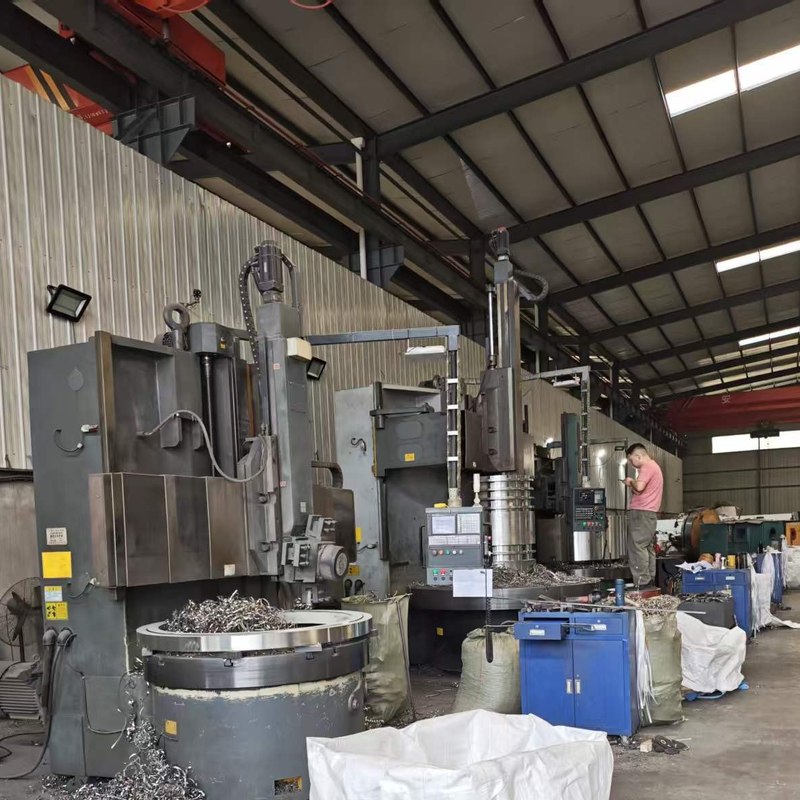
Why are nickel alloys harder to machine than steel?
Nickel alloys such as Inconel 718 (UNS N07718), Inconel 625 (UNS N06625) and Hastelloy C-276 (UNS N10276) resist machining because they keep their strength at the cutting edge temperature, conduct heat poorly, and work-harden rapidly under the tool. Roughly 80% of the heat generated in the cut goes into the tool and the workpiece rather than into the chip, so tool life is dominated by thermal fatigue rather than by abrasion. The practical consequence is a narrow window: cuts must be heavy enough to get under the hardened layer, but slow enough to keep the edge temperature survivable.
| Property | Effect on machining |
|---|---|
| Hot strength retained to 650 °C+ | Cutting edge sees high stresses at temperature |
| Low thermal conductivity | Heat stays in the tool tip and the part |
| Rapid work hardening | A rubbing tool hardens the surface instead of cutting it |
| High tendency to adhere | Built-up edge and smearing on the finished surface |
What cutting speeds should I use?
The table below covers coated carbide tooling in good condition. Treat the numbers as starting points and adjust within the range according to rigidity and tool life rather than chasing the maximum.
| Material | Turning (m/min) | Milling (m/min) | Feed (turning) | Depth of cut |
|---|---|---|---|---|
| Inconel 718 (aged) | 20–30 | 20–25 | 0.15–0.25 mm/rev | 1.0–2.5 mm |
| Inconel 625 | 25–35 | 25–30 | 0.15–0.25 mm/rev | 1.0–2.5 mm |
| Hastelloy C-276 | 15–25 | 15–20 | 0.15–0.25 mm/rev | 1.0–2.0 mm |
| Monel 400 | 40–60 | 40–50 | 0.20–0.30 mm/rev | 1.5–3.0 mm |
| Incoloy 825 | 30–45 | 30–40 | 0.20–0.30 mm/rev | 1.5–3.0 mm |
| Titanium Grade 5 | 30–50 | 40–60 | 0.15–0.25 mm/rev | 1.0–2.5 mm |
Ceramic tooling can run three to five times faster but is only viable for continuous cuts on stable, hardened material — it fails instantly under interrupted cutting or vibration.
What tooling grade should I choose?
Use a tough, fine-grained carbide substrate with a PVD coating rather than the hardest grade available. Nickel alloys punish chipping far more often than they punish flank wear, so edge toughness matters more than hot hardness.
- Turning: PVD TiAlN or AlCrN coated carbide, sharp positive rake, small nose radius
- Milling: tough carbide with high positive rake, or solid carbide for smaller diameters
- Drilling: solid carbide or cobalt HSS with a split point, low speed and high feed
- Inserts should be replaced on a schedule — a worn edge work-hardens the part immediately
- Avoid uncoated grades: they fail by built-up edge within minutes
Why does work hardening cause so many problems?
Every nickel alloy surface hardens when it is deformed without being cut. If the tool rubs — because the feed is too light, the edge is dull, or the tool dwells in the cut — the surface layer hardens from roughly 250 HV to over 400 HV, and the next pass has to cut material harder than the insert. This is the single most common cause of "unmachinable" Inconel.
- Keep the tool moving: never stop the feed with the edge in contact
- Take a minimum depth of cut of about 0.5 mm, below which the tool rubs
- Never take two or three spring passes at the same setting
- Climb milling on CNC machines reduces the work-hardened layer
- For finishing cuts, remove the hardened skin rather than cutting through it in small increments
How should coolant be applied?
Copious, high-pressure coolant aimed at the cutting edge, not at the chip. Because nickel alloys conduct heat poorly, the coolant is protecting the tool and the workpiece rather than cooling the chip.
- Flood coolant with at least 4 bar pressure, directed at the insert
- High-pressure through-tool coolant for drilling and deep pockets
- Water-soluble emulsion at 8–12% concentration for most operations
- For Hastelloy C-276, avoid chlorinated cutting fluids entirely
- Never run a finishing pass dry — thermal cracking in the workpiece is a real risk
Does the material condition change the machining approach?
Yes, and this catches out shops that are used to steel. A solution-annealed Inconel 718 bar machines very differently from the same bar in the aged condition, because aged material is roughly twice as strong and far more notch sensitive. Ask for the condition on the certificate before quoting the job.
| Condition | Relative machinability | Note |
|---|---|---|
| Solution annealed | Baseline | Easier, but work-hardens fast |
| Aged per AMS 5663 | 40–50% slower | Higher tool load, more chipping risk |
| Cold drawn / cold worked | 50% slower | Hardened surface layer must be removed first |
| Cast | Difficult | Interrupted cuts and porosity |
Which standards and test reports apply to machined parts?
Bar stock for machining is supplied to the material standard, and the machining itself is usually covered by the drawing and a general inspection standard rather than a specialist machining standard.
- ASTM B637 — Inconel 718 bar and forging stock for machining
- ASTM B446 — Inconel 625 bar, forging stock and rings
- ASTM B574 — low-carbon nickel-molybdenum-chromium bar (Hastelloy C-276)
- ASTM B166 — nickel-chromium-iron alloy bar and bar stock
- ASTM E112 — average grain size, which strongly affects machinability
Frequently asked questions
Why does my tool fail after only a few minutes on Inconel?
Almost always because the speed is too high for the tool grade or the cut is too light. Drop the surface speed by 20%, increase feed per tooth, and check that the insert is actually cutting rather than rubbing. If the chips come off as fine powder rather than short curls, the edge is rubbing.
Can I machine Inconel 718 in the aged condition?
Yes, but budget for it. Aged 718 machines at roughly half the metal removal rate of the solution-annealed condition. Where the drawing permits, machine to near-net shape before ageing and only finish machine afterwards, which avoids the hardest material.
Is titanium harder to machine than Inconel?
Different, rather than harder. Titanium is easier to cut at the same speed but is notorious for chip welding, poor thermal conductivity and fire risk in fine swarf. Titanium also work-hardens, so the same rule applies: keep the tool cutting and never dwell.
Does Hangbo Alloy supply machining stock in both conditions?
Hangbo Alloy supplies Inconel, Hastelloy, Monel, Incoloy and titanium bar stock in the solution-annealed or aged condition as ordered, cut to length, with the condition and mechanical results stated on the EN 10204 3.1 mill test certificate. Third-party inspection is available on request.