A nickel alloy piping system (UNS N06625, N10276, N08825, N04400, N06600) is assembled from four separate product forms — pipe and tube, forged or wrought fittings, flanges, and the welding consumables — and each one is bought under a different ASTM product standard even when the UNS grade number is identical. Mismatching them is the most common cause of rejected material at the fabrication yard: a certified fitting arrives with the right UNS number but the wrong product standard, and the fabricator cannot release the joint.
This guide is the cross-reference. It sets out which standard governs which product form, how a UNS grade maps across all four, and where the ASME dimensional standards fit in. For the pipe route itself, see Nickel Alloy Pipe and Tube: Seamless vs Welded.
Which standard covers each product form?
The four product forms are never bought under one standard, because the manufacturing routes and the mechanical property requirements differ:
| Product form | Nickel alloy standard | Stainless steel equivalent | What it fixes |
|---|---|---|---|
| Seamless pipe and tube | ASTM B622, ASTM B444, ASTM B161, ASTM B167 | ASTM A312 | Chemistry, condition, tensile floor, NDT |
| Welded pipe and tube | ASTM B619, ASTM B626, ASTM B705 | ASTM A358 | Adds weld-seam testing requirements |
| Forged / wrought fittings | ASTM B366 | ASTM A403 | Fitting chemistry, forging condition, dimensional conformity |
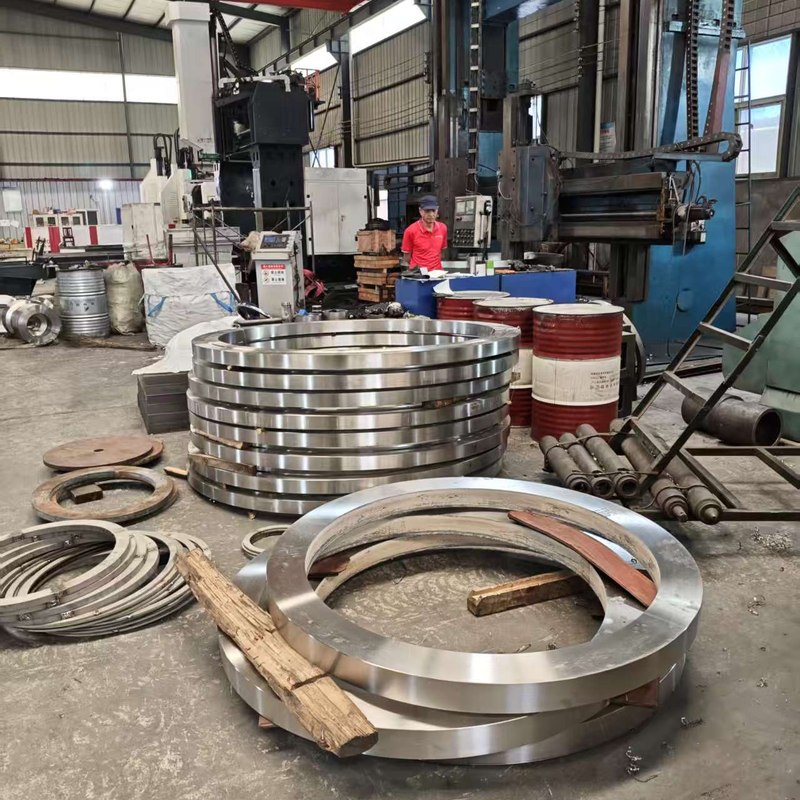
| Flanges and forged rings | ASTM B564 | ASTM A182 | Forging grade table, heat treatment, mechanical properties |
| Plate, sheet, strip | ASTM B575, ASTM B443, ASTM B625 | ASTM A240 | For spools and liners fabricated from plate |
| Bar and rod | ASTM B446, ASTM B166, ASTM B637 | ASTM A276 | For machined parts and fasteners |
The pattern is simple. B366 exists because a forged fitting has a different grain flow and a different test coupon geometry from a length of pipe, so it needs its own property tables. B564 does the same job for flanges. Neither of them replaces the pipe standard — a complete piping system needs all of them.
How does one UNS grade map across all four product forms?
This is the table that stops the argument at the fabrication yard. For each UNS grade, the standard number changes but the alloy does not:
| Grade / UNS | Pipe and tube | Forged fittings | Flange / forging | Filler metal (AWS) |
|---|---|---|---|---|
| Alloy 625, N06625 | B444 seamless / B705 welded | B366 | B564 | ERNiCrMo-3 |
| Alloy C-276, N10276 | B622 seamless / B619 welded | B366 | B564 | ERNiCrMo-4 |
| Alloy C-22, N06022 | B622 | B366 | B564 | ERNiCrMo-10 |
| Incoloy 825, N08825 | B423 / B705 | B366 | B564 | ERNiFeCr-1 |
| Inconel 600, N06600 | B167 / B517 | B366 | B564 | ERNiCr-3 |
| Monel 400, N04400 | B165 | B366 | B564 | ERNiCu-7 |
| Nickel 200, N02200 | B161 | B366 | B564 | ERNi-1 |
| 316L, S31603 | ASTM A312 | ASTM A403 | A182 | ER316L |
| Duplex 2205, S32205 | ASTM A790 | ASTM A815 | A182 F51 | ER2209 |
Read the table one row at a time. A C-276 line is not "B622 material" — it is B622 pipe, B366 fittings, B564 flanges and ERNiCrMo-4 filler metal, all at UNS N10276. The mill, the forge shop and the consumable supplier each certify to a different standard for the same alloy.
Where do the ASME standards fit in?
The ASTM standards define the **material**. The ASME standards define the **shape and the pressure rating**. Both appear on a purchase order, and confusing the two is the second most common specification error:
| Question | Answered by | Example |
|---|---|---|
| What chemistry, condition and strength must the metal have? | ASTM product standard | ASTM B564 UNS N06625 |
| What is the face-to-face length and the bolt circle? | ASME B16.5 (flanges) | 4" Class 150 WN RF |
| What are the centre-to-end and angle dimensions? | ASME B16.9 (buttweld fittings) | 4" long-radius elbow, 90° |
| What are the pipe outside diameters and schedules? | ASME B36.10M / B36.19M | NPS 4 Sch 40S |
| What weld joint efficiency and allowable stress apply? | ASME B31.3 (process piping) | E = 1.0 with full RT |
A purchase order line that reads "4 inch Hastelloy C-276 elbow, Class 150" is ambiguous — a Class 150 rating belongs to a flange, while an elbow is defined by its NPS size and wall thickness. Write "NPS 4, Sch 40S, 90° long-radius elbow, ASTM B366 WPNCMC, ASME B16.9" and there is nothing left to interpret.
Which filler metal matches which base metal?
Filler metal is selected by UNS match, not by trade name, and the AWS classification encodes the chemistry. The full selection logic is in Which Filler Metal Should You Use for Nickel Alloy Welding?; the matching rules that matter at the drawing stage are:
- 1. **Match the molybdenum content for corrosion service.** ERNiCrMo-3 (625 filler) is acceptable on 625 base metal but under-alloyed for C-276; use ERNiCrMo-4 there. A diluted C-276 weld made with 625 filler loses its resistance to reducing acids in the weld root.
- 2. **Dissimilar nickel-to-stainless joints take the nickel filler.** Welding 316L to Alloy 625 uses ERNiCrMo-3, which tolerates the dilution from both sides. Welding nickel alloys to carbon steel uses ERNiCr-3 or ERNiCrMo-3 depending on the service.
- 3. **Order the consumable with the pipe, not after it.** Filler metal in ERNiCrMo-4 is stocked in far fewer diameters than ERNiCrMo-3, and the lead time can exceed the pipe lead time.
- 4. **Bake the certificate to the same standard family.** Request EN 10204 3.1 for the filler metal as well as the pipe, so the whole joint is traceable in one document set.
What are the most common grade-matching mistakes?
In descending order of how often they appear on a rejected shipment:
| Mistake | Consequence | Prevention |
|---|---|---|
| Quoting a flange standard for a fitting | Mill cannot certify; order re-placed | Use B366 for fittings, B564 for flanges |
| Using B444 for welded 625 tube | Wrong tolerances and weld test scope | Use B705 for welded 625 |
| Grade 1 vs Grade 2 mix-up on 625 | Tensile or elongation outside design assumption | State Grade 1 (annealed) or Grade 2 explicitly |
| Filler metal chosen by trade name | Under-alloyed weld in reducing acid service | Match by AWS classification and UNS |
| Bar standard quoted for a forging | No forging reduction ratio evidence | Use B564 / B366; keep bar to B446 |
| Class rating quoted for a fitting | Dimensionally undefined item | Use NPS + schedule + ASME B16.9 |
Ordering a complete nickel alloy piping package
Hangbo Alloy supplies nickel alloy pipe, buttweld fittings, flanges and bar in matched UNS grades — Inconel 600/601/625/718, Incoloy 800/800H/825, Hastelloy C-276/C-22/C-2000, Monel 400/K-500, Nickel 200/201 and the equivalent stainless and duplex grades — with EN 10204 3.1 certification and third-party inspection on request. Because we hold pipe and fittings in the same grade families, a line can be quoted as one matched package rather than four separate orders with four different lead times.
Send us the pipe size, the grade and the service, and we will confirm the standard numbers for every product form before the order is placed.
Frequently asked questions
Can I use one ASTM standard for the whole nickel alloy piping system?
No. No single ASTM standard covers pipe, fittings, flanges and bar, because the product forms are made by different processes with different acceptance tests. A complete system is certified under B622 or B444 (pipe), B366 (fittings), B564 (flanges) and B446 (bar) as applicable, all at the same UNS grade.
Is ASTM A182 interchangeable with ASTM B564?
No. A182 covers forged or rolled alloy and stainless steel pipe flanges, forged fittings and valves for high-temperature service; B564 covers the same product forms in nickel alloy compositions. They are related in scope but list different grades and different chemistry limits. A 316L flange is A182 F316L; a 625 flange is B564 UNS N06625.
Does the fitting have to be the same UNS grade as the pipe?
For corrosion service, yes — the fitting is wetted surface area and must match the pipe chemistry. For purely structural connections at ambient temperature, a lower-alloy fitting is sometimes used as an economic compromise, but it must be a deliberate design decision and is normally prohibited by the project specification on nickel alloy lines.
What wall thickness should the fittings be?
Fittings are ordered by the same schedule as the pipe (Sch 40S, Sch 80S, or by nominal wall thickness for heavy-wall service), and ASME B16.9 guarantees that the fitting's wall at the weld end matches the matching pipe schedule. Where the pipe is ordered to a non-standard wall thickness, the fitting must be ordered to the same nominal wall or to a heavier schedule and tapered.