
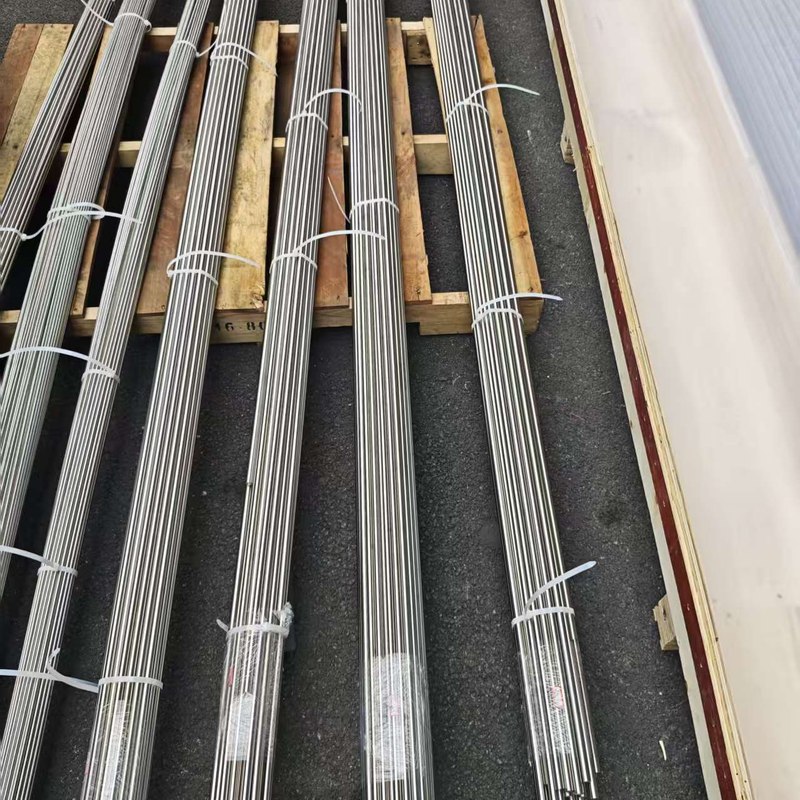
What must a round bar purchase order state?
A nickel alloy round bar order that states only a grade name leaves the mill to guess on at least three variables that change the price and the fit: heat treatment condition, dimensional tolerance and testing scope. Supply the six fields below and the quotation you get back will be comparable with every other quote, instead of being an estimate with hidden assumptions.
| Field | Example | Why it matters |
|---|---|---|
| Grade and UNS | Inconel 718, UNS N07718 | Removes substitution ambiguity |
| Product standard | ASTM B637 | Defines chemistry, properties and tolerances |
| Condition | Solution treated and aged | Determines strength — annealed is half the yield |
| Size and tolerance | Ø 50 mm, cold drawn, h9 | Controls machinability and fit |
| Surface / finish | Peeled and polished, or black | Affects downstream operations |
| Testing and documents | EN 10204 3.1 MTC, UT, PMI | Defines acceptance and traceability |
How do I choose a tolerance class?
Tolerance is the field most often left vague, and it is the one that most often causes a rejection at goods-in. A hot rolled bar and a cold drawn bar of the same nominal diameter can differ by a full millimetre in actual size, and only one of them will fit a collet or a bearing seat.
| Condition | Typical diameter range | Tolerance | Best for |
|---|---|---|---|
| Hot rolled, pickled | 20–500 mm | −0 / +1.0 mm (varies by standard) | Forging stock, machining with stock allowance |
| Peeled / turned | 20–400 mm | −0 / +0.3 mm | Machining, general engineering |
| Cold drawn | 3–100 mm | h9 / h11 (e.g. ±0.03 mm at Ø 50) | Automatic machining, tight fit |
| Ground and polished | 3–100 mm | h6 / h7 | Shafts, hydraulic rod, bearing seats |
The exact allowances come from the product standard you specify — ASTM B637 for 718 bar, ASTM B446 for 625, ASTM B166 for Inconel 600/601 and ASTM B574 for Hastelloy C-276. If your drawing calls a tolerance that the standard does not cover, say so explicitly and expect a special-quotation response.
Which condition should I order in?
Condition decides strength, machinability and price, and it is not something to leave to the mill. Inconel 718 in the aged condition is roughly twice the yield strength of the annealed condition, and it machines at about half the speed — both of which change the delivered part.
- Solution annealed: softest and most formable, best machinability, lowest strength
- Solution treated and aged: full strength, used for finished parts loaded in service
- Cold drawn: closer tolerance and a brighter finish, with some strength gain from cold work
- Stress relieved: reduces distortion during subsequent machining of long bars
- For 718, state the ageing standard, typically AMS 5663, rather than just "aged"
What does EN 10204 3.1 actually mean?
EN 10204 is the European standard that defines the types of inspection document a mill can issue, and the distinction between 3.1 and 3.2 is who signs. In a 3.1 certificate the manufacturer's own independent inspection department validates the results against the order. In a 3.2 certificate the results are validated by an inspector nominated by the purchaser or by a third party — the manufacturer and the inspector must be independent of each other.
- 2.2: declaration of compliance, no test results — not suitable for pressure or aerospace work
- 3.1: inspection certificate issued by the manufacturer's inspection department, with test results — the industry default
- 3.2: inspection certificate countersigned by an independent inspector nominated by the buyer
- Most Hangbo orders are supplied with a 3.1 mill test certificate, with third-party inspection available on request
What testing should I ask for?
Testing should be chosen from what could actually go wrong with the part, not copied from a previous order. The list below covers the great majority of nickel alloy bar requirements.
| Test | What it detects | Typical standard |
|---|---|---|
| Chemical analysis | Composition and grade confirmation | Product standard, e.g. ASTM B637 |
| Tensile test | Strength and ductility | Product standard, at temperature where relevant |
| Hardness | Condition verification, sour service acceptance | ASTM E18 / E10 |
| Ultrasonic test (UT) | Internal defects, porosity, inclusions | ASTM A388, or AMS 2630 |
| PMI / OES | Grade mix-up at goods-in | In-house or third party |
| Microstructure / grain size | Creep and fatigue behaviour | ASTM E112 |
| Intergranular corrosion | Sensitisation in service | ASTM A262 (stainless grades) |
For sour service orders, add the hardness result explicitly — see our NACE MR0175 selection guide.
What is a realistic lead time?
Nickel alloy bar is often stocked in common sizes and made to order in everything else, so lead time depends far more on whether your size is a stock item than on the total tonnage.
- Stock sizes: 3 to 7 days ex-works
- Non-standard diameters or cut lengths: 2 to 3 weeks
- Custom melting to a narrow chemistry range: 5 to 8 weeks
- Machined or threaded parts from bar: 3 to 5 weeks depending on quantity
- Trial orders from a single piece or a few metres are usually accepted
Frequently asked questions
Can I order a single bar to check quality before committing to a larger order?
Yes. Nickel alloy trial orders from one piece or a few metres are accepted routinely, supplied with the full EN 10204 3.1 mill test certificate covering that heat. It is the standard way buyers verify surface finish, tolerance and machining behaviour before releasing a production order.
What does the mill test certificate actually contain?
A 3.1 certificate for nickel alloy bar contains the heat number and its correlation to your order, the chemical analysis from the heat, the mechanical test results from the product, and the standard or specification the material was tested to. It should always state the actual measured values rather than only "conforms".
Why does the same grade cost so much more from one supplier than another?
Usually because the offers are not the same product. Differences in condition, tolerance class, surface finish, test scope and document type can account for a large spread in price between two quotes for "the same" bar. Normalise the six fields before comparing, and the spread usually collapses.
Does Hangbo Alloy supply round bars cut to length with certificates?
Hangbo Alloy supplies nickel alloy round bars from 2 mm to 600 mm diameter in hot rolled, peeled, cold drawn or ground condition, cut to your length, with EN 10204 3.1 mill test certificates, and SGS, BV or TUV third-party inspection on request. Send the six specification fields and you will receive a same-day quotation.