
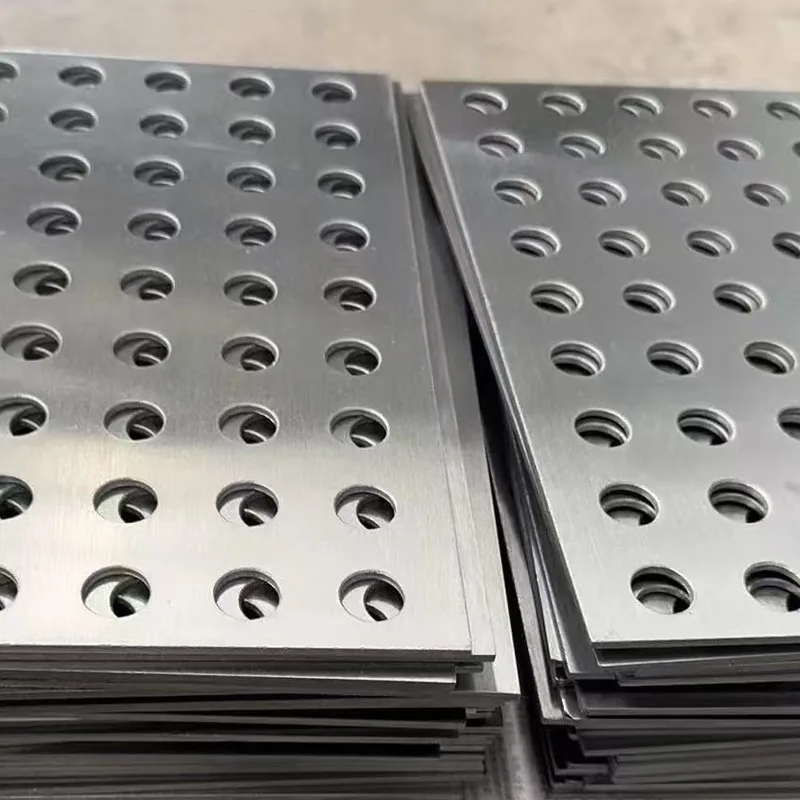
The tubesheet of a heat exchanger is selected by the more corrosive of the two fluids it separates, not by the tube material, so a Hastelloy C-276 (UNS N10276) tubesheet in a 316L shell and a carbon steel tubesheet behind an Inconel 625 (UNS N06625) bundle are both normal designs. Two decisions follow from that, and they are usually made together: which material the tubesheet is made from, and whether the tube-to-tubesheet joint is rolled, welded or both. Getting the second decision wrong is more expensive than getting the first wrong, because a joint failure is a leak into a process stream rather than a wall that can be measured.
This guide covers the material side — solid alloy, clad plate and weld overlay — and the joint side — expansion, seal welding and strength welding — together with the standards and tests that prove both. For the tube itself, see Which Alloy for Heat Exchanger Tubes?.
What decides the tubesheet alloy?
Five inputs drive the choice, and they are not always satisfied by the same answer:
- 1. **The corrosive medium on each side.** A tubesheet is a single plate, so it must survive the tube-side fluid, the shell-side fluid and any leakage between them. Where the two sides differ, the tubesheet takes the more aggressive of the two.
- 2. **Cladding or overlay feasibility.** If the aggressive side is a single wetted face, the plate can be carbon steel or low-alloy steel with a corrosion-resistant barrier, which changes the cost by a large factor.
- 3. **The galvanic couple with the tube.** A nickel alloy tube in a carbon steel tubesheet with a conductive electrolyte between them creates a couple in which the steel becomes the anode. Where the tubesheet cannot be coated, the material has to be close enough to the tube in the galvanic series that the couple is harmless.
- 4. **Mechanical requirements.** Tubesheets are thick, drilled plates carrying the full pressure load and the tube loads. Yield strength and through-thickness properties matter, and some of the highest-corrosion-resistance alloys are also the weakest.
- 5. **Fabrication.** Deep drilling, groove cutting, weld overlay and expansion all have to be possible in the chosen material. Alloy 625 overlays readily; some high-molybdenum alloys are much less forgiving.
| Situation | Tubesheet material | Reason |
|---|---|---|
| Both sides benign, carbon steel shell | Carbon steel plate, or 316L if any condensation | Corrosion barrier comes from the tube side only |
| Tube side aggressive, shell side water | Carbon steel + C-276 or 625 weld overlay / clad | One wetted face needs resistance, the other does not |
| Both sides aggressive, small exchanger | Solid C-276, C-22, 625 or 825 | Plate cost is small relative to the whole unit |
| Both sides aggressive, large exchanger | Carbon steel + clad or overlay | Solid alloy plate is not economic at large diameter |
| Seawater once-through on one side | Titanium Grade 2 clad, or 2507 solid | Chloride pitting on the wetted face |
| High-temperature, low corrosion | 316L, 1.25Cr or 2.25Cr low-alloy steel | Creep and strength govern, not corrosion |
| Sour service | Carbon steel with overlay, or 825 / 625 solid | Hardness limits per NACE MR0175, see below |
| Caustic service | Nickel 200 / 201 (N02200 / N02201) solid or clad | Nickel is the reference caustic material |
Where the exchanger is in sour service, the tubesheet and the joint are both inside the scope of NACE MR0175, which caps hardness rather than specifying an alloy. For the limits themselves, see NACE MR0175 Alloys for Sour Service.
Which standard covers tubesheet plate and forgings?
| Material | Standard | Form |
|---|---|---|
| Carbon steel | ASTM A516 | Plate for pressure vessels |
| Austenitic stainless | ASTM A240 | Plate, sheet and strip |
| Nickel 200 / 201 (N02200 / N02201) | ASTM B162 | Plate, sheet and strip |
| Monel 400 (N04400) | ASTM B127 | Plate, sheet and strip |
| Inconel 600 (N06600) | ASTM B168 | Plate, sheet and strip |
| Incoloy 800 / 800H (N08800 / N08810) | ASTM B409 | Plate, sheet and strip |
| Incoloy 825 (N08825) | ASTM B424 | Plate, sheet and strip |
| Inconel 625 (N06625) | ASTM B443 | Plate, sheet and strip |
| Hastelloy C-276, C-22 (N10276 / N06022) | ASTM B575 | Plate, sheet and strip |
| Nickel alloy plate, general requirements | ASTM B906 | Tolerances, tests, marking |
| Titanium Grade 2 (R50400) | ASTM B265 | Plate, sheet and strip |
| Nickel alloy forged tubesheet | ASTM B564, ASTM B462 | Forgings for corrosive service |
| Titanium forged tubesheet | ASTM B381 | Forgings |
Two selection notes are worth carrying into the enquiry. First, a forged tubesheet is not just a plate cut to a disc: forging gives a better through-thickness structure and is preferred for thick tubesheets where the plate would need heavy machining, and for any tubesheet that will be welded into a closure. Second, the general requirements standard — ASTM B906 for nickel alloys — carries the tolerances, the flatness limits and the marking requirements, and it is the document that decides whether a plate is delivered in a condition that can actually be machined flat.
When is a clad or weld-overlaid tubesheet better than solid alloy?
Above roughly 1.5 m in diameter the plate mass makes solid alloy uneconomic, and the design moves to a composite. Three routes are in common use:
| Method | Barrier | Typical use | Watch out for |
|---|---|---|---|
| Roll-bonded clad plate | 3-10 mm alloy bonded during rolling | Large tubesheets, high-integrity demands | Bond shear test evidence, minimum clad thickness after machining |
| Weld overlay (cladding by welding) | 4-8 mm deposited layer | Tubesheets that are already forged or where delivery is long | Dilution of the first layer, iron content at the surface, and hardness in sour service |
| Loose liner or sleeve | Thin sheet fixed mechanically | Rare, low-pressure | Crevice between liner and steel |
Weld overlay is often the better answer on a large forged tubesheet because the overlay can be applied after the forging is made, and because the overlay can be restricted to the wetted face and the tube-hole bores. The two failure modes to specify against are **dilution**, where the first layer of overlay is diluted by the base metal and no longer meets the chemistry of the alloy it claims to be, and **iron contamination** at the finished surface, which shows up as rusting in service and is the start of a pit.
For both methods the acceptance test is the same: a chemical analysis of the finished surface, a ferrite or iron-contamination check, and for clad plate a shear or bend test of the bond. A clad plate or overlay is not accepted on the certificate of the input materials.
How do you choose between rolling and welding the tube joint?
The joint types are ranked by integrity and by cost, and the choice should be driven by what a leak would do:
| Joint type | How it is made | Pressure capability | Where it is used |
|---|---|---|---|
| Expanded only (rolled) | Tube is expanded into a grooved or plain hole | Limited by friction and hole grip | Low-pressure, non-hazardous, both fluids compatible |
| Expanded into two grooves | Roller expansion into two machined grooves | Higher pull-out resistance | Standard for moderate duty |
| Expanded plus seal weld | Expansion followed by a light weld at the tube face | Seals against leakage, weld carries little load | Where a small leak is unacceptable but pressure is low |
| Strength weld plus light expansion | Full-thickness weld, then expansion only to close the gap | Weld carries the load | High pressure, hydrogen, toxic or flammable service |
| Welded only (no expansion) | Full-thickness weld at the face | Highest integrity at the face | Where the tubesheet cannot be rolled, or thin-wall tube |
| Hydraulic expansion | Uniform internal pressure expands the tube | Controlled, uniform, low residual stress | Where roller expansion would over-work the tube |
| Explosive expansion | Detonation expands the tube into the hole | Very uniform, suitable for difficult joints | Remote or one-off field work |
Three rules cover most cases. **Rolled only** is acceptable where a leak between the circuits is tolerable and the tube and tubesheet are of similar material. **Seal welded** adds a barrier against leakage without making the weld a structural element, and is the usual answer where the two circuits must not mix. **Strength welded and expanded** is used where the joint is part of the pressure-containing boundary, and there the expansion step is there only to eliminate the crevice between tube and hole, not to carry load.
The material consequence is that a strength-welded joint needs a weldable tube and tubesheet pair, and weldability varies a lot across the alloy families. Where the tube is a high-molybdenum alloy with limited weldability, the joint is often designed as expanded-and-seal-welded with a compatible filler metal rather than as a full strength weld.
What tests qualify the tube-to-tubesheet joint?
| Test | What it proves | When it is required |
|---|---|---|
| Pull-out or push-out test on a mock-up | The joint holds against axial load | Any strength-welded or high-integrity joint |
| Hydrostatic test of the assembled exchanger | The joint is leaktight at design pressure | Standard |
| Helium leak test | Very small leaks are detected | Hydrogen, toxic or high-purity service |
| Dye penetrant on the weld face | Surface-breaking defects in the seal weld | Seal-welded and strength-welded joints |
| Magnetic particle test on ferritic tubesheet | Surface and near-surface defects, per ASTM E709 | Ferritic or duplex tubesheet |
| Tube-hole diameter and ovality records | The expansion range is achievable | All expanded joints |
| Weld procedure qualification test | The procedure and the welder | All welded joints |
| Overlay chemistry and iron contamination | The barrier is what it claims to be | Clad and weld-overlaid tubesheets |
The pull-out test is the one that is most often omitted and most often needed. It is run on a mock-up made from the production tube and tubesheet materials with the production hole geometry and expansion procedure, and it produces a load that can be compared with the design axial load. Where a joint is critical, the mock-up is also sectioned to confirm the expansion percentage and the groove fill.
What should a tubesheet enquiry contain?
- **Both fluids** — tube side and shell side — with chloride content, pH, temperature and any sour service designation.
- **Material and standard for each wetted face**, and whether the tubesheet is solid, roll-bonded clad or weld overlaid.
- **Dimensions**: outside diameter, thickness, tube-hole pattern, hole diameter and tolerance, pitch, groove geometry, and whether the holes are to be reamed.
- **Bore surface requirement** for the corrosion-resistant barrier, if overlaid.
- **Joint type** and whether a mock-up pull-out test is required.
- **Heat treatment condition** and any hardness limit, particularly for sour service.
- **NDE requirements**: ultrasonic test of the plate or forging, per ASTM A388 or the applicable standard, plus surface examination of the finished faces.
- **Certification**: EN 10204 3.1 as standard, with third-party inspection available on request.
Tubesheets and tube joints from Hangbo Alloy
Hangbo Alloy supplies tubesheet material and finished tubesheets for heat exchangers, condensers and pressure vessels: nickel alloy plate and forgings in Inconel 600, 601, 617, 625, 690 and 718, Incoloy 800, 800H, 825 and 926, Hastelloy C-276, C-22 and C-2000, Monel 400 and K-500, and Nickel 200 and 201, together with 2205, 2507 and 904L stainless, carbon and low-alloy steel, and titanium Grade 2 and Grade 7 for clad and overlay construction.
Tubesheets are supplied drilled to drawing or as plate and forgings for in-house machining, with ultrasonic testing and dimensional records as standard, weld overlay to the required alloy with surface chemistry and iron contamination reports, and EN 10204 3.1 certification with third-party inspection available on request.
Send us the two fluids, the design temperature and pressure, the tube-hole pattern and the joint type you intend to use, and we will confirm the material arrangement, the barrier method and the test package before the order is placed.
Continue reading
- How to Weld Hastelloy C276 Without Losing Corrosion ResistancePractical welding guidance for Hastelloy C276 — filler metal selection, heat input limits, interpass temperatu
- Inconel 718 Heat Treatment: How to Reach Maximum StrengthHow to solution treat and age Inconel 718 to AMS 5662 and AMS 5663 — temperatures, soak times, cooling rates,
- How Are Nickel Alloy Flanges Made? Forging, Ring Rolling and StandardsA nickel alloy flange is pinned down by three specifications at once — the alloy, the forging standard such as
- Forging and Hot Working Temperatures for Nickel AlloysNickel alloys are forged in a narrow window — roughly 120 to 250 C wide — and the correct range is different f
- How to Machine Inconel and Hastelloy: Speeds, Feeds and ToolingPractical machining data for Inconel 718, 625 and Hastelloy C-276 — cutting speeds, feed rates, tool grades, c
- All 8 Welding, Forming & Heat Treatment guides
Frequently asked questions
Can a tubesheet be made from a different alloy than the tubes?
Yes, and it frequently is. The tubesheet is chosen for the more corrosive of the two fluids and for the mechanical duty, which is not the same requirement as the tube. The two materials must still be checked as a galvanic couple in the presence of the electrolyte, and where a welded joint is used, they must be weldable to one another.
When should a tubesheet be forged rather than cut from plate?
When it is thick, when it will be welded into a closure, or when the through-thickness properties matter. A forged and bored tubesheet has a better internal structure than a plate disc of the same section, and it avoids the edge-grain issues that come with a very thick plate. For standard thin tubesheets, plate is cheaper and perfectly adequate.
Is a strength weld better than a seal weld?
They do different jobs. A seal weld exists only to stop leakage at the joint face and carries no structural load; a strength weld carries the axial load of the tube and is part of the pressure-containing boundary. Where the joint must hold a pressure differential between the circuits, a strength weld with a light expansion step is the normal specification.
Why does the tubesheet need a pull-out test if the exchanger is hydrotested?
Because the hydrotest proves the joint is leaktight at the moment of the test, and the pull-out test proves it can carry the axial load it was designed for. A joint can pass a hydrotest comfortably and still be short of the required pull-out strength, which will only show up after a period of thermal cycling in service.