
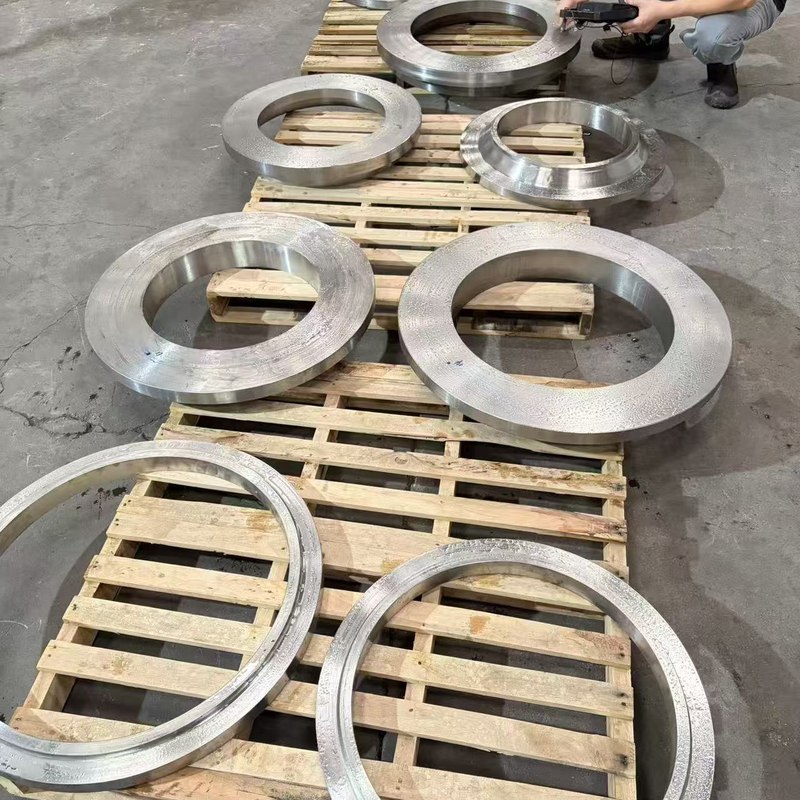
Which standard covers a nickel alloy flange?
A nickel alloy flange is defined by three specifications at the same time, and a purchase order that names only one of them is incomplete: the alloy and UNS number, the forging or forging-stock standard that governs the material, and the dimensional standard that fixes the bolt circle, face and thickness. Inconel 625 flanges made to ASTM B564 with dimensions to ASME B16.5 are a different product from the same alloy cut from ASTM B443 plate, even though the chemistry certificate looks identical.
| Alloy family | Forging standard | Common grades supplied as flanges |
|---|---|---|
| Nickel alloys | ASTM B564 | Inconel 625, Inconel 718, Hastelloy C-276, Monel 400, Incoloy 825 |
| Corrosion resistant forgings | ASTM B462 | 20Cb-3, CN7M, alloy 20 and duplex forgings |
| Stainless and duplex | ASTM A182 | 304/304L, 316/316L, F51, F53, 904L |
| Titanium | ASTM B381 | Grade 2, Grade 5, Grade 7, Grade 12 |
| Forging stock | ASTM B472 | Nickel alloy billets and bars for reforging |
ASTM B564 covers nickel alloy forgings for pressure and corrosion service generally, not only flanges. The same standard governs valve bodies, fittings, tube sheets and pump casings in the same alloy, which is why a flange certificate and a valve body certificate for the same grade are directly comparable.
How is a forged flange made?
A forged flange goes through seven steps, and the ring rolling step in the middle is what separates a properly made flange from one that has simply been cut out of plate.
- 1. Cutting the billet to weight from bar or forging stock, with allowance for oxidation loss
- 2. Heating to the forging range for the alloy — see our forging temperature guide
- 3. Upsetting and punching a hole to make a donut preform
- 4. Ring rolling the preform between a mandrel and a driven roll until the outside diameter and wall thickness are close to the finished size
- 5. Solution annealing, or solution treat plus age where the alloy is precipitation hardening
- 6. Machining the faces, raised face or ring joint groove, bore and bolt holes
- 7. Testing — chemical, mechanical, hardness, ultrasonic, PMI and dimensional
Ring rolling works the metal circumferentially, so the grain flow follows the flange profile all the way around. That continuous flow is the reason a forged flange resists fatigue and chloride stress corrosion cracking better than a plate-cut one, and it is measurable: a forged flange will show the expected grain flow on a sectioned macro-etch, while a plate-cut flange shows a straight-through band of end grain at the bore.
Forged, ring rolled or cut from plate?
Not every flange has to be forged. Large one-off rings in low pressure service are often cut from plate, and the saving is real — but the trade-off has to be understood before the order is placed.
| Method | Grain flow | Relative cost | Best suited to |
|---|---|---|---|
| Forged and ring rolled | Continuous, follows the profile | Highest | Pressure retaining, cyclic loading, sour or chloride service |
| Cut from plate | End grain exposed at the bore | Lower | Low pressure, non-critical, large outside diameters in small quantities |
| Cut from bar | Continuous but wasteful | Medium | Small diameters, thin sections |
For NACE MR0175 sour service, and for any flange that must hold a pressure rating, specify forged and ring rolled. A plate-cut flange can carry the identical EN 10204 3.1 certificate and still fail an engineering review — see the NACE MR0175 alloy selection guide for how hardness and heat treatment enter the acceptance criteria.
What dimensional standard applies?
The dimensional standard is a separate decision from the material standard, and export orders frequently mix the two conventions. State which one applies, or the flange will be made to whichever the workshop is used to.
| Standard | Coverage | Region |
|---|---|---|
| ASME B16.5 | NPS 1/2 to 24, Class 150 to 2500 | US, and most oil and gas projects worldwide |
| ASME B16.47 Series A / B | NPS 26 to 60 | Large diameter pipework |
| EN 1092-1 | DN 10 to 4000, PN 2.5 to PN 400 | Europe |
| DIN 2632 / 2633 and GOST 12820-80 | Raised face, nominal pressure series | Germany, Russia and CIS |
| JIS B2220 | 5K to 30K | Japan and South East Asia |
A common requirement on Middle East and Central Asian projects is a B16.5 drilling pattern combined with a GOST face-to-face or a DIN nominal pressure rating. That combination is manufacturable, but it must be stated on the drawing, because neither standard alone describes it.
Which alloy for which service?
Alloy choice is normally driven by the environment rather than by strength, and the flange is usually the first item in the line to show an environment problem because it carries the largest exposed surface.
| Service | Typical alloy | Reason |
|---|---|---|
| Sour gas and oil with H2S | Inconel 625, Hastelloy C-276 | Meets NACE MR0175 at controlled hardness |
| Hydrochloric and sulphuric acid | Hastelloy C-276, C-22 | Best resistance to reducing acids |
| Seawater and marine splash zone | Inconel 625, Monel 400, Titanium Grade 2 and 12 | Pitting and crevice resistance |
| Hydrofluoric acid alkylation | Monel 400 | Essentially unaffected by HF |
| High temperature to about 1000 C | Incoloy 800HT, Inconel 617 | Creep strength and oxide scale retention |
| Cryogenic service | Invar 36, 304L, 316L | Low temperature toughness |
What testing comes with a forged flange?
Testing for flanges is normally specified from the material standard plus whatever the end user adds on top, and the two are not the same list.
- Chemical analysis and mechanical properties per ASTM B564, taken from the flange itself rather than the billet where the standard requires it
- Hardness on every piece for NACE MR0175 orders, with the maximum permitted value stated on the drawing
- Ultrasonic examination for internal soundness, following ASTM A388 practice or the AMS 2630 series where aerospace approval is involved
- PMI or OES at goods-in to confirm the alloy actually delivered
- Intergranular corrosion testing for stainless grades per ASTM A262
- Dimensional inspection against the drawing and the dimensional standard
Hangbo Alloy supplies flanges and ring rolled rings in nickel alloys, stainless, duplex and titanium from DN 15 to DN 3000, machined to ASME, EN, DIN, GOST or JIS dimensions, with EN 10204 3.1 mill test certificates as standard and third-party inspection by SGS, BV or TUV available on request.
Frequently asked questions
Can a flange be cut from plate instead of forged?
Yes, for low pressure and non-critical service, and it is often the economical choice for large outside diameters in small quantities. The limitation is grain flow: a plate-cut flange exposes end grain at the bore, which reduces resistance to fatigue and to chloride stress corrosion cracking. Any flange that must hold a pressure rating or serve in sour or chloride service should be forged and ring rolled.
Which standard covers Inconel 625 flanges?
The material for a forged Inconel 625 flange is covered by ASTM B564, with chemistry and properties for UNS N06625. The dimensions come from a separate standard such as ASME B16.5 or EN 1092-1. If the flange is instead cut from plate, the plate standard ASTM B443 applies to the material — but the grain flow will be different even though the chemistry is the same.
Why does forging make a flange more corrosion resistant?
Ring rolling works the metal in the circumferential direction, so the grain flow runs continuously around the flange instead of being cut through. In chloride service, cracks initiate and grow along grain boundaries; a continuous flow interrupts that path. Forged flanges are also fully dense and free of the porosity that can be present in a casting.
Do you supply flanges with EN 10204 3.1 certificates?
Yes. Every flange order ships with an EN 10204 3.1 mill test certificate covering the heat, and third-party inspection by SGS, BV or TUV can be arranged on request. Send the alloy, the forging standard, the dimensional standard and the size, and you will receive a quotation the same day.