
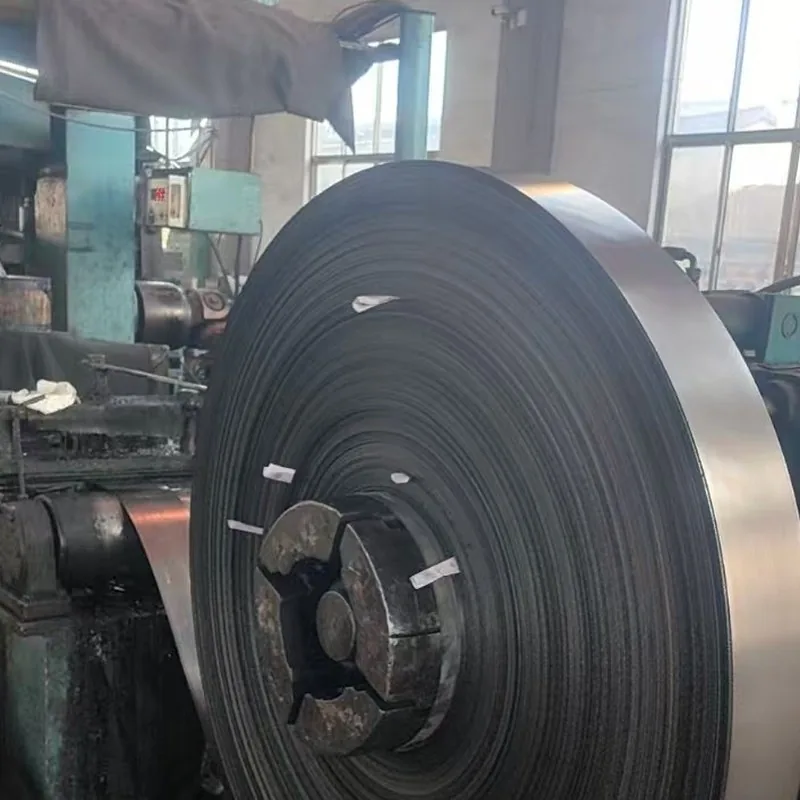
Nickel alloy strip (UNS N02201, N04400, N06625, N08800, N10276) leaves the cold mill hard, bright and dimensionally useless for forming, so it is annealed to restore ductility — and that anneal is what creates the problem this article is about. A cold-rolled nickel alloy strip that has been annealed in air carries a tightly adherent oxide scale that will not come off in a degreaser, will not come off in a caustic cleaner, and will contaminate any weld made through it. Pickling is the step that removes it. The two operations are inseparable in practice, and the way they are sequenced decides the surface finish the customer actually receives.
This guide covers which surface designation means what, the acid chemistry that works on nickel alloys as opposed to stainless steel, the annealing temperature windows by grade, and the defects that appear when either step is run outside its window. For the flat-product tolerances that govern the finished coil, see Nickel Alloy Plate and Sheet Specification; for the strip product forms themselves, see Precision Strips.
Why does annealed nickel alloy strip have to be pickled?
Cold rolling with 40 to 80 per cent reduction per pass stores energy in the lattice as dislocations. That stored energy is what makes cold-rolled strip strong and hard, and it is also what makes it crack instead of bend. Annealing above the recrystallisation temperature lets new strain-free grains nucleate and grow, and the strip comes out soft again — but the furnace atmosphere is the deciding factor.
In an exothermic or air atmosphere, the chromium in Inconel 625 (UNS N06625) or Hastelloy C-276 (UNS N10276) oxidises preferentially. The result is a duplex scale: a chromium-rich inner layer that is chemically tenacious, topped by a nickel-iron spinel that is easier to remove. The inner layer is the reason a simple acid dip does not work. It is also why the scale must be removed before any downstream cold reduction, because rolling an oxide into the surface produces a defect that no later pickling can recover.
| Strip condition | What the surface carries after annealing | Removal method |
|---|---|---|
| Annealed in air or exothermic gas | Duplex oxide scale, chromium-rich at the metal interface | Alkaline or oxidising pre-treatment, then pickling |
| Annealed in nitrogen with residual oxygen | Thin, patchy oxide, often blue or straw coloured | Single acid pickle |
| Bright annealed in dry hydrogen | No oxide for practical purposes | None — the atmosphere did the work |
| Solution annealed then water quenched | Loose, spalled oxide, uneven coverage | Descale plus pickle, watch for quench staining |
Which surface finish do BA, 2B and No.1 actually describe?
The finish designations customers quote come from stainless steel practice and are only partly transferable to nickel alloys. A mill that is asked for "2B" nickel strip will usually deliver the equivalent treatment, but the roughness does not match the stainless steel values, because the alloys work-harden faster and resist the skin-pass reduction that produces the 2B lustre.
| Designation | Processing route | Typical Ra | Where it is used |
|---|---|---|---|
| No.1 (1D) | Hot rolled, annealed, pickled | 2.0–4.0 µm | Heavy gauge, further fabrication, plate thicknesses |
| 2D | Cold rolled, annealed, pickled, no skin pass | 0.8–1.5 µm | Where a matte surface aids coating adhesion |
| 2B | Cold rolled, annealed, pickled, skin passed | 0.1–0.5 µm | Default general-purpose finish for thin strip |
| BA | Cold rolled, bright annealed in hydrogen, no pickle | ≤ 0.1 µm | Gaskets, diaphragms, food and pharma contact, bellows |
| No.4 | Polished with abrasives to a specified grit | 0.4–1.0 µm | Architectural and visible surfaces |
The distinction that matters commercially is between 2B and BA, because they are frequently confused in a purchase enquiry. A 2B strip has been through an acid bath; a BA strip has not. That single difference decides whether the strip carries a residual pickling smudge, whether its edges need trimming, and whether it can be used in a hydrogen environment where a retained fluoride film would be unacceptable.
What acid chemistry removes nickel alloy scale?
Nickel alloys are pickled in nitric-hydrofluoric acid mixtures. The nitric acid oxidises the metal at the scale interface and the fluoride ion complexes the dissolved chromium and nickel so they leave the surface instead of re-depositing. This is a different chemistry from the sulphuric or hydrochloric baths used on carbon steel, and substituting those baths causes pitting that is deep enough to scrap the coil.
| Alloy family | Typical bath | Concentration | Temperature | Notes |
|---|---|---|---|---|
| Stainless steel 304 / 316L | Nitric + hydrofluoric | 10–20 % HNO₃, 1–3 % HF | 20–50 °C | The reference process this industry is built around |
| Nickel 200 / 201 (N02200 / N02201) | Nitric + hydrofluoric | 10–15 % HNO₃, 1–2 % HF | 20–40 °C | Lower temperature; nickel dissolves readily |
| Monel 400 (N04400) | Nitric + hydrofluoric, weaker | 8–12 % HNO₃, 0.5–1 % HF | 20–30 °C | Copper content accelerates attack; short immersion |
| Inconel 600 / 625 (N06600 / N06625) | Nitric + hydrofluoric | 15–20 % HNO₃, 2–4 % HF | 40–60 °C | Scale is tenacious; a pre-treatment pays for itself |
| Hastelloy C-276 (N10276) | Nitric + hydrofluoric, with pre-treatment | 15–20 % HNO₃, 2–4 % HF | 40–60 °C | Molybdenum-rich scale needs alkaline oxidation first |
| Titanium Grade 2 / 5 | Nitric + hydrofluoric, tight control | 20–30 % HNO₃, 1–2 % HF | 20–40 °C | Hydrofluoric acid is aggressive to titanium; monitor closely |
Hydrofluoric acid is the hazard in every one of these baths, and it is also the component most often diluted to save cost. Diluting it does not slow the reaction evenly — it stops the fluoride from keeping up with the dissolved metal, and the bath starts plating smut back onto the strip. Smut is easy to see after the fact and expensive to remove.
For completeness, a fused-salt pre-treatment of sodium hydroxide and sodium nitrate at 400 to 500 °C is still used ahead of pickling on heavily scaled Hastelloy and on hot-rolled material where the scale is thick and laminated. It converts the chromium oxide into a form the acid bath can attack in a reasonable immersion time. ASTM A380 is the practice standard that describes descaling and passivation treatments for stainless and heat-resisting alloys, and its logic carries over to nickel alloys.
What annealing temperature does each grade need?
Recrystallisation temperature rises with the alloying content, and the C-276 and 625 types are the difficult ones because they must be cooled fast enough through the 600 to 900 °C range to avoid re-precipitating secondary phases. Slow cooling is the most common cause of a strip that passes tensile testing and still fails a corrosion test.
| Grade | UNS | Annealing temperature | Cooling |
|---|---|---|---|
| Nickel 201 | N02201 | 700–870 °C | Air or forced air |
| Monel 400 | N04400 | 760–980 °C | Air or water |
| Inconel 600 | N06600 | 870–980 °C | Air or water |
| Inconel 625 | N06625 | 870–1040 °C | Rapid air or water |
| Incoloy 800 / 800H | N08800 / N08810 | 870–980 °C (800H above 950 °C) | Rapid air or water |
| Hastelloy C-276 | N10276 | 1065–1120 °C | Rapid quench mandatory |
| Titanium Grade 2 | R50400 | 650–800 °C | Air, furnace if stress relief only |
Two rules sit underneath that table. First, the top of the window belongs to the softer tempers: if the customer needs a dead-soft strip for deep drawing, anneal at the high end and accept a coarser grain. Second, never exceed the stated maximum on a C-276 or 625 strip in the hope of getting a brighter surface — the extra temperature coarsens the grain, and a coarse-grained strip cracks on a tight bend.
Bright annealing needs a separate note because it is not simply annealing without air. It requires a dry hydrogen or hydrogen-nitrogen atmosphere with a dew point typically at or below −40 °C, a furnace with a gas-tight retort, and an entry and exit purge that keeps oxygen out during threading. The reward is a strip that needs no acid at all. The penalty for a dew point excursion is a cloudy surface that has to be re-pickled, which defeats the purpose of having paid for the bright anneal.
How is the pickled strip verified before shipment?
Pickling removes metal, so thickness is the first thing to check and the first thing that goes wrong. A strip that goes into the bath at the low end of its tolerance and stays in too long will exit undersize, and no downstream operation adds metal back.
| Check | Method | Why it is done |
|---|---|---|
| Thickness after pickling | Micrometer, or continuous gauge on the line | Pickling removes 5–25 µm per face; the order tolerance is the constraint |
| Surface roughness | Stylus or optical profilometer | Confirms the finish designation the customer bought |
| Residual scale and smut | Visual plus adhesive tape test | Predicts weld porosity before the customer finds it |
| Intergranular corrosion resistance | ASTM G28 Method A or B | Detects sensitisation from a wrong anneal or slow cool |
| Pitting resistance | ASTM G48 | Used on the molybdenum-bearing grades for chloride service |
| Chemistry | ASTM E1473 | Confirms no cross-contamination from a shared line |
| Flatness and camber | Plate gauge on a flat table | A pickled coil that has been tension-levelled can still bow |
ASTM B906 is the general requirements specification that governs flat-rolled nickel and nickel alloy plate, sheet and strip, including thickness tolerances and edge condition. ASTM B162 covers nickel plate, sheet and strip specifically. A mill certificate that cites B906 without stating which heat was pickled in which bath is a certificate that will not let you trace a corrosion failure back to its cause.
What goes wrong when pickling is over-run?
Over-pickling does not announce itself. The coil looks clean, often cleaner than a correctly pickled one, and the defect only appears at the customer's press or in the corrosion test.
| Defect | Mechanism | Consequence |
|---|---|---|
| Thickness undersize | Excessive metal removal, both faces | Part is out of tolerance; strip may be scrapped |
| Intergranular attack | Acid preferentially attacks grain boundaries | Corrosion test failure, typically G28 |
| Surface pitting | Localised attack where scale broke down unevenly | Cosmetic rejection, potential leak path after forming |
| Hydrogen embrittlement | Hydrogen absorbed during acid exposure | Cracking in high-strength or cold-worked conditions |
| Smut redeposition | Bath exhausted, dissolved metal plating back | Weld porosity, contaminated surface |
| Edge attack | Coil edges in the bath longest, no masking | Edge cracking on slitting, width loss |
The countermeasure is not a weaker bath but a controlled one. Bath chemistry analysed daily, iron content capped, temperature held in band, and immersion time set by the scale condition of the incoming coil rather than by a fixed figure carried over from the last campaign. A pickling line that runs on a recipe rather than on measurement will pass strip for months and then fail a batch with no warning.
Can pickled strip be welded without further treatment?
Not reliably. Pickling leaves a surface that is chemically clean of scale but not necessarily passive, and the residual fluoride film on a nitric-hydrofluoric pickled surface is enough to cause porosity in a subsequent tungsten inert gas weld. The usual practice is to passivate after pickling, or to remove the affected layer mechanically immediately before welding.
ASTM A967 covers chemical passivation treatments, including the nitric acid and citric acid routes. On nickel alloys the citric route is preferred when the part will enter a high-purity gas or pharmaceutical service, because it leaves no nitrate residue that could outgas later. Nitric passivation remains the default for general corrosion service because it is more forgiving of a marginal surface condition.
A point that is often missed: passivation is not a substitute for pickling. Passivation removes free iron and restores the passive film; it does not remove a chromium oxide scale. A part with scale that is "passivated" has been treated twice and cleaned zero times.
Getting the surface you specified
Strip surface is one of the few properties that cannot be inspected into a product after the fact — it is set by the annealing atmosphere and the pickling bath, and both are decided before the coil is cut. Send the intended service, the finish designation and the corrosion test you intend to run, and the annealing window and pickle recipe can be fixed at the order stage rather than discovered at the customer's press. Start from Precision Strips for the strip forms and tolerances, or Nickel Alloy Plate and Sheet Specification for the flat-product tolerances that apply above strip gauge.
Continue reading
- Seamless Rolled Rings in Nickel AlloysSeamless rolled rings in nickel alloys: ring rolling process, grade selection, size range, tolerances, UT and
- Tubesheet Materials and Tube-to-Tubesheet JointsTubesheet material and tube-to-tubesheet joint selection: when to roll, when to weld, and how the joint decide
- How to Weld Hastelloy C276 Without Losing Corrosion ResistancePractical welding guidance for Hastelloy C276 — filler metal selection, heat input limits, interpass temperatu
- Inconel 718 Heat Treatment: How to Reach Maximum StrengthHow to solution treat and age Inconel 718 to AMS 5662 and AMS 5663 — temperatures, soak times, cooling rates,
- How Are Nickel Alloy Flanges Made? Forging, Ring Rolling and StandardsA nickel alloy flange is pinned down by three specifications at once — the alloy, the forging standard such as
- All 10 Welding, Forming & Heat Treatment guides
Frequently asked questions
Does bright annealing eliminate the need for pickling on nickel alloy strip?
Yes, for practical purposes a correctly bright-annealed strip needs no pickling, because the dry hydrogen atmosphere prevents oxide from forming in the first place; the trade-off is a higher strip price and a tighter process window, and any dew point excursion forces the coil back through an acid line that was supposed to be bypassed.
Can 2B pickled strip be substituted for BA strip?
Only if the application does not care about a residual pickling smudge, edge condition or surface chemistry, which rules out gaskets, diaphragms, bellows and any high-purity gas service; for those, the acid history of a 2B coil is enough to cause a rejection even though the roughness value looks acceptable on paper.
Which standard governs the intergranular corrosion test on a nickel alloy strip?
ASTM G28 is the applicable practice for wrought nickel-rich chromium-bearing alloys such as Inconel 625 and Hastelloy C-276, while ASTM A262 applies to the austenitic stainless steels; quoting A262 against a nickel alloy order leaves the test method ambiguous and the acceptance criterion unenforceable.
How much thickness does pickling remove from nickel alloy strip?
A single nitric-hydrofluoric pickle typically removes 5 to 25 µm per face depending on scale condition, temperature and immersion time, which is why a strip ordered at nominal thickness and then pickled will finish below nominal and should always be ordered with the pickling allowance written into the tolerance.