
Which standard covers which alloy?
Each nickel alloy family has its own plate and sheet standard, and the standard fixes the chemistry, the mechanical properties, the permissible tolerances and the tests. Quoting a plate order with only a trade name such as "Inconel 625" leaves all four open, because the same alloy is also covered by tube, bar and forging standards that do not apply to plate.
| Alloy | UNS | Plate and sheet standard |
|---|---|---|
| Nickel 200 / 201 | N02200 / N02201 | ASTM B162 |
| Monel 400 | N04400 | ASTM B127 |
| Inconel 600 / 601 | N06600 / N06601 | ASTM B168 |
| Inconel 625 | N06625 | ASTM B443 |
| Inconel 718 | N07718 | ASTM B670 |
| Incoloy 800 / 800H / 800HT | N08800 / N08810 / N08811 | ASTM B409 |
| Incoloy 825 | N08825 | ASTM B424 |
| Hastelloy C-276 | N10276 | ASTM B575 |
| Hastelloy B-2 / B-3 | N10665 / N10675 | ASTM B333 |
| Stainless 304 / 316 / 316L | S30400 / S31600 / S31603 | ASTM A240 |
| Duplex 2205 / 2507 | S32205 / S32750 | ASTM A240 |
| Titanium Grade 2 / 5 / 7 / 12 | R50400 / R56400 / R52400 / R53400 | ASTM B265 |
ASTM B906 is the general requirements standard that sits behind many of the nickel alloy plate standards. When a plate standard is silent on a point such as sampling or retest procedure, B906 is where the answer usually is — quote both on the order when the end user asks for full traceability.
For stainless and duplex plate the position is different: ASTM A240 covers the material, and ASTM A480 is the general requirements standard that supplies the tolerances, the finish definitions and the flatness limits. Ordering 316L plate to A240 alone, without A480, is one of the most common reasons a shipment is rejected on thickness tolerance.
Hot rolled or cold rolled?
The rolling condition sets the tolerance, the finish, the flatness and the price, and it is the field most often left unstated. Hot rolled plate is the workhorse: it is produced in the widest thickness range and is the cheaper option above about 5 mm. Cold rolled sheet is thinner, tighter and brighter, and it costs more per tonne for the same alloy.
| Condition | Typical thickness | Thickness tolerance | Surface | Typical use |
|---|---|---|---|---|
| Hot rolled, annealed and pickled | 3–80 mm | ± 5 to 10 % of nominal | Grey, descaled | Pressure vessels, tube sheets, general fabrication |
| Hot rolled, annealed and descaled | 3–50 mm | ± 5 to 10 % | Light grey, smoother | Where pickling marks are not acceptable |
| Cold rolled, annealed and pickled | 0.3–3 mm | ± 3 to 5 % | Smooth, matte | Liners, gaskets, formed parts |
| Cold rolled, bright annealed | 0.1–2 mm | ± 2 to 4 % | Bright, reflective | Decorative, instrument panels, medical |
| Hot rolled, quenched and tempered | 6–100 mm | ± 5 to 10 % | Descaled | Wear plate, higher strength plate |
Thickness tolerance in the ASTM plate standards is expressed as a percentage band that widens as the plate gets thicker, and it is stated as a minus-side and a plus-side allowance around nominal. A 20 mm plate ordered as "20 mm" is not 20.00 mm — if the assembled thickness matters, put the actual tolerance and the measuring method on the drawing.
Which surface finish should I specify?
Surface finish is not only cosmetic in corrosive service. A rough, unpassivated surface holds chlorides and initiates pitting, so the finish specification is part of the corrosion design rather than a delivery preference.
| Finish | How it is produced | Roughness | Corrosive service |
|---|---|---|---|
| No. 1 / hot rolled annealed and pickled | Hot rolled then acid pickled | Rough, Ra above 3 µm | Acceptable for vessels, not for seals |
| 2D | Cold rolled, annealed, pickled | Matte, Ra 0.5–1.5 µm | Good general corrosion resistance |
| 2B | Cold rolled, annealed, skin passed | Smooth matte, Ra 0.3–0.8 µm | Standard for sheet and liner work |
| BA (bright annealed) | Cold rolled then bright annealed in hydrogen | Bright, Ra below 0.3 µm | Best cleanability, pharma and food |
| No. 4 / brushed | Polished with abrasive belt | Directional, Ra 0.4–1.0 µm | Architectural, visible surfaces |
| Mirror polish | Multi-stage polishing | Ra below 0.05 µm | Seals, high purity, low fouling |
For gasket seating surfaces and for anything handling chlorides above about 60 C, order at least 2B and specify that the plate is supplied free of embedded iron and heat tint. A plate that was hot rolled, sheared with a carbon steel blade and left with scale on the surface will pit even if the alloy is correct.
How should the plate be cut and edged?
Plate is normally quoted by the piece or by weight in a mill size, with a cut-size surcharge when you need it to fit your own equipment. The cutting method also determines what happens at the edge, which matters for corrosion and for welding.
- Waterjet cutting: cold process, no heat affected zone, best for stainless, nickel alloys and titanium
- Plasma cutting: fast and economical, but the cut edge must be ground back before welding
- Laser cutting: narrow kerf and good accuracy, practical up to about 20 mm in nickel alloys
- Shear cutting: lowest cost for straight cuts, leaves a work hardened edge
- Saw cutting: for thick plate and for edges that will be welded without further preparation
When plate is supplied to a cut size, state whether the edges must be machined, sheared or left as-cut, and whether the plate must be flat within a stated tolerance. A plasma cut edge left in place on a pressure part is a common cause of a rejected weld repair.
What testing applies to nickel alloy plate?
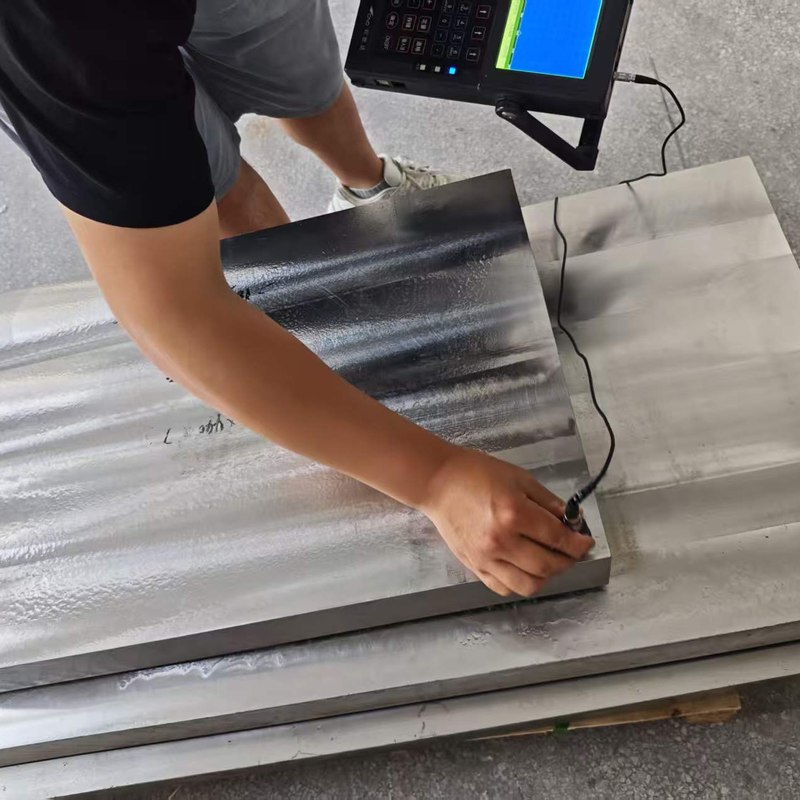
Plate testing is normally lighter than bar or forging testing, because the rolling process is inherently more forgiving than a casting or a large forging. The list below is what a standard order should carry, and what to add when the service demands it.
- Chemical analysis and tensile test per the product standard, normally one test per heat
- Hardness, which doubles as an acceptance criterion for NACE MR0175 sour service orders
- Ultrasonic examination for pressure retaining or thick plate — typically ASTM A578 for plate
- PMI or OES at goods-in to confirm the alloy
- Intergranular corrosion testing per ASTM A262 for stainless grades in acid service
- Grain size per ASTM E112 where creep or forming behaviour matters
Hangbo Alloy supplies nickel alloy, stainless, duplex and titanium plate from 0.3 mm to 100 mm thickness, cut to size by waterjet, plasma, laser or saw, with EN 10204 3.1 mill test certificates as standard and SGS, BV or TUV third-party inspection available on request.
Frequently asked questions
What is the difference between plate and sheet?
The dividing line is thickness. Sheet is generally up to about 3 mm and is usually supplied cold rolled in coil or cut lengths; plate is above that and is usually hot rolled in flat pieces. The standards do not draw the line at exactly the same value, so state the actual thickness rather than relying on the word plate or sheet.
Which standard covers Inconel 625 plate?
ASTM B443 covers Inconel 625 (UNS N06625) plate, sheet and strip. If the same material is ordered as bar, the relevant standard is ASTM B446, and as seamless tube it is ASTM B444 — the chemistry is the same but the tolerances and tests are different, so the product standard must match the product form.
Can you supply plate cut to my drawing?
Yes. Plate is cut by waterjet, plasma, laser or saw to your drawing, with machined edges where the plate will be welded. Waterjet is the preferred method for nickel alloys, stainless and titanium because it introduces no heat affected zone, so the cut edge can go straight to welding without grinding.
Why does the same alloy plate sometimes pit in service?
The usual cause is surface condition rather than the alloy. Embedded iron from carbon steel tooling, heat tint left after welding or thermal cutting, and a rough hot rolled finish all trap chlorides and start pitting. Order a pickled or 2B finish, specify that the plate is iron-free, and passivate welds after fabrication.