
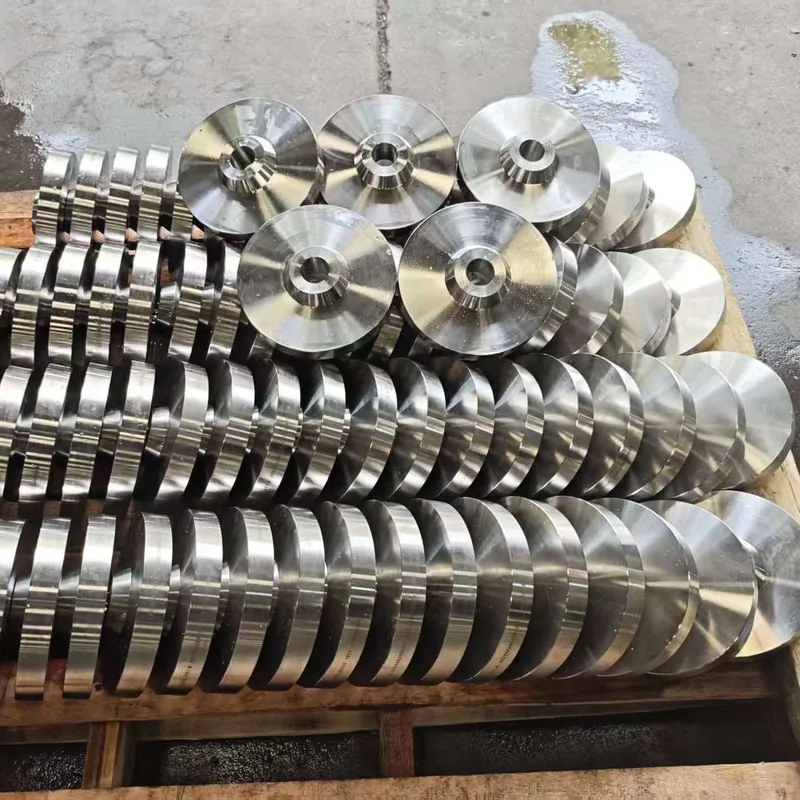
A seamless rolled ring is a forged ring produced by piercing a heated disc and then expanding it between a rotating mandrel and a driven main roll until the bore, wall and height reach the drawing dimensions. **The grade of the ring is what makes it difficult, not the shape** — an Inconel 718 (UNS N07718) ring and a carbon steel ring go through the same machine, but they need different forging temperatures, different reduction sequences and different cooling, and the difference shows up in the ultrasonic test rather than on the dimensional report.
This guide sets out how a ring is actually made, which grades are routinely supplied as rolled rings, what size and tolerance range can be held, why a rolled ring outperforms a plate-cut ring, and how a ring is examined before it is machined. For the forging temperature windows behind these numbers, see Nickel Alloy Forging and Hot Working Temperature; for the examination methods, see Nickel Alloy NDT Inspection Methods.
How is a seamless rolled ring made?
The process runs in five stages, and skipping or shortening any of them produces a defect that appears later as a rejected ultrasonic indication.
| Stage | Operation | What it controls |
|---|---|---|
| 1 | Billet cut from bar or ingot, weighed | Volume for the finished ring plus discard |
| 2 | Heating to the grade's forging window | Whether the ring can be rolled without cracking |
| 3 | Upsetting and piercing | Closes porosity, removes the cast structure, forms the donut |
| 4 | Mandrel expansion and radial-axial rolling | Bore, wall, height, roundness, grain flow direction |
| 5 | Heat treatment, then rough machining and test | Mechanical properties, grain size, defect detection |
The critical difference from open-die forging is stage 4. In radial-axial rolling the wall is reduced between a mandrel on the inside and a main roll on the outside, while two axial rolls control the height. Because the material is squeezed in both directions at once, the grain flow follows the circumference instead of running across it. That circumferential flow is the reason a rolled ring has better tangential tensile and fatigue properties than a ring cut from plate, where every circumferential grain is severed by the profile.
Piercing is the stage where nickel alloys punish a wrong temperature most severely. Roll a 625 or C-276 ring too cold and the pierce turns into a burst — an internal rupture on the bore that is invisible from outside and shows up as a cluster of ultrasonic indications. Roll it too hot and the grain coarsens, the ring loses ductility, and the tensile test may still pass while the impact or corrosion test does not.
Which nickel alloys are supplied as rolled rings?
Any wrought nickel alloy with adequate hot ductility can be ring rolled. The table below covers the grades that account for most demand, with the forging window you need to hold and the specification the certificate should cite.
| Grade | UNS | Forging start temperature | Spec | Typical ring service |
|---|---|---|---|---|
| Inconel 718 | N07718 | 1010–1120 °C | ASTM B637 | Aero and gas turbine seals, high-strength bolting rings |
| Inconel 625 | N06625 | 1090–1170 °C | ASTM B564 | Marine and chemical flanges, expansion joint rings |
| Inconel 600 | N06600 | 1090–1205 °C | ASTM B564 | Furnace and heat-treat fixturing |
| Incoloy 800H / 800HT | N08810 / N08811 | 1090–1175 °C | ASTM B564 | Reformer and cracking furnace components |
| Hastelloy C-276 | N10276 | 1175–1230 °C | ASTM B564 | Chloride service flanges, scrubber rings |
| Hastelloy C-22 | N06022 | 1175–1230 °C | ASTM B564 | Oxidising chloride service |
| Monel 400 | N04400 | 980–1175 °C | ASTM B564 | Marine and seawater hardware |
| Monel K-500 | N05500 | 980–1175 °C | ASTM B564 | Pump shafts, high-strength rings |
| Titanium Grade 5 | R56400 | 900–1010 °C | ASTM B381 | Airframe and chemical rings |
Two rules sit under that table. First, the forging window is not the same as the annealing window, and quoting the wrong one is the most common mistake in a ring enquiry. Second, the higher the molybdenum content, the narrower the window: C-276 gives you a usable range of roughly 55 °C, while Monel 400 tolerates several hundred. A shop that rings Monel well is not automatically equipped to ring C-276.
What size range and tolerance can ring rolling hold?
Ring rolling is economical from a bore of about 200 mm up to an outside diameter of approximately 3500 mm, with heights from 40 mm to over 600 mm. Below the small end, a machined tube or a plate-cut ring is usually cheaper; above the top end, the machine and the handling stop being the constraint and the ingot does.
| Parameter | Practical range | What governs it |
|---|---|---|
| Outside diameter | 200–3500 mm | Ring mill capacity, handling, furnace size |
| Bore | 150–3200 mm | Mandrel diameter, minimum wall |
| Height | 40–600 mm | Axial roll capacity, height-to-wall ratio |
| Wall thickness | 25–400 mm | Reduction ratio needed to refine the structure |
| Ring weight | A few kg to about 6000 kg | Ingot size and crane capacity |
The two dimensions that decide whether the ring is usable are wall uniformity and ellipticality, and both are usually specified as a percentage rather than an absolute figure because they scale with size.
| Tolerance | Typical as-rolled value | Typical machined value |
|---|---|---|
| Wall thickness variation | ± 8–12 % of nominal wall | ± 0.5–1.0 mm |
| Outside diameter | + 1.5 % / − 0 % | To drawing |
| Bore | To clean up, plus machining allowance | To drawing |
| Height | + 3 / − 0 mm | To drawing |
| Ellipticality | 1–1.5 % of OD | 0.1 mm |
| Flatness of faces | 1–2 mm | To drawing |
The dimension that catches buyers out is the bore. A rolled ring is supplied with a bore that will clean up after machining, not at finished size. If the drawing calls for a 300 mm finished bore on a ring with a 40 mm wall, the ordered ring needs enough wall to survive the machining allowance on both the bore and the outside diameter — and a ring ordered at exactly the finished wall will come out undersize on one face.
Why use a rolled ring instead of a plate-cut ring or an open-die forging?
Three routes produce the same finished geometry, and the correct choice depends on size, quantity and the stress direction in service.
| Route | Material yield | Grain flow | Best for |
|---|---|---|---|
| Ring rolling | High, often 70–85 % | Continuous around the circumference | Rings above ~300 mm bore, medium to large quantity |
| Plate-cut or tube-cut ring | Low, typically 25–40 % | Interrupted — every circumferential grain cut | Small quantities, thin rings, short lead time |
| Open-die forging plus machining | Medium, 40–60 % | Directional but not circumferential | Very large or non-circular parts, one-offs |
| Seamless tube cut to length | Medium | Axial, not circumferential | Thin-wall rings where axial properties matter |
The material yield figure is not a footnote on nickel alloys. On a C-276 ring, the alloy cost dominates the part cost, so a plate-cut ring that throws away 60 per cent of a plate is not a cheap alternative — it is a more expensive way to get a part with worse grain flow. This is the single strongest argument for ring rolling on the molybdenum-bearing grades, and it is the reason a ring is often cheaper in the finished part even when the rolled blank is quoted higher.
What tests apply to a rolled ring?
Nickel alloys are austenitic and non-magnetic, which eliminates magnetic particle inspection as an option no matter how convenient it would be. That single metallurgical fact changes the whole examination plan.
| Test | Standard | Applies to | Notes |
|---|---|---|---|
| Ultrasonic examination | ASTM A388 | Wrought rings, all grades | Calibration and acceptance level must be stated in the order |
| Penetrant examination | ASTM E165 | Surface and near-surface defects | The substitute for MT on austenitic and titanium rings |
| Macro-etch | ASTM E381 | Structure, flow lines, segregation | Proves the grain flow is circumferential, not random |
| Grain size | ASTM E112 | All grades | Often the acceptance test that fails on a hot-rolled ring |
| Tensile test | ASTM E8 | All grades | Specimen orientation should be tangential |
| Hardness | ASTM E18 | All grades | Routine, and a poor predictor of tensile on nickel alloys |
| Pitting and crevice corrosion | ASTM G48 | C-276, C-22, 625 | Used on chloride service orders |
Two points about the ultrasonic examination deserve stating plainly. First, coarse-grained austenitic nickel alloys attenuate ultrasound far more than carbon steel, so a procedure written for steel and transferred to a 625 ring will produce noise that hides real indications. The calibration block must be of similar alloy and grain size, and the acceptance level must be agreed before production, not after a report comes back with ambiguous results. Second, ASTM A788, the general requirements specification for steel forgings, is frequently cited alongside the alloy specification for tolerances and testing frequency — but it is written for steel, and any clause taken from it has to be checked against the nickel alloy requirement rather than assumed.
How should a rolled ring be heat treated and machined?
Heat treatment decides whether the ring meets its mechanical properties, and the sequence matters more than the temperature. A ring is normally given its solution treatment before rough machining, then rough machined, then given a stress relief or ageing treatment if the grade requires one, and only then finish machined.
For Inconel 718 the sequence is the one that most often goes wrong, because 718 is precipitation hardened and the two-step ageing treatment decides the strength. A solution anneal at 955 to 980 °C followed by ageing at 720 °C and then 620 °C is the standard route; if the solution temperature drifts high, the grain coarsens and the fatigue properties fall away even though the tensile test still meets the minimum. The ageing curve is developed in Inconel 718 Heat Treatment and applies directly to rings of that grade.
Machining a rolled ring differs from machining a bar or a plate in one respect that matters: the interrupted cut. A ring with a rolled-in seam or an out-of-round section presents a varying depth of cut, which on a work-hardening alloy like C-276 turns into chatter and a hardened skin that the next pass cannot cut. The usual practice is to take a generous first pass to get under the worked surface, then machine to size. Guidance on speeds and tooling is in Nickel Alloy Machining Guide.
What are the common defects in a rolled ring?
Ring rolling has a specific defect family that is worth knowing before an order is placed, because each one is prevented at a different stage.
| Defect | Cause | Detection |
|---|---|---|
| Internal burst | Piercing or expanding below the forging window | Ultrasonic, typically clustered indications near the bore |
| Lap or fold | Excessive reduction per pass, material folding over itself | Penetrant, or macro-etch after sectioning |
| Coarse grain | Forging or annealing temperature too high, or slow cool | ASTM E112, sometimes only after mechanical test failure |
| Ellipticality out of tolerance | Uneven reduction, mandrel deflection | Dimensional inspection |
| Wall thickness variation | Off-centre mandrel, uneven heating | Dimensional inspection, and machining scrap |
| Seam or crack at the bore | Insufficient reduction, or a cold pierce | Penetrant plus ultrasonic |
| Residual stress cracking after machining | Inadequate stress relief before rough machining | Appears at the customer, usually as a bore crack |
The pattern in that table is that most ring defects originate in the hot working stage and are detected in the cold one. A supplier who can show the forging temperature records, not just the final certificate, is the one whose rings do not produce a cluster of ultrasonic indications three weeks into the order.
Ordering a rolled ring
Three pieces of information decide whether a rolled ring order runs smoothly: the grade with its forging window, the examination level with the calibration reference, and the machining allowance that leaves enough wall on both faces. Send the drawing with the intended service, and the ring blank can be sized so that the bore cleans up and the tang grain flow ends up where the stress is. Start from Nickel Alloy Round Bar Specification for the billet side of the process, or Nickel Alloy Flange Manufacturing for rings that finish as flanges.
Continue reading
- Tubesheet Materials and Tube-to-Tubesheet JointsTubesheet material and tube-to-tubesheet joint selection: when to roll, when to weld, and how the joint decide
- How to Weld Hastelloy C276 Without Losing Corrosion ResistancePractical welding guidance for Hastelloy C276 — filler metal selection, heat input limits, interpass temperatu
- Inconel 718 Heat Treatment: How to Reach Maximum StrengthHow to solution treat and age Inconel 718 to AMS 5662 and AMS 5663 — temperatures, soak times, cooling rates,
- How Are Nickel Alloy Flanges Made? Forging, Ring Rolling and StandardsA nickel alloy flange is pinned down by three specifications at once — the alloy, the forging standard such as
- Forging and Hot Working Temperatures for Nickel AlloysNickel alloys are forged in a narrow window — roughly 120 to 250 C wide — and the correct range is different f
- All 10 Welding, Forming & Heat Treatment guides
Frequently asked questions
What is the difference between a seamless rolled ring and a forged ring?
A seamless rolled ring is a forged ring made by a specific process — piercing followed by mandrel and radial-axial rolling — whereas "forged ring" is a broader term that includes rings produced by open-die forging and machining, which have directional rather than circumferential grain flow and much lower material yield.
Can a nickel alloy ring be examined by magnetic particle inspection?
No, nickel-based alloys are austenitic and non-magnetic, so magnetic particle inspection cannot be used and the surface examination has to be carried out by penetrant testing or by ultrasonic examination instead, which is why a ring order written with an MT requirement has to be corrected before it is placed.
What is the maximum outside diameter for ring rolling?
Approximately 3500 mm outside diameter on a radial-axial mill, with height up to about 600 mm; beyond that the practical constraint usually becomes ingot availability and furnace size rather than the mill itself, and the part is more often produced by open-die forging and machining.
Why does an Inconel 718 ring need a two-step ageing treatment?
Because 718 is precipitation hardened by the gamma-double-prime phase, which forms most effectively in two stages — a higher-temperature age that nucleates the precipitate and a lower-temperature age that grows it — and a single-step treatment at either temperature produces a ring that misses its specified yield strength.