
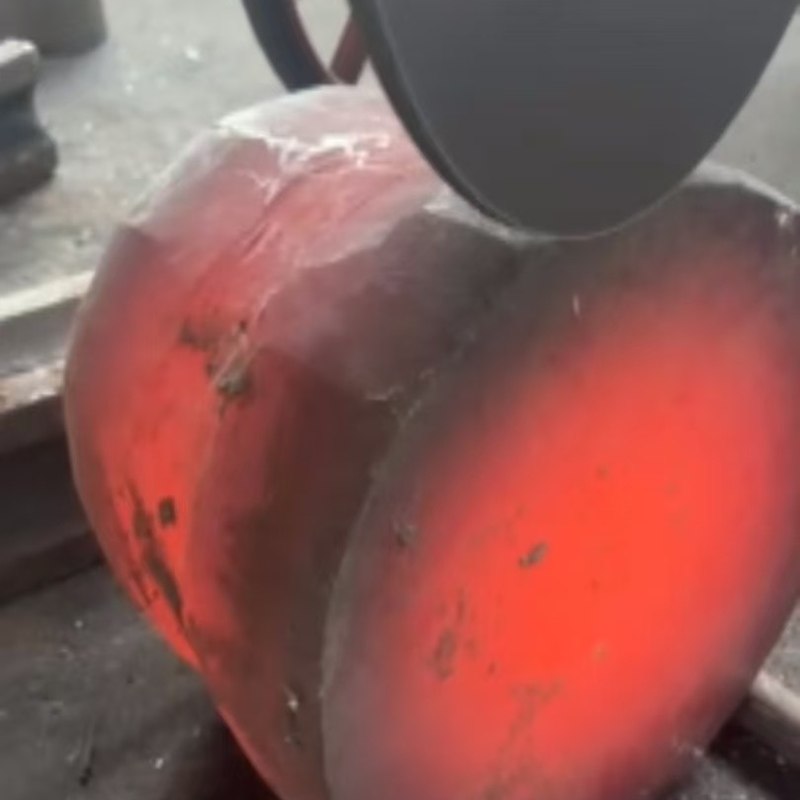
Why the forging window matters
The forging window for a nickel alloy is the temperature band between the maximum the alloy tolerates without incipient melting and the minimum at which it still recrystallises freely during deformation. For carbon and low alloy steel that window is 300 to 400 C wide and forgiving; for a nickel superalloy it is typically 120 to 250 C, which means a furnace thermometer out of calibration by 30 C can turn a good forging into a rejected one. The window is set by the alloy's chemistry — the chromium, molybdenum, niobium and aluminium content that gives the alloy its corrosion and high temperature resistance is also what narrows the working range.
Hot working temperature ranges by alloy
The table below gives typical forging ranges used in production. They are a starting point for a process specification, not a substitute for it: the correct range for a specific heat and a specific part is confirmed by the mill's own forging procedure and, for critical parts, by a trial forging with grain size measured after heat treatment.
| Alloy | UNS | Start forging | Finish forging (minimum) | Notes |
|---|---|---|---|---|
| Inconel 718 | N07718 | about 1120 C | about 930 C | Do not exceed 1120 C; incipient melting near 1210 C |
| Inconel 625 | N06625 | 1150–1200 C | about 950 C | Wide window, tolerant of slow presses |
| Inconel 600 | N06600 | 1200–1230 C | about 950 C | Slower heating needed, low thermal conductivity |
| Inconel X-750 | N07750 | 1150–1200 C | about 950 C | Finish below 950 C risks mixed grain |
| Hastelloy C-276 | N10276 | 1175–1200 C | about 950 C | Slow heat-up; reheat if the part cools toward the limit |
| Hastelloy C-22 | N06022 | 1180–1230 C | about 950 C | Similar window to C-276 |
| Hastelloy B-3 | N10675 | 1150–1200 C | about 950 C | Softer than C-family at temperature |
| Monel 400 | N04400 | 1150–1200 C | about 870 C | Very tolerant; hot short above 1200 C |
| Incoloy 800 / 800H / 800HT | N08800 / 10 / 11 | 1150–1200 C | about 900 C | Forge 800H and 800HT below 1200 C to control grain |
| Incoloy 825 | N08825 | 1150–1200 C | about 950 C | Similar to 800 |
| Duplex 2205 | S32205 | 1150–1250 C | about 950 C | Must be quenched after the last pass |
| Super duplex 2507 | S32750 | 1150–1250 C | about 1000 C | Narrower than 2205; higher risk of sigma phase |
| Stainless 316L | S31603 | 1150–1230 C | about 900 C | Forge in the austenitic range |
| Titanium Grade 5 (Ti-6Al-4V) | R56400 | 900–980 C | about 800 C | Beta transus at about 995 C; alpha-beta forging below it |
| Titanium Grade 2 | R50400 | 700–850 C | about 600 C | Lower window than Grade 5 |
Two entries deserve a note. Super duplex 2507 is not simply a stronger version of 2205 in the forge — its window is narrower and its tolerance to slow cooling is worse, which is why the finish forging temperature is held higher and the quench is mandatory. Titanium Grade 5 is forged below its beta transus of about 995 C for alpha-beta processed parts, and above it for beta forged parts; the two processes give completely different microstructures and cannot be substituted without re-qualification.
What happens if you forge too cold?
Below the minimum working temperature the alloy stops recrystallising as it deforms, so the deformation energy is stored in the metal instead of being released as new grains. The visible symptom is edge cracking and a part that gets progressively harder and more difficult to move with each pass; the invisible symptom is a mixed grain structure that only appears on the final ultrasonic and macro examination.
- Edge and corner cracking, starting at the free surfaces where the tensile strain is highest
- Mixed or duplex grain size, with coarse grains from the early passes and fine grains around the later ones
- Higher forging loads, more press wear and a greater risk of tool breakage
- Residual stress that distorts the part during subsequent machining
- In precipitation hardening alloys such as 718, a finish below about 930 C leaves unrecrystallised bands that the ageing treatment cannot remove
The practical rule is to reheat before the part drops to the minimum, not when it has already reached it. A forging that has cooled to the finish temperature at the press should go back to the furnace rather than take one more pass.
What happens if you forge too hot?
Above the maximum working temperature the risk shifts from the metal's structure to its integrity. The classic failure is incipient melting: the lower melting point phases at the grain boundaries — carbides, eutectics, sulphides — liquify while the bulk of the metal is still solid. The part may pass all the forging steps and then fail ultrasonic inspection, or worse, fail in service.
- Incipient melting and hot cracking at the grain boundaries, usually not visible on the surface
- Uncontrolled grain growth, which reduces tensile ductility and low temperature toughness
- Burning, where the surface oxide penetrates along grain boundaries and cannot be removed by machining
- Heavy scale formation, wasting material and leaving a surface that pits in service
- For duplex grades, a coarse ferrite-austenite balance that no heat treatment will restore
For Inconel 718, the safe ceiling is generally held at about 1120 C even though the melting-related events occur higher, because the useful forging range sits well under the incipient melting point and the alloy loses grain control above it.
Heating rate and furnace atmosphere
Temperature is only half of the specification. Nickel alloys have low thermal conductivity compared with carbon steel — roughly a quarter to a third — so a cold billet charged into a hot furnace develops a steep thermal gradient, and the resulting surface tension can crack the piece before it has been touched. Slow, staged heating is normal practice.
- Heat slowly and uniformly; for thick sections a soak of several hours is not unusual
- Do not charge cold billets directly into a furnace already at forging temperature
- Keep the furnace atmosphere slightly oxidising or neutral; avoid sulphur bearing fuels, which attack nickel alloys at temperature
- Keep the flame off the work; direct impingement gives local overheating that the thermocouple does not see
- Reheat whenever the surface temperature approaches the minimum, and record each heat
- Clean the furnace before nickel alloy work if it has previously run copper or lead bearing alloys
Sulphur is the specific hazard for nickel alloys. A reducing, sulphur bearing atmosphere causes grain boundary penetration and a surface that fails on the first forging pass — the same effect as overheating, reached at a much lower temperature.
Heat treatment after forging
Forging is only the first half of the thermal cycle. The correct post-forging treatment depends on whether the alloy is solid solution strengthened or precipitation hardening, and on whether the part will be welded.
- Solid solution alloys (625, C-276, Monel 400, 800H): solution anneal, typically 1040–1180 C depending on grade, then rapid cool — water quench for the corrosion critical grades
- Precipitation hardening alloys (718, X-750, A286): solution treat, then age to the required strength, for example per AMS 5663 for 718
- Duplex and super duplex: solution anneal then water quench, with the quench mandatory to suppress sigma phase
- Titanium: anneal below the beta transus for alpha-beta processed parts, in vacuum or inert atmosphere
- Do not slow cool a nickel alloy through the 600–900 C range if it is destined for chloride or acid service
Grain size after heat treatment is the acceptance criterion that catches forging problems, and it is measured per ASTM E112. A forging that was finished too cold will show a mixed grain structure even after a correct anneal, which is why the finish forging temperature is recorded for every piece rather than only for the first.
Which standards apply?
The forging process itself is usually governed by the customer's drawing and a material specification, while the product standards set the properties the forging must reach after heat treatment. The list below covers the usual nickel alloy grades.
- ASTM B637 for Inconel 718 bar and forging stock, with ASTM B670 covering the high temperature service condition
- ASTM B564 for nickel alloy forgings generally, including flanges, fittings and valve bodies
- ASTM B446 for Inconel 625 bar and ASTM B443 for 625 plate
- ASTM B574 for Hastelloy C-276 bar and ASTM B575 for C-276 plate
- ASTM A388 for ultrasonic examination of the finished forging
- AMS 5662, 5663 and 5664 for the solution and ageing treatments of 718 in aerospace applications
Hangbo Alloy supplies forged and ring rolled parts in nickel alloys, stainless, duplex and titanium — flanges, rings, discs, shafts and blanks — with forging temperatures recorded per heat, EN 10204 3.1 mill test certificates as standard, and grain size and ultrasonic testing to the specification you nominate.
Frequently asked questions
What is the forging temperature of Inconel 718?
Inconel 718 (UNS N07718) is typically forged starting at about 1120 C and finished no lower than about 930 C. The ceiling is set well below the incipient melting range because grain control is lost first, and the floor exists because the alloy stops recrystallising below it, leaving a mixed grain structure that ageing cannot repair.
Why do nickel alloys have a narrower forging window than steel?
The alloying elements that give nickel alloys their corrosion and high temperature resistance — chromium, molybdenum, niobium and aluminium — also raise the recrystallisation temperature and lower the point at which grain boundary phases start to melt. The two limits move toward each other, leaving a working range of roughly 120 to 250 C compared with 300 to 400 C for carbon steel.
Can Hastelloy C-276 be forged at the same temperature as Inconel 625?
They overlap but they are not identical, and they are not interchangeable in a process specification. Hastelloy C-276 (UNS N10276) is typically forged from about 1175–1200 C down to about 950 C, while Inconel 625 (UNS N06625) is forged from 1150–1200 C down to about 950 C. C-276 also demands slower heating because of its lower thermal conductivity.
What happens if a duplex forging is cooled slowly?
Slow cooling through the 600–900 C range precipitates sigma phase, a hard brittle intermetallic that destroys toughness and corrosion resistance. Duplex and super duplex forgings are solution annealed and then water quenched, and the quench is a specified step rather than an option — a slow cooled duplex forging has to be re-solution treated before it can be used.