
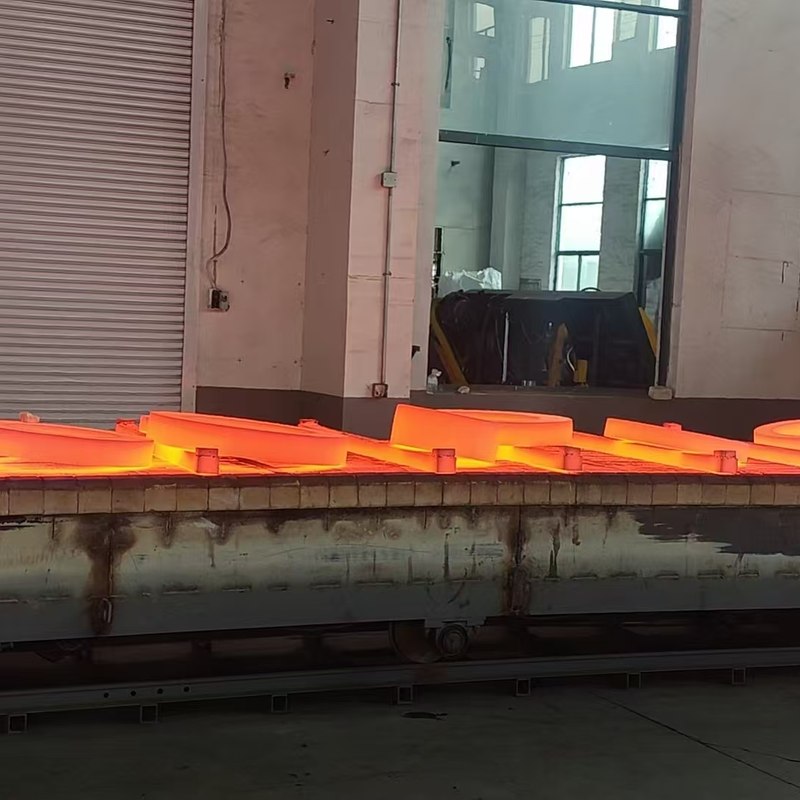
What is the standard heat treatment for Inconel 718?
Inconel 718 (UNS N07718) is a precipitation-hardening nickel superalloy, and its strength comes entirely from a controlled two-step ageing treatment rather than from cold work. The cycle below is the aerospace-standard schedule defined by AMS 5662 and AMS 5663, and it is the one Hangbo Alloy applies to bar, forging and ring stock before shipment.
| Step | Temperature | Soak | Cooling |
|---|---|---|---|
| Solution treatment | 955–980 °C | 1 h per 25 mm of section | Rapid quench (oil, water or forced air) |
| First age | 720 ± 10 °C | 8 h | Furnace cool at about 55 °C/h |
| Second age | 620 ± 10 °C | 8 h | Air cool |
The furnace cool between the two holds is not optional. Cooling too fast through the 720–620 °C window leaves the gamma double-prime phase incompletely precipitated, and the part simply will not reach the specified yield strength. Total cycle time is roughly 18 hours of furnace time plus the solution treatment.
What strength does Inconel 718 reach after ageing?
The difference between annealed and aged 718 is the whole reason the alloy exists. Aged material is roughly twice as strong in yield, and this is why 718 dominates highly loaded rotating parts and fasteners.
| Condition | Tensile strength | Yield strength (0.2%) | Elongation |
|---|---|---|---|
| Solution annealed | about 965 MPa | about 550 MPa | about 25% |
| Aged per AMS 5663 | about 1240 MPa | about 1035 MPa | about 12% |
| Direct aged (DA) | about 1275 MPa | about 1035 MPa | about 15% |
Direct ageing skips the separate solution treatment and is applied to closed-die forgings where the forging operation itself has already produced the required structure. It is not a substitute for proper solution treatment on bar stock.
Does the quench rate after solution treatment matter?
Yes, and it is the most common cause of failed mechanical tests. Inconel 718 must be cooled quickly enough from the solution temperature to keep the strengthening elements in solution. Slow cooling — for example letting a large section cool in still air — precipitates coarse phases at the grain boundaries, and no subsequent ageing step can recover the lost ductility.
- Sections under about 25 mm: forced air or polymer quench is usually adequate
- Sections over 50 mm: oil or water quench, with distortion control built into the process
- Complex forgings: quench in a fixture or press-quench to hold dimensions
What temperature can aged Inconel 718 be used to?
Inconel 718 holds its strength to about 650 °C and is routinely used in that range for turbine discs, casings and high-pressure fasteners. Above roughly 650 °C the gamma double-prime phase transforms to the stable delta phase, the alloy over-ages and strength falls away. If your application runs continuously hotter than 700 °C, Inconel X-750, Waspaloy or Hastelloy X are the correct families to look at instead.
- Continuous service ceiling: about 650 °C for load-bearing parts
- Short-term excursions: up to about 700 °C without permanent loss
- Oxidation resistance in air: good to about 980 °C, but with no structural credit above 650 °C
Which standards govern Inconel 718 heat treatment?
Heat treatment is specified by the material standard you order against, so the standard number belongs in your enquiry. The schedules and acceptance values come from these documents:
- AMS 5662 — bars, forgings and rings, solution treated and aged
- AMS 5663 — consumable-electrode vacuum-melted bars and forgings, solution treated and aged
- ASTM B637 — precipitation-hardening nickel alloy bars and forgings for general service
- ASTM B670 — precipitation-hardening nickel alloy plate, sheet and strip
- AMS 5664 — 718 forged and solution heat treated
Can Inconel 718 be welded in the aged condition?
Inconel 718 is weldable in the solution-treated condition and is best welded that way, then aged after welding. Welding in the fully aged condition is possible but reduces ductility in the heat-affected zone and raises the risk of strain-age cracking. The practical sequence is:
- 1. Weld in the solution-treated or annealed condition
- 2. Use matching filler metal — ERNiFeCr-2 (Inconel 718 filler) for TIG and MIG
- 3. Keep interpass temperature below 150 °C and heat input low
- 4. Age the complete assembly afterwards to AMS 5663
Frequently asked questions
Can Inconel 718 be hardened by cold working?
Not usefully. Inconel 718 gains strength from precipitation of gamma double-prime during ageing, not from deformation. Cold working raises strength slightly but cannot approach the approximately 1035 MPa yield of a properly aged part, and it makes the subsequent solution treatment harder to control.
How long does the ageing cycle take?
The furnace cycle is about 18 hours: 8 hours at 720 °C, a controlled cool of roughly 2 hours down to 620 °C, and 8 hours at 620 °C. Add the solution treatment of 1 hour per 25 mm of section plus quench time. A typical mill turnaround including testing is 5 to 10 days.
Do I need to specify the heat treatment on my purchase order?
Yes, always. Ordering "Inconel 718 bar" alone leaves the condition open, and you may receive solution-annealed material at roughly half the strength you expected. State the standard and the condition, for example: Inconel 718 round bar, AMS 5662, solution treated and aged, 50 mm diameter.
Does Hangbo supply 718 in the aged condition with test reports?
Hangbo Alloy supplies Inconel 718 bar, plate, tube, forgings and rings in the solution-treated or fully aged condition, with heat treatment certificates and mechanical test results at the ageing temperature reported on the EN 10204 3.1 mill test certificate. Third-party inspection by SGS, BV or TUV is available on request.