
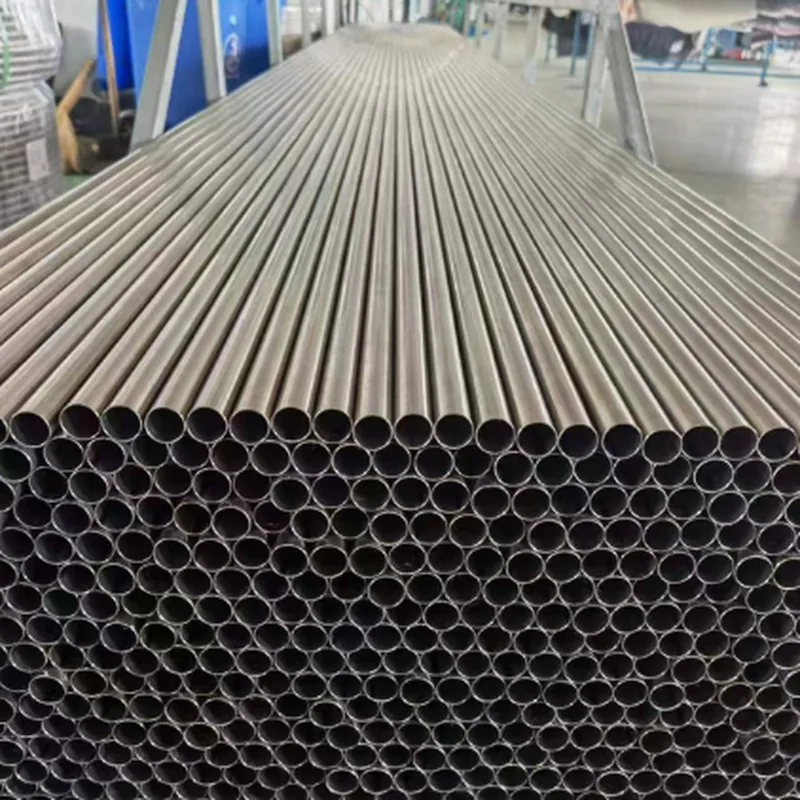
A heat exchanger tube is selected from the medium on the tube side, the metal temperature of the tube wall and the tube standard that governs its dimensions and testing — Inconel 625 (UNS N06625) and Hastelloy C-276 (UNS N10276) for chloride and acid duty, Incoloy 800 and 825 (UNS N08800 and N08825) for high-temperature and mixed-acid service, titanium Grades 2, 7 and 12 (UNS R50400, R52400 and R53400) for seawater, and 316L or duplex stainless for benign cooling water. A 316L tube and an Inconel 625 tube may both be described as "seamless heat exchanger tube", but they are ordered under different ASTM specifications with different tolerances, different inspection requirements and different price levels, and they cannot be substituted for one another without re-checking the corrosion allowance.
This guide sets out which standard applies to which alloy, how to match the tube to the medium, and what a complete tube line item on an enquiry actually needs to contain. For the welded-versus-seamless question in general piping, see Seamless or Welded Tube?.
Which standard covers which heat exchanger tube alloy?
The tube standard is decided by the alloy family and by whether the tube is seamless or welded. Getting this wrong is the most common cause of a rejected mill certificate, because the mechanical property limits and the permissible tolerances differ between the specifications:
| Alloy family | Typical grades | Seamless tube | Welded tube |
|---|---|---|---|
| Commercially pure nickel | Nickel 200 / 201 (N02200 / N02201) | ASTM B163 | ASTM B725 |
| Nickel-copper | Monel 400 (N04400) | ASTM B163 | ASTM B725 |
| Nickel-chromium-iron | Inconel 600 / 601 / 690 (N06600 / N06601 / N06690) | ASTM B167 | ASTM B516 |
| Nickel-iron-chromium | Incoloy 800 / 800H / 800HT (N08800 / N08810 / N08811) | ASTM B407 | ASTM B515 |
| Nickel-iron-chromium-molybdenum-copper | Incoloy 825 (N08825) | ASTM B423 | ASTM B704 |
| Nickel-chromium-molybdenum (C-family) | Hastelloy C-276 / C-22 (N10276 / N06022) | ASTM B622 | ASTM B626 |
| Titanium | Grade 2 / Grade 7 / Grade 12 (R50400 / R52400 / R53400) | ASTM B338 | ASTM B338 |
| Austenitic stainless | 304L / 316L / 904L | ASTM A213 | ASTM A249 / A269 |
| Duplex stainless | 2205 / 2507 (S32205 / S32750) | ASTM A789 | ASTM A789 |
Two practical consequences follow from that table. First, **a welded tube is not automatically cheaper than a seamless tube** — for the C-family alloys the welded product (B626) carries a lower price but also a lower permissible design stress in most pressure-vessel codes, so the wall thickness has to be recalculated before the saving is real. Second, **titanium tubes are ordered under one standard for both product forms**, which is why the testing clause — eddy current for all, hydrostatic at the buyer's option — needs to be written explicitly rather than assumed.
For tube sheets, channels and covers in the same exchanger, the corresponding product standards are different again: plate and sheet in the 600 and 800 families come under ASTM B168, the C-family under ASTM B575 for low-carbon grades, 625 plate under ASTM B443, and forgings under ASTM B564.
How do you match the tube alloy to the cooling medium?
Selection is driven by the tube-side medium, the external medium (including cooling water quality and whether it is once-through or closed circuit), and the tube wall temperature. The table below covers the cases that account for most real orders:
| Tube-side / external medium | Recommended tube | Reason | Avoid |
|---|---|---|---|
| Clean cooling water, closed circuit, below 60 °C | 316L / 904L | Lowest cost that meets the duty | — |
| Cooling water with chlorides, wall above 60 °C | Inconel 625, Inconel 690, Incoloy 800, or 2205 | Resists chloride SCC that destroys 304/316L | 304, 316L |
| Seawater, once-through | Titanium Gr2, 90/10 Cu-Ni, 2507 | Titanium is effectively immune to seawater pitting | 316L, 304 |
| Brine and high-chloride process side | Titanium Gr7, Hastelloy C-276 | Titanium for oxidising conditions, C-276 where reducing acids are present | 316L |
| Dilute sulphuric acid, below 60 °C | Hastelloy C-276, Incoloy 825 | C-276 resists the reducing side; 825 is the lower-cost option | 304 |
| Concentrated sulphuric acid | Hastelloy C-276 / C-22, Alloy 20 | — | 316L |
| Hydrochloric acid, any concentration | Hastelloy B-2 / B-3, C-276 | B-family for HCl; C-family where oxidising species are also present | All stainless |
| Caustic (NaOH) above 50 % | Nickel 200 / 201 | Pure nickel is the reference caustic material | 316L (caustic SCC) |
| Nitric acid, oxidising | 304L, Inconel 690 | Oxidising acids need chromium, not molybdenum | C-family, B-family |
| Flue gas, hot side above 600 °C | Inconel 625, Incoloy 800HT, Hastelloy X | Oxidation and creep resistance | 316L |
| Organic chemicals, no aqueous phase | 316L, 321 | — | — |
The single most valuable check on this table is the **tube wall metal temperature**, not the process inlet temperature. In a high-temperature exchanger the tube wall runs hotter than the bulk fluid on the cold side, and if that wall crosses roughly 60 °C in a chloride-bearing water the SCC risk changes from theoretical to immediate. Ask the process engineer for the design metal temperature and calculate the tube wall condition from it before locking the material.
When is a nickel alloy tube worth the extra cost over stainless?
The honest answer is: when the failure mode you are avoiding costs more than the alloy. There are four cases where this normally holds.
- 1. **Chloride stress corrosion cracking.** Austenitic stainless steels crack in the presence of chlorides and tensile stress above roughly 60 °C. The failure is not a gradual wall loss — it is a through-wall crack, and it typically appears on the cold side of the tube where the chlorides concentrate. Inconel 625, Inconel 690, Incoloy 800 and duplex 2205 all resist this. This is the most common reason a nickel alloy tube is specified.
- 2. **Pitting and crevice corrosion under deposits.** Once-through seawater and dirty river water leave deposits that create oxygen-depleted crevices. Titanium and 2507 super duplex resist this; 316L does not.
- 3. **Corrosion at temperature where the acid is reducing.** The C-family (C-276, C-22) is the only common tube material that handles both oxidising and reducing acids in the same exchanger, which is why it dominates phosphoric acid and mixed-acid duties.
- 4. **High-temperature strength.** Above roughly 550 °C, 316L loses the creep strength the design assumed. Inconel 625, Incoloy 800HT and Hastelloy X keep usable strength to 700–900 °C depending on load.
The trade-off is heat transfer. Copper alloys conduct heat at 100–400 W/m·K, carbon and stainless steels at roughly 16 W/m·K, and nickel alloys at roughly 10–15 W/m·K, depending on grade and temperature:
| Material | Thermal conductivity at 20 °C (W/m·K) | Relative to copper |
|---|---|---|
| Copper (C11000) | 388 | 1.00 |
| Aluminium bronze | 42 | 0.11 |
| Carbon steel | 52 | 0.13 |
| 316L stainless | 16.3 | 0.042 |
| Titanium Grade 2 | 16.4 | 0.042 |
| Monel 400 | 21.8 | 0.056 |
| Inconel 600 | 14.8 | 0.038 |
| Inconel 625 | 9.8 | 0.025 |
| Hastelloy C-276 | 10.2 | 0.026 |
Two consequences follow. A nickel alloy tube bundle has to be larger than the copper alloy bundle it replaces for the same duty, and the tube wall should be kept as thin as the corrosion allowance and the pressure duty permit — every 0.1 mm of wall is a measurable loss of duty. This is also why the standard wall thickness for a nickel alloy condenser tube sits between about 0.9 mm and 2.1 mm rather than at the heavier schedule wall used for process piping of the same diameter.
What should a complete tube line item contain?
A tube enquiry that cannot be quoted without a follow-up question is an enquiry that loses a week. The line item needs:
- **Alloy and UNS number**, plus the trade name if one is in common use, e.g. "Inconel 625, UNS N06625".
- **Product standard and edition**, e.g. ASTM B163, and whether seamless or welded.
- **Dimensions**: outside diameter, wall thickness or BWG gauge, and length. State whether you want random lengths, a fixed length, or tube cut to a U-bend leg length.
- **Dimension basis**: outside diameter and wall, or outside diameter and inside diameter. For condenser tubes, outside diameter and wall is standard; for some heat exchanger duties the required inside diameter is fixed by the flow calculation and the wall must be derived from it.
- **Temper condition**: annealed (soft), as-drawn, or annealed and pickled. For U-bent tubes the U-bend area must be stress relieved after bending.
- **Form**: straight, U-bent, finned, or with a welded end fitting.
- **Testing**: eddy current test is normally applied to every tube for heat exchanger service; hydrostatic test, flattening test and flare test are applied per the product standard or at the buyer's option.
- **Certification**: EN 10204 3.1 as standard, with third-party inspection available on request.
- **Ends**: plain, bevelled, or with a specified end preparation.
What does the test package for a condenser tube order look like?
| Test / document | Applies to | Notes |
|---|---|---|
| Chemical analysis of the heat | All | Must show the actual heat analysis, not the specification range |
| Tensile test at room temperature | All | One test per lot as defined in the product standard |
| Flattening test | All seamless tube | Detects wall eccentricity and internal defects |
| Flare test | Where the tube is to be rolled into a tube sheet | Confirms the tube will expand without cracking |
| Eddy current test | Heat exchanger and condenser tube | Nondestructive test of the full length; specify the reference standard |
| Hydrostatic or pneumatic test | At buyer's option | Usually waived where the eddy current test is specified |
| Grain size | Where a high-temperature tensile or creep test is required | Per ASTM E112 |
| Intergranular corrosion test | Where the service is oxidising acid | Per ASTM G28 or ASTM A262 as applicable |
| U-bend stress relief record | U-bent tubes | Furnace chart plus hardness survey of the bend |
| Mill test certificate | All | EN 10204 3.1 with the heat number traceable to the tube |
For high-chloride or acid service, the pitting resistance tests in ASTM G48 give a comparative number — critical pitting temperature — that can be written into the specification instead of leaving the resistance claim to the grade name. This is worth doing where two alloys are close on price and you need a defensible basis for the choice.
Heat exchanger tubes from Hangbo Alloy
Hangbo Alloy supplies seamless and welded heat exchanger and condenser tube in Inconel 600, 601, 617, 625, 690 and 718, Incoloy 800, 800H, 800HT, 825 and 926, Hastelloy C-276, C-22 and C-2000, Monel 400 and K-500, Nickel 200 and 201, and titanium Grades 2, 7 and 12 — with the matching tube sheet plate and forgings supplied from the same plant so the material certificate set is consistent across the exchanger.
Tube is supplied solution annealed and pickled, straight or U-bent, with eddy current testing and full dimensional records as standard, and EN 10204 3.1 certification with third-party inspection available on request.
Send us the tube-side medium, the design metal temperature, the standard you are working to and the dimensions, and we will confirm the alloy, the tolerances and the test package before the order is placed.
Continue reading
- How to Specify Nickel Alloy Plate and Sheet: Standard, Condition and FinishA nickel alloy plate order is not complete until it names the product standard, the rolling condition, the thi
- How to Specify Nickel Alloy Round Bars on a Purchase OrderWhat a complete Inconel, Hastelloy or Monel round bar order must state — grade, UNS, product standard, conditi
- Inconel 718 Round Bar (φ2–600 mm): Composition, Mechanical Properties & SupplierInconel 718 round bar (N07718) supplier: composition, aged properties, sizes and tolerances. Factory price fro
- Inconel 625 Round Bar (φ2–600 mm): Composition, Mechanical Properties & SupplierInconel 625 round bar (N06625) supplier: composition, aged properties, sizes and tolerances. Factory price fro
- Hastelloy C-276 Plate & Sheet: Composition, Mechanical Properties & SupplierHastelloy C-276 plate (N10276) supplier: composition, aged properties, sizes and tolerances. Factory price fro
- All 11 Product Forms & Specifications guides
Frequently asked questions
Is seamless tube better than welded tube for a heat exchanger?
Not universally. Seamless tube removes the longitudinal weld as a potential defect site and is normally required for high-pressure and cyclic duties. Welded and drawn tube has become the standard choice for titanium and for large-volume stainless orders because the weld is fully recrystallised by the cold-draw and anneal sequence. For the C-family alloys, welded tube under ASTM B626 is acceptable for many duties, but confirm the design stress allowance in the applicable pressure vessel code before substituting it for B622 seamless.
Can 304 or 316L tubes be used in seawater?
They should not be. Both grades pit in natural seawater, and where chlorides can concentrate — under deposits, in crevices, or on the hot side of a bundle — they also crack by stress corrosion. The realistic alternatives are titanium, 2507 super duplex or 90/10 copper-nickel, with the choice driven by velocity, sand content and whether the water is chlorinated.
Why did a 316L tube bundle fail in a duty that had run for years at the same temperature?
In most such cases one of the three process conditions has moved without a material review: the chloride level rose, the wall temperature crossed the SCC threshold because fouling reduced the heat transfer on one side, or the oxygen level changed and allowed pitting to start. A material re-evaluation should look at the wall condition and the deposit chemistry, not only at the bulk analysis.
Do nickel alloy tubes need a different cleaning procedure?
Yes. Nickel alloys are not attacked by the standard nitric-hydrofluoric pickling used on stainless steel in the same way. Follow the mill's recommended pickling and passivation sequence, and for the high-molybdenum C-family, keep the passivation simple — a clean, oxide-free surface is the objective, and aggressive acid cleaning can leave the surface in a worse state than the pickled surface it started from.