
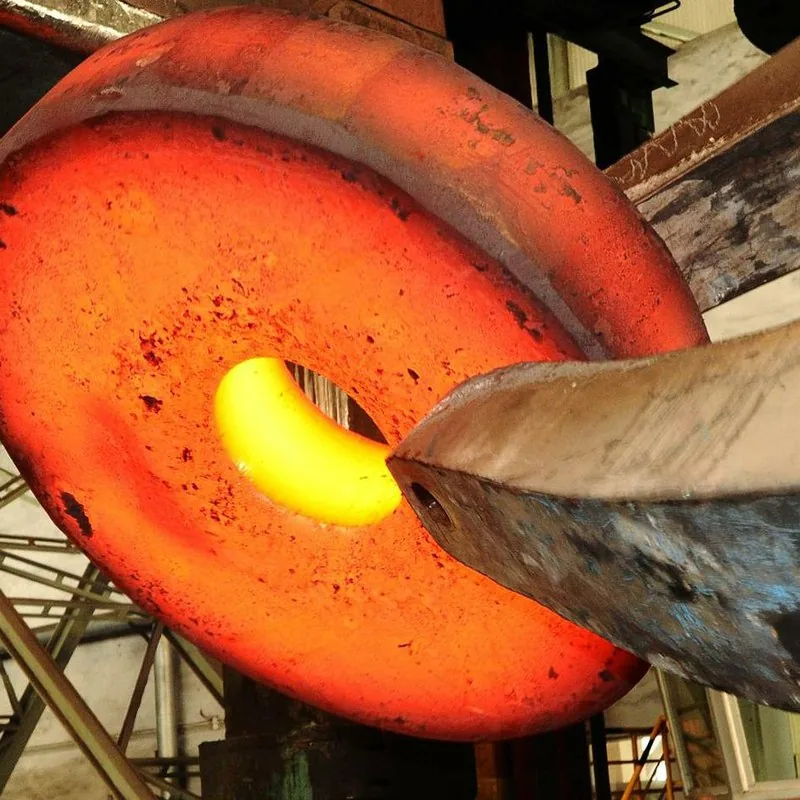
Inconel 718 (UNS N07718) forging is a precipitation-hardening nickel-base superalloy component produced by hot deformation of a cast or wrought billet, then strengthened by a two-stage ageing treatment. The grade is a nickel-chromium-iron alloy hardened by niobium, titanium and aluminium, and it is the one superalloy that combines 650 °C service capability with genuinely practical welding, which is why forged 718 has become the default material for discs, shafts, rings, valve bodies and wellhead components.
The purchasing problem is not the grade — it is the condition. Two mills can quote "718 forging to B637" and deliver parts that behave completely differently, because the forging temperature window, the amount of reduction per heat, the finishing temperature and the ageing cycle are all variables the standard permits within limits. This guide covers which standard actually governs a forging, what the temperature window is and why it is narrow, what the heat treatment does, and where forged 718 stops being the right answer.
What is an Inconel 718 forging and why forge rather than machine from bar?
Inconel 718 is a nickel-base superalloy that gains its strength from the gamma double prime phase, Ni3Nb, with gamma prime Ni3(Al,Ti) contributing at higher temperatures. Neither phase exists in the as-cast or as-forged condition; both are precipitated during ageing, which means the forging operation sets the grain structure and the ageing operation sets the strength, and the two are not independent.
Forging is chosen over machining from bar for three reasons that no amount of stock removal can reproduce. First, hot deformation closes the shrinkage porosity and micro-cavities left by casting, so a forged part is sounder in the interior than the billet it came from. Second, the grain flow follows the die contour, orienting the worked structure along the load path — a rolled bar has unidirectional grain flow that may run across the finished part's principal stress direction. Third, large monolithic shapes such as rings and discs beyond roughly 500 mm diameter are simply not available as bar.
The counter-argument is cost: forging needs dies, extra machining allowance and a thermal cycle, so a small simple part is usually cheaper machined from 718 round bar. The crossover is generally where the part is large, where fatigue life is designed rather than assumed, or where internal soundness has to be demonstrated by ultrasonic testing.
Which standards govern Inconel 718 forgings?
There is no single "718 forging" specification, and the number on the purchase order decides what the mill is actually obliged to do. ASTM B637 is the general-industry standard for precipitation-hardening nickel alloy bars, forgings and forging stock; ASTM B564 covers nickel alloy forgings generally. Aerospace work moves to the AMS series, where the condition at delivery is written into the standard number.
| Standard | Product form | What it actually fixes |
|---|---|---|
| ASTM B637 | Bar, forgings, forging stock | Chemistry, mechanical properties, general industrial tolerances |
| ASTM B564 | Forgings, all nickel alloys | Forging-specific requirements across the nickel alloy family |
| AMS 5662 | Bar, forgings, rings | Delivered solution treated and aged — the part arrives at full strength |
| AMS 5663 | Bar, forgings, rings | Delivered solution annealed only — soft, to be aged after machining |
| AMS 5664 | Bar, forgings, rings | Tighter rotor-grade cleanliness and inspection |
| ASTM B906 | Plate, sheet, strip | Flat-rolled general requirements, not a forging standard |
The AMS 5662 versus 5663 choice is the one that causes most schedule damage. AMS 5662 forges and ages at the mill, so the part arrives hard and can only be finished by grinding or light machining; AMS 5663 arrives in the soft solution-treated condition, which is what a shop needs if it intends to machine the forging to near-net shape before ageing. Order 5662 when the geometry is already final, 5663 when significant machining remains.
What is the chemical composition of Inconel 718?
The chemistry that matters for a forging is the balance between niobium, titanium and aluminium on one side and carbon and sulphur on the other. Niobium at 4.75–5.50% is what forms the gamma double prime phase and gives 718 its strength; carbon and sulphur are kept low because they segregate to grain boundaries and cut notch toughness in a large section.
| Element | ASTM B637 limit (wt%) | Role |
|---|---|---|
| Nickel | 50.0–55.0 | Matrix, stabilises austenite |
| Chromium | 17.0–21.0 | Oxidation and corrosion resistance |
| Iron | Balance | Matrix, reduces cost against pure nickel alloys |
| Niobium + tantalum | 4.75–5.50 | Forms gamma double prime, the main strengthener |
| Molybdenum | 2.80–3.30 | Solid solution strengthening, pitting resistance |
| Titanium | 0.65–1.15 | Gamma prime former |
| Aluminium | 0.20–0.80 | Gamma prime former |
| Cobalt | 1.00 max | Residual |
| Carbon | 0.08 max | Carbide former, controlled for toughness |
| Manganese | 0.35 max | Deoxidation |
| Silicon | 0.35 max | Deoxidation |
| Boron | 0.006 max | Grain boundary strengthening |
| Phosphorus | 0.015 max | Residual, controlled |
| Sulphur | 0.015 max | Residual, controlled for hot ductility |
For a full grade datasheet including the European and Chinese designations, see Inconel 718 (N07718).
What forging temperature range does Inconel 718 need?
The forging window for 718 is narrow compared with a solid-solution alloy such as 625, and most forging defects in the grade trace back to finishing below the lower limit. The upper limit is set by incipient melting and grain growth; the lower limit is set by the precipitation of delta phase, the orthorhombic Ni3Nb that forms between roughly 870 °C and 900 °C and turns into brittle acicular plates along grain boundaries.
| Stage | Temperature | Practical rule |
|---|---|---|
| Billet soak | 1095–1150 °C | Hold long enough to equalise; never exceed 1200 °C |
| Initial forging | 1150–1000 °C | Take the bulk reduction in this band |
| Finish forging | 1000–950 °C | Finish before the workpiece drops below 950 °C |
| Absolute floor | 900 °C | Below this, delta phase forms and cracking follows |
| Reduction per heat | 30% or more | Avoid the 5–15% critical range that leaves mixed grain |
| Cooling after forging | Air or controlled | Section thickness decides; large sections may need slower cooling |
Two rules matter more than the table. The first is that reduction per heat should be either substantial or skipped: a 10% pass puts the metal in the critical strain band, where only some grains recrystallise and the result is a duplex grain structure that ultrasonic testing will find and the customer will reject. The second is that a forging rejected for low finishing temperature cannot be fixed by re-forging at a higher temperature once delta phase has formed in a heavy section — the plates have to be dissolved by a full solution treatment, and if they are coarse enough the part is scrap.
The same temperature logic applies across the nickel alloy family and is set out in more detail in nickel alloy forging hot working temperature.
What heat treatment gives Inconel 718 its strength?
The standard cycle is a solution treatment followed by a two-stage age, and the controlled cooling between the two stages is not optional decoration — it is what separates a forging with good notch toughness from one that cracks in service. Solution treatment dissolves the delta phase, any Laves phase left from ingot segregation and the carbides that would otherwise pin the grain boundaries.
| Step | Temperature | Time | Purpose |
|---|---|---|---|
| Solution treatment | 954–982 °C | 1 h per 25 mm of section | Dissolve delta and Laves, homogenise |
| Quench | Oil, polymer or air | Immediate | Retain supersaturated solid solution |
| First age | 720 °C | 8 h | Nucleate gamma double prime and gamma prime |
| Controlled cool | 50 °C per hour down to 620 °C | — | Avoid thermal stress, keep precipitates fine |
| Second age | 620 °C | 8 h total at temperature | Complete precipitation, stabilise structure |
| Final cool | Air | — | — |
A single-stage age at 760 °C is used where highest notch toughness matters more than peak strength, and it is common on parts with stress concentrations. The double age gives the highest tensile and yield in the grade. Whichever is specified, the requirement should be written as a cycle, not as a hardness target, because hardness alone does not prove the gamma double prime morphology that delivers fatigue life. The metallurgy behind the cycle is covered in Inconel 718 heat treatment.
What mechanical properties do Inconel 718 forgings deliver?
Property values depend entirely on the delivered condition, which is why the AMS number on the drawing matters as much as the alloy name.
| Condition | Tensile strength | 0.2% yield | Elongation | Hardness |
|---|---|---|---|---|
| AMS 5663, solution annealed | 965 MPa (140 ksi) | 550 MPa (80 ksi) | 20% min | Typically below 250 HB |
| AMS 5662, solution plus aged | 1275 MPa (185 ksi) | 1035 MPa (150 ksi) | 12% min | 331–388 HB |
| Aged, tested at 650 °C | About 1000 MPa | About 860 MPa | 12% typical | — |
| Aged, tested at −196 °C | Above room temperature values | Above room temperature values | Ductile | — |
The temperature story is what sells 718. It holds useful strength from cryogenic temperature up to 650 °C for long-term service and about 704 °C for short excursions, and unlike many high-strength grades it does not become brittle at liquid nitrogen or liquid hydrogen temperature — which is why forged 718 appears in cryogenic valve bodies and rocket hardware as well as in hot sections. Prolonged exposure above roughly 650 °C converts gamma double prime to delta phase and the strength falls away permanently; that is a transformation, not a reversible softening, so a part overheated in service cannot be re-aged back to specification.
How does forged 718 compare with cast or additively manufactured 718?
All three routes deliver the same nominal chemistry and, after the same ageing treatment, similar tensile strength on a test bar. They differ in what the test bar does not show.
| Attribute | Forged 718 | Cast 718 | Additive 718 |
|---|---|---|---|
| Internal porosity | Closed by deformation | Shrinkage possible in heavy sections | Gas porosity and lack of fusion possible |
| Grain structure | Flow lines follow the contour | Equiaxed, isotropic | Columnar and strongly anisotropic |
| Fatigue life in the short transverse direction | Best of the three | Lower, casting defects dominate | Part and build orientation dependent |
| Maximum practical size | Rings and discs beyond 1 m | Large complex shapes | Limited by build envelope |
| Repair | Weld repair routine | Weld repair routine | Weld repair possible but re-qualification heavy |
| Aerospace qualification base | Long established | Established for specific parts | Still being built part by part |
For a rotating part where fatigue life is calculated rather than tested, forging remains the conservative choice. Casting wins where the shape is complex and the section is thick enough to feed soundly; additive manufacturing wins on small complex parts with internal channels that cannot be machined, and on lead time, but it carries a directional property penalty that has to be designed around rather than ignored.
Which industries specify Inconel 718 forgings?
Forged 718 sits wherever high strength at moderate temperature, corrosion resistance and weldability are needed in the same part.
| Industry | Typical forged part | Driving requirement |
|---|---|---|
| Aero engines | Compressor discs, shafts, spacers, casings | Fatigue life and 650 °C capability |
| Gas turbines | Discs, blades in later stages, combustion hardware | Creep and thermal cycling |
| Oil and gas | Wellhead bodies, valve blocks, Christmas tree components | Pressure containment plus sour service resistance, see API 6A wellhead alloy selection |
| Cryogenic | Valve bodies, seals, rocket engine hardware | Ductility at −196 °C and below |
| Nuclear | Reactor internals, pump shafts | Irradiation behaviour and corrosion |
| Power generation | Steam turbine fasteners, seals | Stress relaxation resistance |
| Heavy machinery | Large rings and rolled rings | Section size, see seamless rolled rings |
Two of these deserve a caution. Wellhead service often adds a hardness ceiling and NACE MR0175 / ISO 15156 compliance on top of the standard, and the acceptable hardness limit in sour service is lower than what aged 718 naturally delivers, so the alloy may be in the wrong place unless the exposure is confirmed as non-sour — the qualification position is set out in our NACE MR0175 sour service guide. Cryogenic service, conversely, is where 718 is unusually easy to justify, because few high-strength alloys keep impact toughness down to liquid helium temperature.
How are Inconel 718 forgings inspected and certified?
Inspection scope is where two quotations for the same forging usually differ, and it is worth writing the scope into the enquiry rather than discovering it at the material test report stage.
| Test | Reference | When it applies |
|---|---|---|
| Chemical analysis | ASTM B637 or AMS 5662 limits | Every heat |
| Room temperature tensile | ASTM E8, one per lot | Every lot |
| Hardness | Brinell or Rockwell, after ageing | Every forging |
| Grain size | ASTM E112 | Where specified; aerospace commonly calls for 6 or finer |
| Ultrasonic inspection | ASTM A388 | Required for critical rotating and pressure parts |
| Penetrant inspection | ASTM E165 | Surfaces after machining or as-forged where specified |
| Delta phase check | Metallographic | Where service temperature or a specification history raises the risk |
| Dimensional and visual | Drawing plus B637 tolerances | Every forging |
| Documentation | EN 10204 3.1 material test report | Every shipment |
Ultrasonic inspection is the line item most often skimmed. The acceptance level determines how much of the forging is proven sound, and AMS 5664 exists precisely because rotor-grade parts need a tighter level than standard 5662. If the drawing is silent, the mill will apply the default level, which may not be what a fatigue-critical design assumed.
Ordering Inconel 718 forgings from Hangbo Alloy
Hangbo Alloy supplies Inconel 718 (UNS N07718) forgings, rolled rings, shafts and forged blanks to ASTM B637, ASTM B564 and AMS 5662 or 5663, with ultrasonic and penetrant inspection to the level the drawing calls for and an EN 10204 3.1 material test report with every shipment. Third-party inspection and witness testing can be arranged against the purchase order.
To quote a forging we need the standard and the delivered condition, the finished drawing with machining allowance stated, the section thickness that governs the ageing time, the inspection level for ultrasonic testing, the quantity, and whether the part will be aged by us or by you. If the service involves H2S or temperatures above 650 °C, tell us at the enquiry stage — the answer may be a different alloy or a different heat treatment rather than a heavier section, and it is far cheaper to change it before the billet is cut.
Continue reading
- Inconel 718 Heat Treatment: How to Reach Maximum StrengthHow to solution treat and age Inconel 718 to AMS 5662 and AMS 5663 — temperatures, soak times, cooling rates,
- How Are Nickel Alloy Flanges Made? Forging, Ring Rolling and StandardsA nickel alloy flange is pinned down by three specifications at once — the alloy, the forging standard such as
- Forging and Hot Working Temperatures for Nickel AlloysNickel alloys are forged in a narrow window — roughly 120 to 250 C wide — and the correct range is different f
- How to Machine Inconel and Hastelloy: Speeds, Feeds and ToolingPractical machining data for Inconel 718, 625 and Hastelloy C-276 — cutting speeds, feed rates, tool grades, c
- How Do You Match Nickel Alloy Pipe, Fittings, Flanges and Filler Metal?Match nickel alloy pipe, fittings, flanges and filler metal by UNS grade: which ASTM standard covers each prod
- All 11 Welding, Forming & Heat Treatment guides
Frequently asked questions
Is an Inconel 718 forging stronger than Inconel 718 bar?
No — after the same solution and ageing cycle, forged and rolled 718 reach the same tensile and yield strength. The forging advantage is structural rather than in test-bar strength: closed internal porosity, grain flow following the contour, and better transverse toughness and fatigue life in the finished part.
At what temperature does an Inconel 718 forging lose its strength?
Inconel 718 holds design strength to about 650 °C for continuous service and roughly 704 °C for short excursions. Above that range gamma double prime converts to delta phase, which is a permanent microstructural change, so the loss cannot be recovered by re-ageing the part.
Can Inconel 718 be welded after forging?
Yes, and 718 is the most weldable of the precipitation-hardening nickel superalloys. Welds are normally made in the solution-treated condition and aged afterwards with the part; ageing a welded joint without a prior solution treatment risks strain-age cracking and Laves phase in the weld metal.
What is the difference between AMS 5662 and AMS 5663 forgings?
AMS 5662 is delivered solution treated and aged, so the forging arrives at full strength and can only be finished by grinding or light machining. AMS 5663 is delivered solution annealed only, which leaves the part soft enough to machine to final shape before the buyer performs the ageing treatment.