
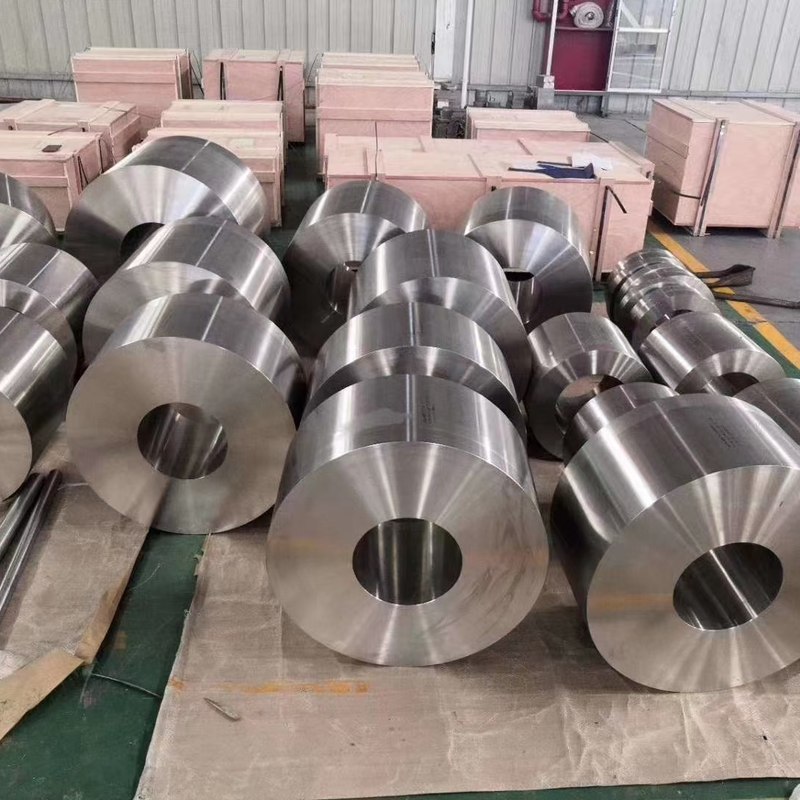
Quick Answer: What Is Inconel 718?
Inconel 718 (UNS N07718 / W.Nr. 2.4668 / GH4169) is a premier precipitation-hardening nickel-iron-chromium superalloy formulated for service environments demanding high mechanical strength and exceptional corrosion resistance. Its high performance stems from the precipitation hardening through gamma-prime (γ′) and gamma-double-prime (γ″) phases nucleated by aluminum (0.2–0.8%), titanium (0.65–1.15%), and niobium (4.75–5.50%) within its stable nickel-chromium matrix. This requires a carefully controlled solution anneal followed by a two-stage aging cycle to achieve full hardening. Operating efficiently from cryogenic limits down to -253°C up to a useful strength limit of approximately 700°C (1300°F), Inconel 718 is widely utilized in aerospace turbine discs, rocket engines, high-strength fasteners, and oil & gas downhole tools.
Product Overview
At the atomic level, its face-centered cubic (FCC) austenitic matrix that retains exceptional toughness even at cryogenic temperatures. Its primary advantage is precipitation hardening, which produces a yield strength nearly double that of solid-solution alloys while maintaining good fatigue resistance, which yields good oxidation and corrosion resistance combined with outstanding high-cycle fatigue strength and creep-rupture performance.
Shanghai Hangbo Alloy Group Co., Ltd., established in 2012, stands as a top-tier global manufacturer and supplier of Inconel 718. Operating under a certified ISO 9001:2015 quality management system, we command an export network covering 50+ countries. Our portfolio contains high-precision centerless ground round bars, heavy industrial plates, and high-pressure seamless tubing engineered for critical industrial applications. By managing carbon distribution and grain refinement during melting and forging, we ensure our material provides robust structural performance under severe stress. Every order comes with 100% material traceability and certified documentation, ensuring compliance with strict global engineering standards.
Executive Standards
Shanghai Hangbo Alloy Group Co., Ltd. manufactures Inconel 718 in strict compliance with international technical specifications:
| Product Form | ASTM Specification | ASME Section II | AMS Standard | W.Nr. / DIN |
|---|---|---|---|---|
| Round Bar & Forging | ASTM B637 | ASME SB637 | AMS 5662 / 5663 | 2.4668 |
| Seamless Tube & Pipe | ASTM B983 | ASME SB983 | AMS 5589 | 2.4668 |
| Sheet, Plate & Strip | ASTM B670 | ASME SB670 | AMS 5596 | 2.4668 |
| Wire & Welding Rod | AWS A5.14 | — | AMS 5832 | 2.4668 |
| Forged Flanges & Fittings | ASTM B564 | ASME SB564 | AMS 5664 | 2.4668 |
Note: Shanghai Hangbo executes 100% confirmation of chemical compliance using Optical Emission Spectroscopy (OES) for every melt lot.
Chemical Composition
The corrosion-resistant profile of Inconel 718 depends on its exact chemical balance. Chromium ensures high-temperature oxidation resistance, while molybdenum safeguards against localized pitting in chloride environments.
| Element | Min (%) | Max (%) | Primary Metallurgical Role |
|---|---|---|---|
| Nickel (Ni) | 50.0 | 55.0 | base element; corrosion and high-temperature resistance |
| Chromium (Cr) | 17.0 | 21.0 | oxidation resistance and acid resistance |
| Iron (Fe) | Balance | — | cost control and thermal processing |
| Niobium + Tantalum (Nb+Ta) | 4.75 | 5.50 | principal γ″ strengthening phase former |
| Molybdenum (Mo) | 2.80 | 3.30 | solid-solution strengthening |
| Titanium (Ti) | 0.65 | 1.15 | γ′ and γ″ co-strengthening |
| Aluminum (Al) | 0.20 | 0.80 | γ′ precipitate former |
| Cobalt (Co) | — | 1.0 | cost and thermal stability control |
| Carbon (C) | — | 0.08 | carbide control |
| Manganese (Mn) | — | 0.35 | deoxidizer |
| Silicon (Si) | — | 0.35 | deoxidizer |
| Phosphorus (P) | — | 0.015 | impurity control |
| Sulfur (S) | — | 0.015 | impurity control |
Mechanical Properties
Inconel 718 delivers excellent design allowable stresses. The data below outlines typical properties for annealed stock.
Room-Temperature Mechanical Properties
| Technical Property | Metric Value | Imperial Value | Design Significance |
|---|---|---|---|
| Ultimate Tensile Strength (UTS) | ≥1240 MPa | ≥180 ksi | exceptional pressure-retaining safety factor |
| Yield Strength (0.2% Offset) | ≥1034 MPa | ≥150 ksi | prevents deformation under extreme loads |
| Elongation (in 2 in. / 50mm) | ≥12% | ≥12% | adequate ductility for high-stress parts |
| Hardness (Brinell) | 331–420 HB | 331–420 HB | high strength, machinability requires care |
| Impact Strength (Charpy V-Notch) | ≥40 J | ≥30 ft-lb | retains toughness at cryogenic temperatures |
High-Temperature Performance: Strength Retention Analysis
Inconel 718 retains remarkable mechanical properties under thermal stress, establishing its credentials as a critical superalloy:
| Service Temperature | Yield Strength (MPa) | UTS (MPa) | Elongation (%) | Structural Suitability |
|---|---|---|---|---|
| Room Temp (20°C) | 1034 | 1240 | 15 | 100% baseline structural capacity |
| 500°C (932°F) | 900 | 1050 | 14 | retains ~87% strength; turbine disc service |
| 650°C (1200°F) | 750 | 900 | 13 | retains ~72% strength; creep-limited |
| 700°C (1292°F) | 600 | 750 | 12 | near maximum useful strength limit |
How Inconel 718 Is Produced
Round Bar & Forging
- 1. Triple Melting (VIM + VAR/ESR): Vacuum Induction Melting followed by Vacuum Arc Remelting or ESR ensures ultra-high purity and ingot soundness.
- 2. Hot Forging: large ingots are isothermally forged on hydraulic presses to refine grains and achieve directional integrity.
- 3. Solution Treating & Aging: a precisely controlled two-stage age cycle develops the γ′/γ″ precipitate distribution for peak strength.
- 4. Precision Grinding: bars are centerless-ground to h8/h9 tolerances with Ra under 0.8 μm.
Seamless Tube & Pipe
- 1. Billet Piercing & Extrusion: forged rounds are pierced and extruded into heavy-walled hollows.
- 2. Cold Drawing / Pilgering: multi-pass reductions produce uniform wall thickness and tight concentricity.
- 3. Solution + Age Heat Treatment: tubes are heat-treated to develop full precipitation-hardened properties.
- 4. Defect Testing: 100% Eddy Current and hydrostatic testing per ASTM standards.
Sheet, Plate & Strip
- 1. Hot Rolling: slabs are hot-rolled with controlled reduction to avoid segregation.
- 2. Cold Rolling: precise gauge control to within ±0.05 mm.
- 3. Solution + Age: plate is heat-treated to achieve specified aged strength.
- 4. Pickling & Leveling: scale removal and tension leveling for flatness.
Industry Applications: Solving Engineering Challenges
Aerospace and Defense
Inconel 718 is the workhorse alloy for jet engine turbine discs, compressor blades, and rocket engine turbopump components. Its high strength-to-weight ratio and fatigue resistance are critical for flight safety.
Oil & Gas
Used for high-strength downhole tools, wellhead components, and fasteners that must resist both high stress and sour-gas (H2S) environments.
Cryogenic Engineering
Its FCC structure retains exceptional toughness at liquid-nitrogen and liquid-hydrogen temperatures, making it suitable for rocket fuel systems.
Power Generation
718 is widely used for gas-turbine discs, seals, and high-temperature fasteners in land-based power plants.
Quality Assurance: 7-Stage Zero-Defect Inspection Protocol
Shanghai Hangbo Alloy Group Co., Ltd. deploys an intensive inspection matrix to support a zero-defect mandate across all production lines:
- 1. Chemical verification: OES analysis on every melt batch alongside handheld PMI validation on finished products ensures composition parameters match executive limits.
- 2. Ultrasonic Testing (UT): Performed per ASTM A388 standards across all bars and plates to confirm the absence of inner voids, seams, or gas inclusions.
- 3. Eddy Current Testing (ET): Applied 100% to tubes following ASTM E309 protocols to check surface and sub-surface continuity.
- 4. Hydrostatic Pressure Verification: Tubes undergo hydrostatic tests up to 10,000 PSI to verify wall integrity under high-pressure parameters.
- 5. Mechanical Destructive Testing: Tensile, offset yield, elongation, and Brinell hardness examinations are executed per heat lot to verify strength criteria.
- 6. Dimensional Metrology Check: Digital calipers and computerized laser sensors measure geometry, guaranteeing all diameter, wall, and length tolerances match orders.
- 7. Visual and Microstructure Audit: Surface quality checks are paired with metallographic microscope tests to evaluate grain size (ASTM E112) and phase homogeneity.
All items leave our facilities accompanied by ISO 9001:2015 certification and EN 10204 3.1 Mill Test Certificates. Third-party inspection options through SGS, TUV, or Bureau Veritas (BV) are organized upon customer request.
Frequently asked questions
What is Inconel 718 used for?
Inconel 718 is used for aerospace turbine discs, compressor blades, rocket engine components, high-strength bolts, and oil & gas downhole tools.
What is the maximum service temperature for Inconel 718?
For load-bearing applications its useful limit is approximately 700°C (1300°F). It retains strength down to cryogenic temperatures as low as -253°C.
How does Inconel 718 compare to Inconel 625?
Inconel 718 is precipitation-hardened, delivering roughly double the yield strength of 625, but 625 offers better weldability and corrosion resistance in aggressive acids.
Is Inconel 718 weldable?
Yes, but it requires controlled welding procedures and post-weld heat treatment to restore the age-hardened properties in the heat-affected zone.
What product forms does Shanghai Hangbo supply?
We supply Inconel 718 as forged round bars, seamless tubes, plates, sheets, welding wire, and custom-machined components.
Does Inconel 718 require heat treatment?
Yes. A solution anneal followed by a two-stage aging cycle is required to achieve full precipitation-hardened strength.
What is the price of Inconel 718 per kg?
Pricing follows LME nickel plus alloying-element surcharges. Contact us at demi@nickel-alloy.com for a detailed quote based on your required volume.
Does Shanghai Hangbo ship internationally?
Yes. We ship to 50+ countries using specialized maritime and air packaging to protect material during transit.