
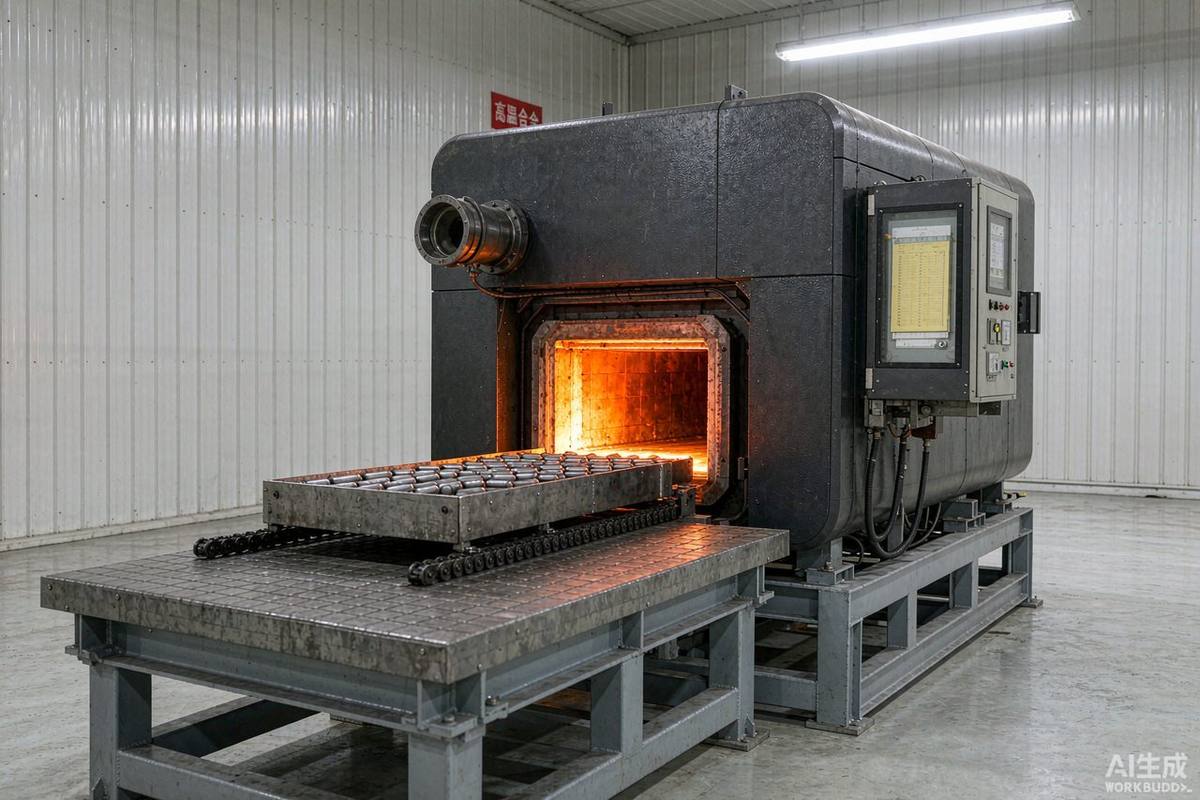
Superalloy performance depends on heat treatment as much as on chemistry. The same Inconel 718 gives about 1000 MPa tensile when solution annealed and over 1275 MPa after standard double ageing — the entire difference comes from heat treatment.
1. Solution treatment
The alloy is heated into the range where precipitates fully dissolve and held so alloying elements enter the matrix, then cooled rapidly (water quench or air cool) to freeze the high-temperature state as a supersaturated solid solution. It serves three purposes: dissolving harmful precipitates, homogenising chemistry and setting grain size.
- Temperature is typically 980–1200 °C depending on grade
- Soaking time is calculated from section thickness, commonly 30–60 minutes per 25 mm
- Cooling rate sets grain-boundary carbide morphology; too fast can introduce quench stress
- For grades such as 800H/800HT, solution treatment also produces the coarse grain that raises creep strength
2. Ageing
After solution treatment, holding at an intermediate temperature precipitates nanoscale γ′ (Ni₃(Al,Ti)) or γ″ (Ni₃Nb), blocking dislocation motion and raising strength. Ageing may be single or double stage; double ageing nucleates at a higher temperature then grows at a lower one, giving a more uniform structure and a better strength/toughness balance.
3. Recommended cycles for common grades
| Grade | Solution treatment | Ageing | Note |
|---|---|---|---|
| Inconel 718 | 955–980 °C, air cool | 720 °C ×8 h → furnace cool → 620 °C ×8 h, air cool | AMS 5663 cycle |
| Inconel 625 | 980–1150 °C, air cool / water quench | — | Solid-solution alloy; no ageing |
| Inconel X-750 | 1150 °C (spring) / 980 °C (structural) | 843 °C ×24 h + 704 °C ×20 h (spring) | Spring-specific cycle |
| Inconel 725 | 1010–1065 °C, air cool | 732 °C ×8 h → furnace cool → 621 °C ×8 h, air cool | NACE requirement |
| A-286 / GH2132 | 980 °C ×1 h, oil cool | 720 °C ×16 h, air cool | AMS 5731 |
| Monel K-500 | 980 °C, rapid cool | 593–607 °C ×16 h → furnace cool to 482 °C | Non-magnetic plus high strength |
| 17-4PH | 1040 °C, air cool | H900: 482 °C ×1 h / H1150: 621 °C ×4 h | Chosen by strength vs toughness |
| Hastelloy C-276 | 1120 °C, water quench | — | Normally no post-weld treatment |
4. Stress relieving
Holding below the ageing temperature and cooling slowly reduces residual stress from welding, cold forming or machining. It does not change the strengthened condition but markedly lowers the risk of stress-corrosion cracking and distortion. Typical stress-relief temperatures for nickel alloys are 550–900 °C, avoiding the 650–870 °C sensitising range.
5. Quality control points
- Furnace uniformity should be within ±5 °C (AMS 2750)
- Each load should carry coupons for mechanical testing
- Heat treatment charts must be recorded and traceable by heat number
- Vacuum or protective atmosphere treatment avoids surface oxidation and decarburisation
- For precipitation-hardening alloys, cooling rate directly controls strengthener size distribution
Frequently asked questions
Why is rapid cooling needed after solution treatment?
Rapid cooling freezes the high-temperature supersaturated solid solution to room temperature, preventing alloying elements from precipitating as coarse equilibrium phases during slow cooling. Cooling too slowly precipitates carbides or intermetallics at grain boundaries, reducing toughness and weakening the subsequent ageing response.
What happens if the ageing temperature is wrong?
Too low and the precipitates are too fine — under-aged, with poor toughness and insufficient strength. Too high or too long and they coarsen — over-aged, losing strength but gaining toughness. Double ageing exists precisely to reach a repeatable balance between the two.