
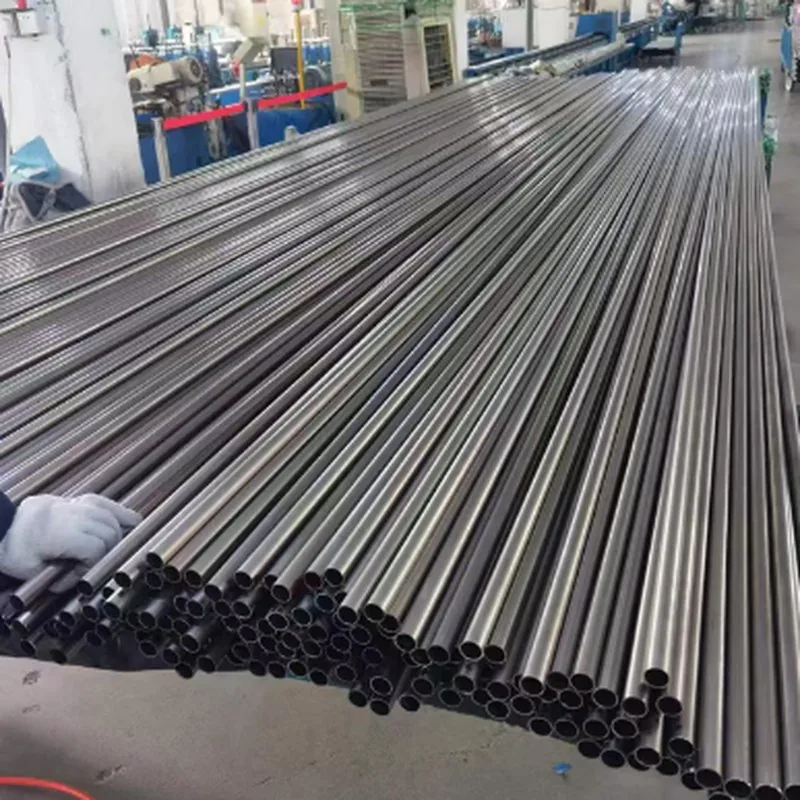
Inconel 625 (UNS N06625) and Hastelloy C-276 (UNS N10276) are the reference alloys for the hot end of a polysilicon plant — the reduction furnace bell jar, the gas inlet nozzles, the electrode holders and the exhaust hardware — because the process gas is a mixture of trichlorosilane (SiHCl3), silicon tetrachloride (SiCl4) and hydrogen chloride at 1,000-1,150 °C, and hydrogen chloride at that temperature destroys ordinary stainless steel within a single campaign. The cold end of the same plant, and the semiconductor fab it ultimately feeds, has an almost opposite requirement: the metal must not add anything to the product, so 316L (UNS S31603) with controlled ferrite and an electropolished surface becomes the standard line material instead of a nickel alloy.
This guide separates the two halves of the problem — high-temperature chlorosilane corrosion in the reduction furnace, and contamination control in the ultra-high-purity sections — and sets out which alloy, which product standard and which surface condition apply to each. For the families behind these grades in general industrial service, see Nickel-Based Alloys.
What happens to metal inside a polysilicon reduction furnace?
The Siemens process deposits silicon from trichlorosilane onto heated silicon filaments at 1,000-1,150 °C. The gas that reaches the metal surfaces is therefore not a single compound but a mixture whose composition changes along the furnace: trichlorosilane and hydrogen at the inlet, hydrogen chloride and silicon tetrachloride in the bulk, and unconverted chlorosilanes plus fine silicon powder in the exhaust. Three attack mechanisms run at the same time:
- 1. **Hydrogen chloride attack.** HCl at 300-600 °C is aggressive to iron-based alloys. It forms volatile metal chlorides, and on stainless steel the result is a scaling, spalling surface that sheds particles into the product. Nickel alloys with 15-23 % molybdenum resist this far better because the chlorides they form are less volatile.
- 2. **Chlorosilane decomposition on hot metal.** Where the metal surface is hot enough, SiHCl3 decomposes on the metal itself and deposits silicon, which then diffuses in. This is a form of metal dusting and it is the reason the bell jar is water cooled rather than insulated.
- 3. **Silicon diffusion and eutectic formation.** Silicon in contact with nickel forms a eutectic at about 966 °C and with iron at about 1,200 °C. Any nickel alloy that is allowed to touch hot solid or molten silicon — for example at a filament contact — will be consumed long before the gas corrosion would have mattered.
The practical result is that the furnace is designed so that no nickel alloy ever sees both a high temperature and direct silicon contact. Metal parts are placed where the wall is cooled and the gas is what attacks them; silicon contact is handled by graphite, silicon, or a refractory lining.
Which alloy for which part of a polysilicon plant?
| Plant section | Part | Base-case alloy | Product standard |
|---|---|---|---|
| Reduction furnace | Bell jar / dome | Inconel 625, Hastelloy C-276 | ASTM B443, ASTM B575 |
| Reduction furnace | Gas inlet nozzle, tail-gas nozzle | Inconel 625, Hastelloy C-276 | ASTM B564, ASTM B366 |
| Reduction furnace | Electrode holder, busbar hardware | Nickel 200 / 201, Inconel 600 | ASTM B162, ASTM B168 |
| Reduction furnace | Cooling jacket and piping | 316L, Incoloy 825 | ASTM A240, ASTM B424 |
| Tail-gas recovery | Chlorosilane condenser tube | Hastelloy C-276, Inconel 625 | ASTM B622, ASTM B626 |
| Tail-gas recovery | Column internals, reboiler | Hastelloy C-276 | ASTM B575 |
| Hydrogenation / conversion | Reactor internals | Inconel 625, Hastelloy C-276 | ASTM B443 |
| UHP gas and water lines | Tube, fittings, valves | 316L electropolished | ASTM A269, ASTM A312 |
| UHP gas lines | High-purity nickel alloy tube | Inconel 625, Hastelloy C-276 | ASTM B829, ASTM B444 |
| Wet chemistry, CMP | Slurry and chemical lines | 316L, Hastelloy C-276 | ASTM A269, ASTM B622 |
Two entries in that table carry most of the risk. The bell jar is the largest single nickel alloy item in the plant and the one with the shortest life, and the tail-gas condenser tube is where chlorides concentrate as the gas cools. Both are normally ordered as solid nickel alloy rather than as a lining or a coating, because a coating defect in either location is a release of contamination rather than a localised repair.
Why is the alloy chosen for the wall temperature and not the gas temperature?
Because in a water-cooled bell jar the two differ by several hundred degrees, and nickel alloys behave very differently across that range.
| Material | Short-term usable to | Long-term limit in oxidising / chlorosilane gas | Note |
|---|---|---|---|
| 316L (S31603) | ~800 °C | ~550 °C | Scaling and HCl attack above 400 °C |
| Nickel 200 / 201 (N02200 / N02201) | ~600 °C | ~315 °C | Excellent caustic and chloride resistance, poor at temperature |
| Inconel 600 (N06600) | ~1,000 °C | ~700 °C | Good oxidation; the standard electrode hardware alloy |
| Inconel 625 (N06625) | ~980 °C | 650-700 °C | Niobium-strengthened, best combination of creep and chloride resistance |
| Hastelloy C-276 (N10276) | ~1,040 °C | ~650 °C | Best HCl and wet-chloride resistance; embrittles if held hot |
| Inconel 617 (N06617) | ~1,100 °C | ~900 °C | Higher creep strength, lower chloride resistance |
| Hastelloy X (N06002) | ~1,100 °C | ~870 °C | Oxidation resistance, lower corrosion resistance |
The engineering consequence is that the bell jar is designed so that the cooled wall stays in the 150-400 °C band even while the gas 100 mm away is at 1,100 °C. In that band Inconel 625 and Hastelloy C-276 both have long service lives, and the choice between them comes down to the HCl concentration and the presence of any wet or condensing chloride: C-276 is the more resistant of the two, and 625 is the more economical and the easier to weld and form.
Above roughly 650-700 °C the picture reverses. Both alloys lose ductility through long-term precipitation and oxidation, and the alloys that are actually specified — Inconel 617, Hastelloy X, Inconel 601 — are the ones with lower molybdenum but better high-temperature stability. A bell jar that is allowed to run hot at the wall will fail by cracking, not by wastage, and the failure will look like a material defect when it is a cooling design defect.
When does the semiconductor plant need a nickel alloy instead of 316L?
In the fab, 316L is the default because it can be electropolished to a passive, low-shedding surface and it is well understood by every fabricator. It stops being adequate where the chemistry attacks the passive film:
| Medium / condition | 316L adequate? | Upgrade to | Reason |
|---|---|---|---|
| High-purity water, nitrogen, argon, hydrogen | Yes | — | No aggressive species |
| Dry high-purity gases at ambient temperature | Yes | — | — |
| Hydrofluoric acid, buffered HF, fluoride-containing etchants | No | Hastelloy C-276, Monel 400 | Fluoride attacks the chromium oxide film |
| Wet chloride-containing effluent, scrubber liquor | No | Hastelloy C-276, Inconel 625 | Pitting and crevice corrosion |
| Concentrated sulphuric or phosphoric acid | No | Hastelloy C-276, C-22 | Reducing acid conditions |
| Ozone and strongly oxidising chemistries | Partial | 316L EP or C-22 | Oxidising conditions suit stainless better than the B-family |
| High-purity hydrogen at elevated temperature | No | Inconel 600, Inconel 625 | Hydrogen embrittlement of high-strength steel |
| Hot chlorosilane vapour (reagent delivery) | No | Inconel 625, Hastelloy C-276 | HCl formation at temperature |
The economic logic is different from a chemical plant. A nickel alloy in a fab is not bought for corrosion allowance — the walls are thin and the pressures are low — it is bought to stop the metal from becoming the contamination source. That is why the specification for these lines is dominated by surface condition, weld quality and leachable-ion limits rather than by mechanical properties.
Why does surface finish matter more than grade in UHP service?
Because a defect in the surface is a particle generator and a crevice, and both are measured in single-digit nanometres of process control. Three parameters do the work:
- **Roughness (Ra).** Standard UHP tube is specified at Ra ≤ 0.4 µm after electropolishing, with 0.25 µm achievable for critical lines. A mechanically polished surface at the same Ra still carries a cold-worked, non-passive layer that releases iron into the gas stream; only electropolishing removes it and leaves the chromium-enriched surface behind.
- **Weld bead and heat-affected zone.** Orbital welds are made without filler on a square-butt joint, purged with high-purity argon, and inspected for bead geometry and colour. An oxidised, discoloured weld is a corrosion site and a particle source even when it passes a pressure test.
- **Crevices and dead legs.** Every gasket face, threaded connection and unflushed branch is a place where moisture accumulates and corrosion starts. UHP systems use face-seal or metal-gasket joints and avoid threaded connections wherever the line is wetted.
The surface requirement is the reason a fab will accept a 316L tube from one mill and reject an identical 316L tube from another: the grade on the certificate is the same, but the Ra, the inclusion rating and the electropolishing process are not.
Which standards cover polysilicon and semiconductor alloy products?
| Product | Typical standard | What it fixes |
|---|---|---|
| Nickel alloy seamless tube | ASTM B829 | General requirements: tolerances, tests, marking |
| Inconel 600 / 601 / 690 tube | ASTM B167 | Chemistry, tensile, flattening, hydrostatic |
| Inconel 625 tube | ASTM B444 | Chemistry, tensile, grain size on request |
| C-276 tube | ASTM B622 / ASTM B626 | Seamless and welded product forms |
| Nickel alloy fittings | ASTM B366 | Fitting dimensions, NDE, marking |
| 316L UHP tube | ASTM A269, ASTM A312 | Seamless and welded austenitic tube and pipe |
| Plate and sheet | ASTM B906, ASTM A240 | General requirements and chemistry |
| Corrosion qualification | ASTM G48 | Critical pitting temperature for comparative selection |
Where the end user works to a semiconductor industry standard rather than an ASTM one — SEMI F19 and SEMI F20 for high-purity 316L wetted surfaces, for example — the ASTM product standard is still the ordering document, and the SEMI requirement is added as a supplementary surface and cleanliness clause. The two are not alternatives.
What should a UHP tube and fitting order contain?
- **Alloy and UNS number**, plus the product standard and edition, for example "Inconel 625, UNS N06625, ASTM B444".
- **Surface condition**: electropolished, bright annealed, or pickled; Ra target with the measurement method; whether the internal surface is to be inspected.
- **Dimensions** outside diameter, wall and length, with the tolerance basis stated — for gas lines the outside diameter and wall are usual, for reagent delivery the inside diameter is often fixed by the flow and the wall is derived from it.
- **End preparation**: square cut, bevelled, or pre-machined for orbital welding.
- **Cleanliness**: degreased, capped, double bagged in cleanroom-compatible packaging, with the maximum particle and hydrocarbon count stated.
- **Weld and NDE requirements**: eddy current test for tube, dye penetrant or radiographic test for fittings, and the acceptance level.
- **Traceability**: heat number marked on each piece, with the mill certificate traceable to the heat, and EN 10204 3.1 certification as standard. Where a third-party witness is required, that is arranged on request.
- **Grain size** where the part will be welded and the heat-affected zone matters, tested per ASTM E112.
Polysilicon and semiconductor alloys from Hangbo Alloy
Hangbo Alloy supplies the hot-end and cold-end materials for polysilicon and semiconductor plants from the same plant: Inconel 600, 601, 617, 625, 690 and 718, Incoloy 800, 800H, 825 and 926, Hastelloy C-276, C-22 and C-2000, Monel 400 and K-500, and Nickel 200 and 201 in seamless tube, pipe, fittings, plate, sheet, bar and forgings, together with 316L and 316L low-ferrite UHP tube and fittings in electropolished condition.
Hot-end items are supplied solution annealed with the grain size and mechanical properties documented per heat, and UHP items are supplied electropolished, degreased and bagged with a surface roughness record. Certification is EN 10204 3.1 as standard, with third-party inspection available on request.
Send us the medium, the wall temperature, the standard and the surface requirement, and we will confirm the alloy, the product form and the test package before the order is placed.
Continue reading
- Which Alloy Resists Seawater Best? 316L to TitaniumSeawater corrosion alloy selection ranked by pitting resistance equivalent number and critical pitting tempera
- Urea Plant Alloys: 316L Mod, 25-22-2 and DuplexUrea plant alloy selection: how carbamate corrosion decides between 316L Mod, 25-22-2 and duplex stainless for
- API 6A Wellhead Alloys: 718, 625 and 925API 6A wellhead alloys: how PSL level, temperature class and sour service decide between Inconel 718, 625 and
- Alloys for Wet FGD Scrubbers and AbsorbersWet FGD scrubber alloy selection: which alloy for absorber walls, spray headers and dampers at chloride levels
- Which Alloy for a High-Temperature Furnace? 600 °C to 1250 °CFurnace alloy selection by service temperature and atmosphere — oxidation, carburisation and sulphidation — wi
- All 7 Corrosion & Grade Selection guides
Frequently asked questions
Can 316L be used in the polysilicon reduction furnace?
No. The reduction furnace runs at 1,000-1,150 °C in hydrogen chloride and chlorosilane, which is far outside the range where 316L retains either its strength or its oxide film. Inconel 625 and Hastelloy C-276 are the base-case materials for the wetted hot parts, and even they are protected by water cooling rather than by their own oxidation resistance alone.
Why not use a refractory or ceramic lining instead of a nickel alloy bell jar?
Refractories are used where the geometry allows, but the bell jar has to be gas tight, must tolerate rapid thermal cycling between campaigns, and must be repairable. A cooled metal jar with a nickel alloy wetted surface is the compromise that gives a predictable life and a known corrosion rate, and it avoids the silicon and dust contamination that a spalling refractory lining would release.
Is Hastelloy C-276 always better than Inconel 625 for chlorosilane service?
Not always. C-276 has the better resistance to wet chlorides and to reducing acid conditions, but it embrittles if held at high temperature for long periods and it costs more. Inconel 625 has better high-temperature stability, better creep strength and better weldability, so where the chloride level is moderate and the wall temperature is the controlling condition, 625 is usually the more durable choice of the two.
What surface finish is specified for semiconductor-grade gas lines?
Electropolished internal surfaces at Ra ≤ 0.4 µm are the normal specification, with 0.25 µm used for critical applications. The requirement is written together with a cleanliness clause covering particle count, hydrocarbon residue and packaging, because an electropolished surface that is contaminated after polishing is no better than a mechanically polished one.