
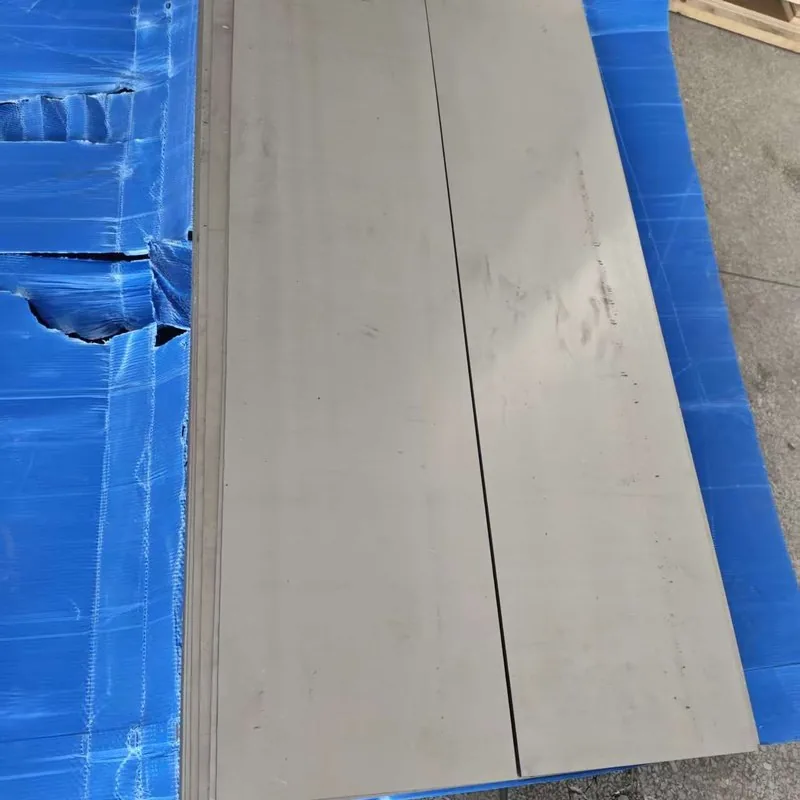
Urea-grade 316L Mod (UNS S31603 with restricted ferrite) and 25-22-2 (UNS S31050) are the two alloys that carry the wetted high-pressure circuit of a urea plant — the reactor lining, the stripper tubes, the carbamate condenser and the high-pressure pipework — because the process fluid is ammonium carbamate at 180-200 °C, which dissolves the protective oxide film on ordinary stainless steel and then attacks the iron selectively. A general-purpose 316L plate and a urea-grade 316L Mod plate carry the same UNS number and are not interchangeable: the urea grade adds limits on carbon, silicon, molybdenum, nitrogen and delta ferrite that the general specification does not contain, and those limits are what make the difference between a ten-year lining and a two-year one.
This guide explains what makes carbamate so aggressive, which alloy is used in which part of the plant, what the "Mod" restrictions actually are, and how a heat is qualified before it is released to the fabricator. For the underlying stainless grades, see 316L Stainless Steel and the stainless and duplex family overview.
Why is urea service different from ordinary stainless steel service?
Ammonium carbamate (NH4COONH2) is not an acid and not a chloride. It attacks stainless steel by a mechanism that the usual corrosion criteria do not describe:
| Condition in the urea circuit | What it does to stainless steel | Consequence for selection |
|---|---|---|
| Ammonium carbamate at 180-200 °C | Strips the passive film and dissolves iron preferentially | Alloy must be able to re-passivate, or must not rely on a passive film at all |
| High ammonia activity | Raises the pH and changes the passive film chemistry | Nickel-rich alloys behave differently from iron-based ones |
| Low oxygen content | The passive film cannot be maintained | Oxygen is injected deliberately into the CO2 feed |
| Water content 0.3-0.5 % | Dilutes the carbamate but does not stop the attack | Water content is a design variable, not a safety margin |
| No chlorides present | Chloride pitting and SCC criteria do not apply | PREN is not the right selection parameter here |
| High flow velocity in stripper tubes | Removes corrosion product and exposes fresh metal | Tube alloy and velocity limit must be considered together |
The last row is the one that catches out engineers transferring experience from other plants. In the urea stripper, the falling film inside the tube is travelling fast enough that a corrosion product layer cannot protect the wall. That is why the stripper tube is almost always made of the highest-grade alloy in the plant, and why it is usually replaced on a campaign basis rather than on condition.
Which alloy is used in which urea plant component?
| Component | Typical alloy | Why this alloy |
|---|---|---|
| Urea reactor lining (HP) | 316L Mod (S31603), 25-22-2 (S31050) | Carbamate resistance at 185-200 °C; 25-22-2 for the hotter designs |
| Reactor top internals | 25-22-2, zirconium | Highest temperature and the most concentrated carbamate |
| Stripper tubes | 25-22-2 (S31050) | Highest corrosion severity in the plant, high velocity, thin wall |
| Stripper shell | 316L Mod, 25-22-2 | Lower severity than the tubes |
| Carbamate condenser tubes | 316L Mod, 25-22-2 | Carbamate in condensing service |
| High-pressure pipework and fittings | 316L Mod | Thick section, lower velocity |
| High-pressure valves and pump bodies | 316L Mod, 25-22-2 | Static carbamate contact |
| Medium-pressure decomposer and heater | 316L, 316L Mod | Recovered carbamate, lower temperature |
| Low-pressure sections, condensate | 316L, duplex 2205 (S32205) | Cooling-water-side chlorides become the controlling condition |
| Cooling water exchangers | 2205, 316L, titanium | Chloride pitting, not carbamate |
| Urea product handling, prilling | 316L, 304L | Benign, wear-driven |
The pattern to notice is that the high-pressure carbamate circuit and the cooling-water side are two separate material problems in the same plant. 25-22-2 is chosen for carbamate resistance and has no particular advantage in cooling water; 2205 duplex is chosen for chloride resistance and must not be used in the high-pressure carbamate circuit. A material list that mixes the two up is one of the most common technical errors in urea project reviews.
What does "316L Mod" actually change?
A general-purpose 316L plate and a urea-grade 316L Mod plate share the UNS number S31603. The urea grade is a licensor specification written on top of the ASTM product standard, and it changes five things:
| Element or property | General-purpose 316L | Urea-grade 316L Mod | Why it matters |
|---|---|---|---|
| Carbon | ≤ 0.030 % | ≤ 0.020 % | Lower carbon reduces sensitisation during fabrication |
| Silicon | ≤ 0.75 % | Typically ≤ 0.50 % | Silicon promotes sigma and ferrite formation |
| Molybdenum | 2.00-3.00 % | Typically 2.20-2.80 %, restricted range | Molybdenum drives ferrite; a wide range is unpredictable |
| Nitrogen | ≤ 0.10 % | Restricted, typically ≤ 0.020 % | Nitrogen stabilises austenite but affects re-passivation |
| Delta ferrite | Not specified | Typically ≤ 0.6 %, often ≤ 0.3 % in weld metal | Ferrite is attacked preferentially in carbamate service |
| Corrosion acceptance | Not required | Huey test and metallographic examination required | A heat inside the chemistry range can still fail the test |
Two consequences follow. First, **a general 316L plate cannot be substituted for a urea-grade plate even though the certificate looks correct** — the UNS number matches and the delivery condition matches, but the ferrite content and the corrosion test result are what the plant depends on. Second, **the weld metal matters as much as the plate**, because the filler metal has its own ferrite content and its own corrosion performance. Urea-grade welding consumables are matched to the parent metal, and weld procedure qualification includes the same corrosion test applied to a welded specimen.
The ASTM product standards cited for this material are ASTM A240 for plate, ASTM A312 for pipe, ASTM A269 for tube and ASTM A182 for forged fittings, with the licensor's supplementary requirements added as purchase-order clauses.
When is 25-22-2 worth the extra cost over 316L Mod?
25-22-2 — also written X1CrNiMoN25-22-2, EN 1.4466 and UNS S31050 — is a high-chromium, high-nickel, nitrogen-bearing austenitic grade with roughly 25 % chromium, 22 % nickel and 2 % molybdenum. The comparison with 316L Mod is not a matter of price alone:
| Property | 316L Mod (S31603) | 25-22-2 (S31050) |
|---|---|---|
| Chromium | 16.5-18.5 % | 24.0-26.0 % |
| Nickel | 11.0-14.0 % | 21.0-23.0 % |
| Molybdenum | 2.20-2.80 % | 2.00-3.00 % |
| Nitrogen | Restricted, ≤ 0.020 % | 0.10-0.16 % |
| Pitting resistance equivalent | roughly 24-26 | roughly 31-33 |
| Practical carbamate limit | to about 190 °C | to about 210 °C and to higher oxygen demand |
| Relative material cost | 1.0 | typically 2-3 times |
| Formability and welding | Easy, widely available | Requires qualified procedures and controlled heat input |
| Typical use | Reactor lining, HP pipework, condenser tubes | Stripper tubes, reactor top internals, high-severity service |
Three rules of thumb decide the choice. Use 25-22-2 where the metal temperature in the carbamate circuit rises above about 190 °C, where the process design calls for a low oxygen content in the CO2 feed, or where the component experiences high carbamate velocity — which is the stripper tube in almost every modern design. Use 316L Mod for everything else in the high-pressure circuit, including the reactor lining in a conventional design. Do not use either alloy where the controlling condition is chloride-bearing cooling water; use 2205 duplex or titanium there.
Zirconium is the other material that appears in urea plants, in the reactor top internals and in some stripper liners. It is effectively immune to carbamate attack, but it is expensive, it has a low allowable stress, and it is difficult to weld, so it is confined to the small high-severity areas where the stainless grades cannot be made to last.
How is urea-grade material qualified before release?
Chemistry alone does not release a heat. The qualification package normally contains:
| Test | Method | What it proves |
|---|---|---|
| Huey test | ASTM A262 Practice C, boiling nitric acid | Resistance to intergranular attack and to selective dissolution; five 48-hour periods are standard |
| Strauss test | ASTM A262 Practice E, copper sulphate / sulphuric acid | Susceptibility to sensitisation after a sensitising heat treatment |
| Delta ferrite | Magnetic measurement or metallographic point count | Ferrite content of parent metal and of weld metal |
| Chemical analysis | Heat analysis, including nitrogen | Confirms the restricted urea-grade ranges |
| Grain size | ASTM E112 | Consistency of the solution annealing treatment |
| Metallographic examination | Cross-section of the corrosion specimen | Detects sigma phase and carbide precipitation |
| Intergranular corrosion of welded joint | Same corrosion test on a welded specimen | Confirms the filler metal as well as the plate |
The acceptance rate is set by the licensor and typically falls in the 0.3-0.6 mm/year band for 316L Mod and lower for 25-22-2, but the number that matters is the one written in the project specification. Two heats with identical chemistry can produce very different Huey rates depending on the solution annealing treatment, which is why the test is applied to the finished product and not to a sample of the heat.
Where duplex is used in the downstream sections, it is qualified differently — the ASTM A923 method and the ASTM G48 pitting test are the relevant ones, not the Huey test.
What should a urea project material order contain?
- **Alloy and UNS number**, with the licensor specification identified, for example "316L Mod to Stamicarbon specification". The UNS number alone is not sufficient.
- **Product standard and edition**, for example ASTM A240 for plate or ASTM A213 for seamless tube.
- **Restricted chemistry ranges** written out in full, not by reference, so that the mill does not fall back to the standard range.
- **Delta ferrite limit** for parent metal and for weld metal, with the measurement method.
- **Corrosion test** with the method, the number of periods and the acceptance rate.
- **Heat treatment condition** — solution annealed, with the temperature range and the cooling method stated.
- **Surface condition**: pickled and passivated, or machined.
- **Certification**: EN 10204 3.1 as standard, with third-party inspection available on request.
- **Traceability**: heat number on every piece, and the corrosion test result traceable to that heat.
Urea plant alloys from Hangbo Alloy
Hangbo Alloy supplies urea-grade and general-purpose austenitic stainless steel for urea plants: 316L and 316L Mod plate, sheet, seamless tube, pipe and forgings, 25-22-2 (UNS S31050, EN 1.4466) plate, tube and bar, and 2205 duplex plate, tube and bar for the low-pressure and cooling-water sections, together with the matching urea-grade welding consumables.
Urea-grade material is supplied with restricted chemistry documented per heat, a delta ferrite result and a corrosion test report, and with the heat number traceable to every piece. Certification is EN 10204 3.1 as standard, with third-party inspection available on request.
Send us the licensor specification, the component, the design temperature and the corrosion acceptance rate, and we will confirm the alloy, the heat treatment and the test package before the order is placed.
Continue reading
- API 6A Wellhead Alloys: 718, 625 and 925API 6A wellhead alloys: how PSL level, temperature class and sour service decide between Inconel 718, 625 and
- Alloys for Wet FGD Scrubbers and AbsorbersWet FGD scrubber alloy selection: which alloy for absorber walls, spray headers and dampers at chloride levels
- Which Alloy for a High-Temperature Furnace? 600 °C to 1250 °CFurnace alloy selection by service temperature and atmosphere — oxidation, carburisation and sulphidation — wi
- Which Alloys Comply with NACE MR0175 for Sour Service?NACE MR0175 / ISO 15156 sour service alloy selection — what counts as sour, which nickel alloys are pre-qualif
- Alloys for Polysilicon and Semiconductor PlantsPolysilicon and semiconductor plant alloy selection: reduction furnace bells, CVD liners and ultra-high-purity
- All 7 Corrosion & Grade Selection guides
Frequently asked questions
Can general-purpose 316L be used instead of 316L Mod in a urea plant?
No, not in the high-pressure carbamate circuit. The two materials share the UNS number S31603 but the urea grade restricts carbon, silicon, molybdenum and nitrogen and caps the delta ferrite content, then requires a corrosion test on the finished product. A general-purpose plate can be inside every chemistry limit of ASTM A240 and still show a ferrite content or a Huey rate that would fail the plant's acceptance criteria.
Why does a urea plant inject oxygen into the CO2 feed?
Because the corrosion resistance of the stainless steel depends on a passive film that only exists when an oxidising species is present. Ammonium carbamate removes that film when there is no oxygen, and the metal then dissolves. Adding a small amount of oxygen to the CO2 maintains the passive state; the required oxygen level is one of the design parameters that decides whether 316L Mod is sufficient or 25-22-2 is needed.
Is duplex 2205 suitable for the urea reactor?
No. Duplex 2205 is a good choice for the cooling-water side and for low-pressure sections where chlorides are the controlling condition, but it is not the material for the high-pressure carbamate circuit. Its ferrite content, which is what gives duplex its strength and chloride resistance, is precisely the phase that carbamate attacks.
How often do urea stripper tubes need replacing?
It depends on the alloy and on the operating oxygen level, but the stripper tube is the shortest-lived item in the plant and is normally replaced at planned turnarounds rather than on condition. Plants running 316L Mod tubes in aggressive conditions see far shorter lives than plants with 25-22-2 tubes, which is why the stripper tube alloy is one of the first decisions made in a urea revamp.