
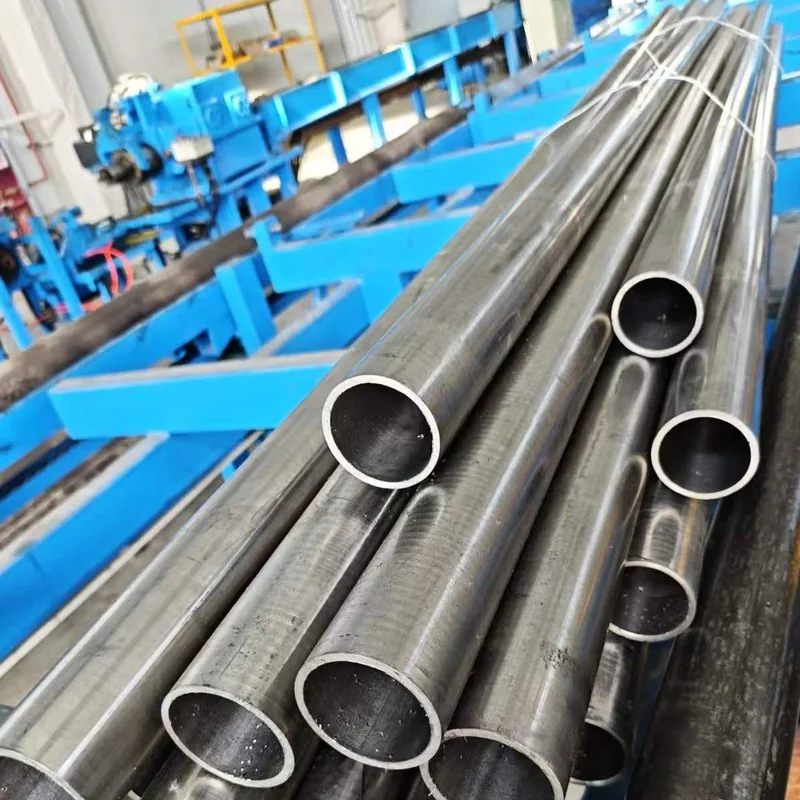
A wet flue gas desulfurization (FGD) absorber is a chloride problem rather than an acid problem: the limestone or lime slurry is recirculated from the sump through the spray headers and back again, so chlorides concentrate to 20,000-80,000 ppm while the pH is held at 5.0-5.8 to absorb sulphur dioxide, and it is that combination — high chloride, mildly acidic pH and a wall temperature of 50-60 °C — that destroys 316L. The materials that survive it are 2205 duplex (UNS S32205) to roughly 30,000 ppm, 2507 super duplex (UNS S32750) and 904L (UNS N08904) above that, and Hastelloy C-276 (UNS N10276) or titanium where the chloride level passes about 60,000 ppm or where fluorides are present alongside the chlorides.
This guide covers the corrosion mechanisms inside a wet scrubber, how the chloride level and the pH narrow the alloy choice, which alloy is used for which component, and what the critical pitting temperature test actually tells you that the grade name does not. For the chloride-stress-corrosion side of the same problem, see Seawater and Chloride Alloy Selection.
What actually corrodes in a wet FGD absorber?
Four mechanisms run at once, and they are not ranked the same way as in a chemical plant:
| Mechanism | Where it occurs | What it looks like | Controlling variable |
|---|---|---|---|
| Chloride pitting | Below the slurry line, under scale, in crevices | Discrete pits, then perforation | Chloride concentration, temperature |
| Crevice corrosion | Flange faces, under deposits, at support welds | Localised deep attack in a shielded area | Chloride, oxygen access, geometry |
| Chloride stress corrosion cracking | Above the slurry line and at welds, in the vapour space | Through-wall cracks, often near a weld | Chloride, temperature above about 60 °C, tensile stress |
| Erosion-corrosion | Spray header nozzles, pump impellers, recirculation pipe | Thinning rather than pitting | Velocity, solids content, pH |
The vapour space above the slurry line is often the more dangerous location than the slurry itself, because the slurry splashes and dries there, leaving a concentrated chloride film on a warm wall that is also carrying residual fabrication stress. This is why the upper part of an absorber and the inlet duct are frequently specified in a higher alloy than the sump.
Fluoride is the hidden variable. Where the coal or the limestone carries fluorine, the fluoride ion forms hydrofluoric acid in the acidic slurry, and fluorides attack the passive film of stainless steel and titanium in a way that chlorides do not. A material selection made on the chloride analysis alone can therefore be wrong at the same plant within a year of a fuel change.
How does the chloride level decide the alloy?
The table below is the practical version used in FGD material selection. It assumes a wall temperature of 50-60 °C and a pH between 5.0 and 5.8; both variables have to be checked before the table is applied.
| Chloride in slurry | Alloy for the wetted surface | Notes |
|---|---|---|
| Below 2,000 ppm | 316L (S31603) | Benign, closed-loop, clean limestone |
| 2,000-10,000 ppm | 316L, 904L (N08904) | 316L acceptable if pH is controlled and no fluorides |
| 10,000-30,000 ppm | 2205 duplex (S32205) | The standard modern choice for mid-range chloride |
| 30,000-60,000 ppm | 2507 super duplex (S32750), 904L | 904L where welding is difficult, 2507 where strength is wanted |
| Above 60,000 ppm | Hastelloy C-276, C-22, titanium Gr2 | C-family also covers fluorides; titanium does not |
| Fluoride present with any chloride | Hastelloy C-276 or C-22 | Titanium and stainless steel are both unsuitable |
| Absorber wall (large area) | Carbon steel with C-276 or titanium clad | Solid alloy is rarely economic at this area |
| Spray header and nozzles | C-276, 2507, SiC or ceramic-lined | Erosion as well as corrosion |
| Outlet duct, stack, bypass | 316L with C-276 wallpaper at the wet zone | Condensation zone is the risk |
Two practical points follow. First, the chloride level is a design input that moves: the water balance of the plant is set by the gypsum dewatering and the wastewater treatment, and a plant that adds a wastewater treatment step will often allow the chloride level to rise, which changes the correct alloy. Second, the wall temperature is not the flue gas temperature: the wetted wall of a spray absorber sits within a few degrees of the slurry, while an uninsulated duct above the slurry line can be cold enough to condense acid or warm enough to concentrate chlorides, depending on the season.
Which alloy for which FGD component?
| Component | Typical material | Why |
|---|---|---|
| Absorber shell, below slurry line | Carbon steel + C-276 or titanium clad / wallpaper | Large area, uniform wetting, corrosion allowance available |
| Absorber shell, upper zone | Carbon steel + C-276 wallpaper, or solid 2205 | Splash and vapour-zone concentration |
| Inlet duct, wet-dry interface | C-276, 2507, or flake-glass lining | Worst combination of temperature, chloride and stress |
| Spray headers and branches | C-276, 2507, FRP with lined bore | High velocity, erosion plus corrosion |
| Nozzles | SiC, ceramic, C-276 | Wear-dominated |
| Oxidation air spargers | C-276, 2507 | High velocity in a saturated chloride solution |
| Mist eliminator | Polypropylene, FRP, 316L for the frame | Mostly non-metallic |
| Recirculation pumps and impellers | 2507, C-276, rubber-lined | Erosion-corrosion |
| Agitator shafts and blades | 2507, C-276 | Bending load plus corrosive slurry |
| Damper and bypass duct | 316L with C-276 trim, or C-276 | Thermal cycling and condensation |
| Gypsum dewatering, hydrocyclone | 316L, 2205 | Lower chloride, abrasion is the driver |
| Flue gas reheater tube | 316L, 2205, C-276 at the cold end | Acid condensation at the cold end |
Why is the absorber wall clad rather than solid alloy?
Because the economics of a wet scrubber are dominated by area. A 600 MW absorber shell can present several thousand square metres of wetted surface, and the wall thickness is set by structural and pressure considerations rather than by a corrosion allowance. Making that shell from solid C-276 is not affordable in most projects; making it from carbon steel with a 1.5-2.0 mm C-276 or titanium corrosion barrier is.
Three wall construction options compete:
- 1. **Roll-bonded clad plate.** The nickel alloy or titanium layer is metallurgically bonded to the carbon steel during rolling. This is the highest-integrity option and the most expensive, and it is used where the pressure boundary must be fully reliable and the wall cannot be inspected easily.
- 2. **Wallpapering.** Thin alloy sheet is welded to the carbon steel wall, with a fillet weld at the edges and often a leak-detection groove. This is the common solution for absorber shells because it can be installed on site and repaired locally.
- 3. **Organic lining.** Flake glass, rubber or vinyl ester lining on carbon steel. Cheapest, but permeable over time, sensitive to surface preparation and to temperature limits.
The choice between them is driven by whether a barrier failure is tolerable. Wallpaper and organic linings are acceptable where a failure produces localised corrosion that is found at the next inspection; a roll-bonded clad is used where the barrier is the only thing between the slurry and a structural wall that will not tolerate chloride attack at all. For the general plate product standards behind these materials, see Nickel Alloy Plate and Sheet.
What does the corrosion test show that the grade name does not?
The pitting resistance equivalent number is a ranking device, not a test. It is calculated from chromium, molybdenum and nitrogen, and it produces the same number for alloys with very different real behaviour. The critical pitting temperature per ASTM G48 is the measured version:
| Alloy | Typical PREN | Typical CPT in ASTM G48 Method E | Comment |
|---|---|---|---|
| 316L (S31603) | 24-26 | 20-25 °C | Below normal absorber temperature |
| 904L (N08904) | 34-36 | 40-50 °C | Borderline at high chloride |
| 2205 duplex (S32205) | 34-36 | 45-60 °C | Same PREN as 904L, higher measured CPT |
| 2507 super duplex (S32750) | 42-44 | 80-90 °C | Comfortable margin at moderate chloride |
| 254SMO (S31254) | 43-45 | 80-90 °C | — |
| Titanium Grade 2 (R50400) | not applicable | above 100 °C | Immune to chloride pitting, vulnerable to fluoride |
| Hastelloy C-276 (N10276) | 68-70 | above 110 °C | No pitting in the standard test |
| Hastelloy C-22 (N06022) | 65-68 | above 110 °C | Better oxidising-acid resistance than C-276 |
Two alloys with a PREN of 35 can differ by 15 °C in measured critical pitting temperature, which is the whole margin in a scrubber that runs at 55 °C. This is why a defensible material selection for an FGD project should be supported by a measured CPT rather than by a calculated PREN, and why the CPT is worth writing into the purchase specification as an acceptance criterion. The chromium-molybdenum alloy plate and tube for these duties is ordered under ASTM B575 for plate and ASTM B622 or ASTM B626 for tube, while the duplex and super duplex grades are ordered under ASTM A240 for plate and ASTM A789 for tube.
What should a wet FGD material specification contain?
- **Chloride, fluoride and pH ranges**, not a single design point, together with the wall temperature range for each zone of the absorber.
- **Alloy and UNS number** for each zone, with the standard, for example "Hastelloy C-276, UNS N10276, ASTM B575".
- **Corrosion acceptance**: critical pitting temperature per ASTM G48 Method E, and for duplex the ASTM A923 intermetallic phase test.
- **Wall construction**: roll-bonded clad, wallpaper, or solid, with the bond shear test requirement if clad.
- **Weld consumables** matched to the base material, and the corrosion test applied to a welded specimen where the alloy is at the FGD limit.
- **Surface condition**: pickled and passivated, with the maximum surface iron contamination stated.
- **Fabrication controls**: no weld spatter left in place, no carbon steel tooling used on the alloy surface, and no grinding wheels shared between carbon steel and alloy work.
- **Certification**: EN 10204 3.1 as standard, with third-party inspection available on request.
The last group of clauses is not administrative. In FGD work the most common cause of early corrosion is not the wrong alloy but contamination during fabrication — iron particles embedded in a passivated surface rust and start a pit that then spreads under the lining.
FGD alloys from Hangbo Alloy
Hangbo Alloy supplies the corrosion-resistant materials for wet FGD absorbers, ducts, spray headers and dampers: Hastelloy C-276, C-22 and C-2000 plate, sheet, tube, pipe, bar and forgings, 2205 duplex and 2507 super duplex plate, sheet, tube and bar, 904L and 316L plate and tube, and titanium Grade 2 for wallpaper and tube applications, together with the matching welding consumables.
Alloy plate and tube are supplied solution annealed and pickled, with critical pitting temperature testing and intermetallic phase testing available as part of the release package, and with EN 10204 3.1 certification as standard and third-party inspection available on request.
Send us the chloride and fluoride analysis, the pH, the zone temperatures and the wall construction you intend to use, and we will confirm the alloy, the corrosion acceptance criteria and the test package before the order is placed.
Continue reading
- Which Alloy for a High-Temperature Furnace? 600 °C to 1250 °CFurnace alloy selection by service temperature and atmosphere — oxidation, carburisation and sulphidation — wi
- Which Alloys Comply with NACE MR0175 for Sour Service?NACE MR0175 / ISO 15156 sour service alloy selection — what counts as sour, which nickel alloys are pre-qualif
- Alloys for Polysilicon and Semiconductor PlantsPolysilicon and semiconductor plant alloy selection: reduction furnace bells, CVD liners and ultra-high-purity
- Which Alloy Resists Seawater Best? 316L to TitaniumSeawater corrosion alloy selection ranked by pitting resistance equivalent number and critical pitting tempera
- Urea Plant Alloys: 316L Mod, 25-22-2 and DuplexUrea plant alloy selection: how carbamate corrosion decides between 316L Mod, 25-22-2 and duplex stainless for
- All 7 Corrosion & Grade Selection guides
Frequently asked questions
Can 316L be used in a wet FGD absorber?
Only in the low-chloride, well-controlled cases — typically below about 10,000 ppm with a stable pH and no fluorides. Above that the chloride pitting and crevice corrosion rate on 316L is unacceptable, and the vapour zone above the slurry line becomes a chloride stress corrosion cracking risk because the wall temperature is in the sensitive range. The realistic upgrade for mid-range chloride is 2205 duplex, not a thicker 316L wall.
Why is titanium not the default choice for an FGD absorber?
Titanium is excellent against chlorides and is widely used for wallpaper, but it is attacked by fluoride ions, which are present in many coals and limestones, and it cannot tolerate dry, hot conditions where it can absorb hydrogen and become brittle. Where fluorides are present, the C-family alloys are the safer choice despite the higher cost.
What is the difference between wallpapering and clad plate?
Wallpapering welds a thin sheet of alloy to the carbon steel wall with fillet welds and relies on the sheet as a barrier; it is more tolerant of site conditions and easier to repair. Roll-bonded clad plate bonds the alloy to the steel during rolling so the two act as one plate; it has higher integrity and is used where a barrier leak would not be detectable. Wallpaper is the usual choice for large absorber shells.
Does a wet FGD scrubber need a corrosion allowance on the carbon steel?
The structural carbon steel behind a corrosion barrier normally does not need a corrosion allowance, because the barrier is what resists the slurry and the steel is protected from it. However, the vapour space, the wet-dry interface and the areas around penetrations are often left with an allowance because barrier damage there is the most likely to go unnoticed.