
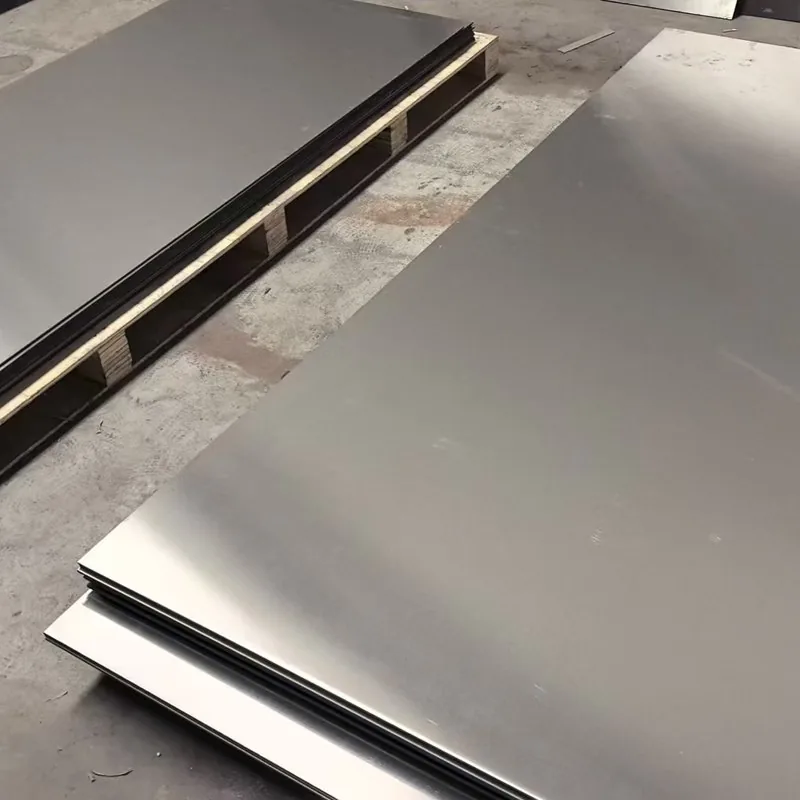
Hydrogen production by water electrolysis splits into two technology families whose material requirements have almost nothing in common. **An alkaline electrolyser runs in 25 to 35 % potassium hydroxide at 60 to 90 °C** on nickel-based electrodes, while **a PEM electrolyser runs in an acidic perfluorosulphonic acid membrane at 60 to 80 °C** with an anode held at a strongly oxidising potential. **Nickel 201 (UNS N02201), Monel 400 (UNS N04400), Inconel 625 (UNS N06625) and 316L (UNS S31603)** are the four materials that come up in almost every electrolyser specification, and knowing which one belongs in which circuit is most of the engineering.
This guide sets out what each environment does to metal, which alloy goes where in an alkaline stack and in a PEM stack, why nickel 201 is preferred over nickel 200 in hot caustic, and which standards an electrolyser plate, tube or fittings order has to name. For the plate product forms themselves, see Nickel Alloy Plate and Sheet Specification.
What does an electrolyser environment actually do to metals?
| Factor | Alkaline stack | PEM stack |
|---|---|---|
| Electrolyte | 25 to 35 % KOH | Acidic ion-conducting membrane, effective pH around 2 |
| Temperature | 60 to 90 °C | 60 to 80 °C |
| Cathode environment | Hydrogen evolution, reducing | Hydrogen evolution at high current density, reducing |
| Anode environment | Oxygen evolution, oxidising but alkaline | Oxygen evolution at high anodic potential, strongly oxidising and acidic |
| Dominant metal failure mode | Caustic corrosion, iron and copper contamination, crevice attack at gaskets | Dissolution of the anode substrate, fluoride attack, poisoning of the catalyst and membrane |
| Materials that survive it | Nickel and nickel alloys, austenitic stainless with limits | Titanium and precious-metal-coated titanium on the anode side |
| Sensitivity to impurities | Moderate; carbonate formation from CO₂ ingress | High; metal ions poison the membrane irreversibly |
The critical asymmetry is the anode. In alkaline electrolyte, nickel forms a stable oxyhydroxide surface and is in fact the catalyst for the oxygen evolution reaction, which is why the same metal is both the structure and the active surface. In the acidic PEM environment, nickel dissolves at the anode potential, which is why the anode side of a PEM stack is titanium with an iridium oxide coating and not nickel at all. Nickel alloys do not disappear from a PEM plant — they move into the balance of plant, where the environment is water, hydrogen and caustic rather than hot acid.
The impurity sensitivity of the PEM side has a direct procurement consequence. Trace metal ions released by a corroding pipe, valve or fitting upstream of the stack will exchange into the membrane and reduce its conductivity permanently. That is why PEM water loops are specified in electropolished 316L or a nickel alloy rather than in whatever is cheapest, and why copper-containing alloys are excluded from the circuit entirely.
Which alloy goes where in an alkaline stack?
| Component | Material normally specified | Why | Product standard |
|---|---|---|---|
| Cathode electrode mesh and perforated sheet | Nickel 200 or 201 | Stable in caustic, catalytically active for hydrogen evolution | ASTM B162 |
| Anode electrode mesh | Nickel 200 or 201, sometimes with a catalytic coating | Stable oxyhydroxide surface in alkaline oxygen evolution | ASTM B162 |
| Bipolar plate | Nickel 200 or 201 plate, or nickel-plated steel | Conductive, stable, and weldable into the stack frame | ASTM B162 |
| Cell frame and end plate | 316L, or nickel-plated carbon steel | Mechanical duty, moderate corrosion duty | ASTM A240 |
| Electrolyte circulation pipe | 316L, upgrading to nickel 200 in the hot return | Temperature and concentration decide it | ASTM A312, ASTM B161 |
| Gas-liquid separators | 316L | Moderate temperature, alkaline | ASTM A240 |
| Caustic storage and make-up tanks | 316L at ambient, nickel 201 where concentrated and hot | Caustic cracking risk on stainless at high temperature | ASTM A240, ASTM B162 |
| Heat exchangers | 316L, Inconel 625 where the cooling water is seawater or brackish | Chloride on the cooling side is the usual reason to upgrade | ASTM B444 |
| Bolting | 316L or Inconel 625 | Relaxation and galling on nickel-plated threads | ASTM B446 |
The table has one recurring theme: the material changes with temperature and concentration, not with the electrolyte name. The same KOH that 316L handles at 40 °C will attack it in a hot concentrated evaporator section, which is where nickel 201 takes over.
Which alloy goes where in a PEM stack and its balance of plant?
| Component | Material normally specified | Why |
|---|---|---|
| Anode porous transport layer | Titanium, sintered or felt, with iridium oxide coating | The only substrate stable at the acidic anode potential |
| Cathode gas diffusion layer | Carbon paper or cloth with platinum on carbon | Conductive and stable in the reducing hydrogen environment |
| Anode bipolar plate | Coated titanium, or coated stainless in some designs | Must survive acid plus high potential plus fluoride |
| Cathode bipolar plate | Coated titanium, coated stainless, or carbon composite | Reducing side is less aggressive but still acidic |
| Stack frame and end plate | 316L, sometimes coated | Structural duty outside the active cell |
| Feed water and cooling loop | Electropolished 316L | Any released ion poisons the membrane |
| Hydrogen drying and purification | 316L, Inconel 625 where the duty is hot or cyclic | Hydrogen embrittlement and thermal cycling |
| Oxygen handling | 316L, clean and oil-free | Oxygen service cleaning applies |
| Balance-of-plant heat exchangers | Inconel 625 or titanium grade 2 on the water side | Cooling water chemistry decides it |
The honest summary for a nickel alloy supplier is that the PEM stack interior is titanium territory, and the nickel alloy content of a PEM plant sits in the balance of plant: the water treatment loop, the hydrogen conditioning, the heat exchangers and the instrumentation. Buyers who approach a nickel mill expecting to supply a PEM stack are usually working from an alkaline bill of materials, and the clarification is worth making early.
Why is nickel 201 preferred over nickel 200 in hot caustic?
Because of carbon. Nickel 200 allows up to 0.15 % carbon and nickel 201 is restricted to about 0.02 %, and above roughly 315 °C that carbon precipitates as graphite at the grain boundaries, embrittling the metal. The mechanism is slow, cumulative and invisible from the outside until a component cracks, which is why the codes restrict nickel 200 in high-temperature caustic service and why nickel 201 is the specified grade in evaporators, concentrators and hot caustic lines.
| Attribute | Nickel 200 (N02200) | Nickel 201 (N02201) |
|---|---|---|
| Maximum carbon | 0.15 % | 0.02 % |
| Behaviour in caustic above about 315 °C | Intergranular graphitisation, embrittlement | Stable |
| Room-temperature strength | Marginally higher | Marginally lower |
| Typical service limit in caustic | Below about 315 °C | Up to about 600 °C in dry caustic |
| Cost | Lower | Slightly higher |
| Where it is specified | Electrodes, cold caustic equipment | Hot concentrated caustic, evaporators, welded assemblies that will be stress relieved |
At the 60 to 90 °C of an alkaline stack, graphite formation is not a mechanism that operates, so nickel 200 electrodes are entirely normal and are in fact the common choice. Nickel 201 is specified where the assembly will be stress relieved after welding at a temperature that would embrittle 200, and in the hotter upstream or downstream sections of the plant. The specification rule that avoids the argument is simple: state the grade you want, and if the part will be heated above about 315 °C in service or in fabrication, state 201.
Where is Monel 400 used, and where should it not be?
Monel 400 (UNS N04400) is excellent in reducing acids and in caustic at all concentrations, and it resists chloride stress corrosion cracking far better than 304 or 316 stainless. Those properties make it a strong candidate for caustic handling, for the alkaline side of an electrolyser plant, and for any section where cooling water or feed water carries chloride.
It has two hard limits in this industry:
| Limit | What happens | Practical rule |
|---|---|---|
| Oxidising acids and oxidising salts | Rapid attack; Monel is not an oxidising-acid alloy | Do not use in nitric acid, ferric or cupric salt solutions, or in the acidic PEM loop |
| Copper in a PEM circuit | Dissolved copper exchanges into the membrane and poisons the catalyst | Keep Monel out of any line feeding a PEM stack |
| Ammonia and amine environments | Stress corrosion risk under some conditions | Check the chemistry before specifying |
The copper point is a procurement trap rather than a metallurgical one. Monel is a nickel-copper alloy, and a plant that specifies it for a caustic tank on the alkaline side and then reuses the same specification detail on a shared water loop can contaminate the PEM side of the site through a line that nobody thought connected. Where a plant runs both technologies, the material specification is worth writing per circuit.
Where does Inconel 625 earn its cost in an electrolyser plant?
| Location | Duty | Why 625 and not 316L |
|---|---|---|
| Heat exchangers on seawater or brackish cooling | Chloride plus temperature | 316L pits and crevice-corrodes; 625 does not |
| Valves, bellows and flexible sections in hydrogen service | Pressure cycling plus vibration fatigue | Higher fatigue strength and no hydrogen embrittlement issue |
| Acidic or fluoride-containing process sections | Acid plus halide | 625 covers both; stainless does not |
| High-pressure hydrogen piping above about 100 bar | Hydrogen plus pressure | Austenitic and nickel alloys resist hydrogen embrittlement far better than ferritic or martensitic steel |
| Bolting in hot alkaline flanges | Relaxation and galling | Higher strength retention and better galling behaviour than stainless on stainless |
| Instrument and sample lines | Small bore, vibration, mixed chemistry | The cost of a failure dwarfs the cost of the tube |
Hydrogen embrittlement deserves one clear statement, because it is widely misunderstood. Fully austenitic stainless steels and the nickel alloys are substantially resistant to hydrogen embrittlement at electrolyser pressures, which is why 316L and Inconel 625 are the standard high-pressure hydrogen materials. Ferritic and martensitic steels, and high-strength quenched and tempered bolts, are not, and are the materials that fail in hydrogen service. Titanium sits in between: it forms hydrides under cathodic charging, which is why titanium bipolar plates in PEM stacks are coated rather than bare.
Which standards apply to electrolyser plate, tube and fittings?
| Product | Standard | Typical electrolyser use |
|---|---|---|
| Nickel plate, sheet and strip | ASTM B162 | Electrodes and bipolar plates |
| Nickel seamless pipe and tube | ASTM B161 | Hot caustic lines |
| General requirements for nickel plate | ASTM B906 | The supplementary requirements on an electrode plate order |
| Monel 400 plate, sheet and strip | ASTM B127 | Caustic tanks and vessel internals |
| Monel 400 seamless pipe and tube | ASTM B165 | Caustic and reducing-acid lines |
| Inconel 625 plate, sheet and strip | ASTM B443 | Heat exchanger and vessel plate |
| Low-carbon nickel-chromium-molybdenum plate | ASTM B575 | Acidic sections |
| Inconel 625 seamless pipe and tube | ASTM B444 | High-pressure hydrogen and hot process lines |
| Inconel 625 bar | ASTM B446 | Bolting and machined parts |
| Nickel alloy fittings | ASTM B366 | Elbows, tees and reducers, per ASTM B366 Nickel Alloy Pipe Fittings |
| 316L plate, sheet and strip | ASTM A240 | Frames, tanks, separators |
| 316L pipe | ASTM A312 | Water and electrolyte loops |
| Intergranular corrosion test | ASTM G28 | Where sensitisation is a concern on the nickel alloys |
| Pitting and crevice corrosion test | ASTM G48 | Where chloride is present on the cooling side |
Electrode plate orders are the place where a generic nickel plate specification is not enough. The supplementary requirements that matter are the flatness and thickness tolerance, because a bipolar plate has to seal against a gasket over its whole area, and the surface condition, because the electrode surface is the reaction site.
What should the specification say beyond the grade?
| Requirement | Typical wording | Why it is needed |
|---|---|---|
| Thickness tolerance | Stated as a tolerance band, not a nominal thickness | A bipolar plate that is thin at one corner leaks |
| Flatness | Maximum deviation over a stated gauge length | Stack sealing depends on it |
| Surface finish | As-rolled, ground, or a stated roughness value | The electrode surface is the reaction site |
| Chemistry restriction | Low-carbon grade where the part is heated | Prevents graphitisation on nickel 200 |
| Grain size | Where the part is deep drawn or spun | Controls orange peel and earing |
| Iron contamination | Free-iron test, or a dedicated fabrication line | Iron on a nickel surface becomes a corrosion site |
| Corrosion test | ASTM G28 or G48 where the duty justifies it | Proves the heat, not just the chemistry |
| PMI | On finished parts, with the element set stated | The only defence against mixed material |
| Certificate | EN 10204 3.1, heat number traceable | The project default |
Iron contamination is specific to nickel and is worth a sentence of explanation. A nickel plate cut on a shared shear, or handled with carbon steel slings, picks up free iron that rusts in service and initiates pitting. It is invisible to a chemistry certificate, because the certificate describes the heat and not the surface. The fix is a dedicated handling route or a passivation step, and it is cheap to specify and expensive to discover later.
Where are nickel alloys over-specified in an electrolyser plant?
Three places, all of them common:
- **Ambient caustic storage.** 316L handles cold to warm KOH at ambient concentration perfectly well. Specifying nickel 201 for a 20 °C storage tank buys nothing measurable.
- **Structural frames and supports.** These are mechanical parts with a mild corrosion duty. 316L or a coated carbon steel is the correct answer, and nickel plate in a frame is a cost with no engineering return.
- **Long runs of feed water pipe.** Electropolished 316L is the standard for the PEM water loop. Inconel 625 is justified at the hot, acidic or chloride-contaminated points, not along the whole run.
The discipline that gets the best result is to specify the alloy per circuit and per temperature band rather than per plant, and to spend the nickel alloy budget where corrosion, temperature and cycling coincide.
Nickel alloys for electrolysers from Hangbo Alloy
Hangbo Alloy supplies nickel 200 and 201 plate, sheet and strip to ASTM B162 for electrodes and bipolar plates, nickel pipe and tube to ASTM B161, Monel 400 plate and tube to ASTM B127 and B165, Inconel 625 plate, tube and bar to ASTM B443, B444 and B446, and nickel alloy butt weld fittings to ASTM B366 — with the flatness, thickness tolerance, surface finish and low-carbon requirements stated on the order rather than left to a catalogue default.
Material is supplied with EN 10204 3.1 certification traceable to the heat, controlled handling to limit free iron on nickel surfaces, corrosion testing to ASTM G28 or G48 where the duty justifies it, and positive material identification on finished parts where the circuit demands it. Third-party inspection is available on request.
Send us the technology, the circuit, the operating temperature and the product forms, and we will confirm the grade, the standard and the test package before the order is placed.
Continue reading
- How to Specify Nickel Alloy Plate and Sheet: Standard, Condition and FinishA nickel alloy plate order is not complete until it names the product standard, the rolling condition, the thi
- How to Specify Nickel Alloy Round Bars on a Purchase OrderWhat a complete Inconel, Hastelloy or Monel round bar order must state — grade, UNS, product standard, conditi
- Inconel 718 Round Bar (φ2–600 mm): Composition, Mechanical Properties & SupplierInconel 718 round bar (N07718) supplier: composition, aged properties, sizes and tolerances. Factory price fro
- Inconel 625 Round Bar (φ2–600 mm): Composition, Mechanical Properties & SupplierInconel 625 round bar (N06625) supplier: composition, aged properties, sizes and tolerances. Factory price fro
- Hastelloy C-276 Plate & Sheet: Composition, Mechanical Properties & SupplierHastelloy C-276 plate (N10276) supplier: composition, aged properties, sizes and tolerances. Factory price fro
- All 13 Product Forms & Specifications guides
Frequently asked questions
Is nickel 200 or nickel 201 the right electrode material for an alkaline electrolyser?
Nickel 200 is the normal electrode material at stack temperature, because the graphitisation mechanism that separates it from nickel 201 only operates above roughly 315 °C and a stack runs at 60 to 90 °C. Nickel 201 is specified where the part will be stress relieved after welding at a temperature that would embrittle 200, or where it serves in a hot concentrated caustic section upstream or downstream of the stack.
Can Monel 400 be used in a PEM electrolyser circuit?
No. Monel 400 is a nickel-copper alloy and performs very well in caustic and reducing acids, but dissolved copper is a membrane and catalyst poison in a PEM stack, and Monel has poor resistance to oxidising acid. It belongs in the alkaline caustic circuits and in reducing-acid service, and it should be kept out of any line that feeds a PEM stack.
Why is titanium used instead of nickel in a PEM stack?
Because the PEM anode operates at a high oxidising potential in an acidic membrane, and nickel dissolves under those conditions. Titanium forms a stable passive oxide at that potential and is used as the porous transport layer and the bipolar plate substrate, normally with an iridium oxide or platinum-group coating. Nickel alloys appear in the PEM balance of plant — water loops, hydrogen conditioning and heat exchangers — rather than in the active cell.
Does hydrogen embrittlement affect nickel alloys in electrolyser service?
Austenitic stainless steels such as 316L and the nickel alloys are substantially resistant to hydrogen embrittlement at electrolyser pressures, which is why they are the standard materials for high-pressure hydrogen piping. The materials that fail in hydrogen service are the ferritic and martensitic steels and high-strength quenched and tempered fasteners. Titanium is a special case: it absorbs hydrogen and forms hydrides under cathodic charging, which is why titanium PEM bipolar plates are coated.