
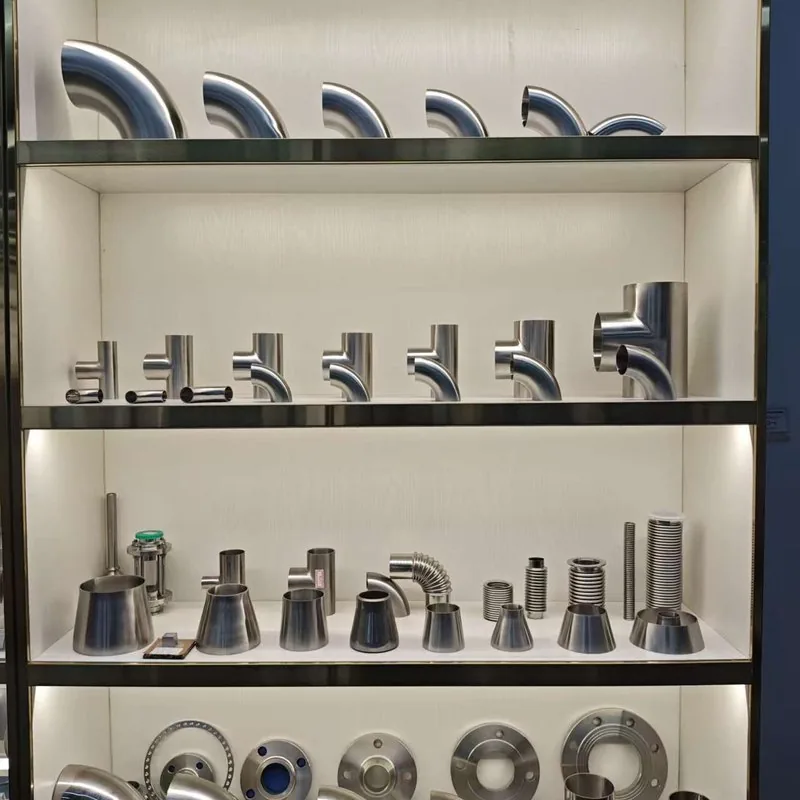
Pipe fittings are where a nickel alloy piping specification is most often compromised, because fittings are the parts that arrive without a visible heat number, in mixed sizes, from a sub-supplier rather than from the mill. **ASTM B366 (UNS N06625 and the other nickel alloys)** is the specification that covers factory-made wrought nickel and nickel alloy fittings — elbows, tees, reducers, caps, crosses and stub ends — and it is deliberately written as a material specification only. It tells the manufacturer what the alloy must be and what tests prove it; it does not tell anyone what an elbow looks like. The dimensions come from a separate standard, and the wall thickness has to be reconciled with the pipe it is welded to by the designer.
This guide sets out which grade of fitting matches which pipe grade, what the WP-S and WP-W prefixes mean in practice, how the wall thickness discipline works, and where a B366 fitting order typically goes wrong. For how fittings sit inside a complete material take-off, see Nickel Alloy Piping Grade Matching.
What does ASTM B366 cover, and what does it leave to other standards?
| Item | Covered by ASTM B366 | Covered elsewhere |
|---|---|---|
| Alloy chemistry of the fitting | Yes, by grade designation | — |
| Tensile properties at room temperature | Yes | — |
| Product analysis and test frequency | Yes | — |
| Fitting shape, centre-to-end dimensions, angularity | No | ASME B16.9 |
| Socket weld and threaded dimensions | No | ASME B16.11 |
| Thin-wall corrosion-resistant butt weld fittings | No | MSS SP-43 |
| Short radius elbows | No | ASME B16.28 |
| Wall thickness of the fitting | Partly, by reference to the matching pipe schedule | The piping class and the design code |
| Weld examination of welded fittings | Yes, as a class requirement | The project specification |
| PMI of finished fittings | Not a standard requirement | The buyer's clause |
The practical consequence of this split is that "ASTM B366" on its own is an incomplete purchasing description. A complete line item reads: 90° long radius elbow, 6 inch, schedule 40S, seamless, ASTM B366 WP625, dimensions to ASME B16.9, with PMI on the finished fitting and EN 10204 3.1 certification. Anything shorter than that leaves a decision to the supplier, and a supplier who has been left a decision will make the cheapest one that satisfies the letter of the order.
Which B366 fitting grade matches which pipe grade?
The WP prefix on a fitting grade means wrought. The number or letter that follows is the alloy, and it usually maps one to one onto the pipe grade it is welded to — a WP625 elbow belongs on an Inconel 625 (UNS N06625) pipe, a WPHC276 elbow on a Hastelloy C-276 (UNS N10276) pipe. The table below lists the grades that account for most nickel alloy fitting demand.
| Fitting grade | UNS number | Common name | Matching pipe or tube standard |
|---|---|---|---|
| WPN | N02200 | Nickel 200 | ASTM B161 |
| WPNIC | N02201 | Nickel 201 | ASTM B161 |
| WP600 | N06600 | Inconel 600 | ASTM B167 |
| WP601 | N06601 | Inconel 601 | ASTM B167 |
| WP625 | N06625 | Inconel 625 | ASTM B444, ASTM B705 |
| WP718 | N07718 | Inconel 718 | ASTM B983 |
| WP800 | N08800 | Incoloy 800 | ASTM B163, ASTM B407 |
| WP800H | N08810 | Incoloy 800H | ASTM B407 |
| WP825 | N08825 | Incoloy 825 | ASTM B423, ASTM B705 |
| WPHC276 | N10276 | Hastelloy C-276 | ASTM B622, ASTM B619 |
| WPHC22 | N06022 | Hastelloy C-22 | ASTM B622 |
| WPHB2 | N10665 | Hastelloy B-2 | ASTM B622 |
| WPHX | N06002 | Hastelloy X | ASTM B622 |
| WP20CB | N08020 | Alloy 20 | ASTM B729 |
| WPS31254 | S31254 | 254 SMO | ASTM A312 |
Two secondary families also appear in the same specification. The **CR** designation covers cast fittings made to a chemistry grade rather than a wrought one, and the **WP-S / WP-W** suffixes classify a wrought fitting as seamless or welded. A cast fitting is not interchangeable with a wrought fitting even where the chemistry looks similar, because the cast grain structure, the porosity acceptance criteria and the impact properties are different, and a piping class that permits one will not automatically permit the other.
The stainless grades in the table are worth a comment. A 254 SMO or Alloy 20 fitting is a super-austenitic stainless fitting, not a nickel alloy fitting in the narrow sense, and it is supplied to a stainless specification rather than to B366. Mixing the two families inside one spool is normal, but the specification has to name the correct standard for each item or the receiving inspection will not know what to check.
What do WP-S and WP-W actually mean?
| Attribute | WP-S (seamless) | WP-W (welded) |
|---|---|---|
| How it is made | Pierced and formed from a seamless tube or forged and machined | Fabricated from plate or sheet, welded along a seam |
| Weld in the fitting | None | One or more longitudinal seams |
| Weld examination | Not applicable | Radiographic or penetrant examination of the seam, to the class requirement |
| Chemistry | Single heat, fully homogeneous | Base metal plus filler metal, so the weld is a separate composition |
| Typical size limit | Limited by tube availability, rarely above 24 inch | No practical limit; the normal route for very large fittings |
| Cost at large size | High and availability-limited | Lower, and the only realistic option above a certain diameter |
| Corrosion risk | Uniform | Weld and heat-affected zone are preferential attack sites |
| Where it is accepted | Default for pressure and cyclic service | Accepted where the project permits welded fittings and the examination is specified |
The commercial point is that a WP-W fitting is not a defective WP-S fitting. It is a different product with a defined examination route, and it is the correct engineering answer for a 30 inch C-276 elbow that cannot be made seamlessly at any sensible cost. What is *not* acceptable is a welded fitting supplied under a specification that assumed seamless, which is what happens when the purchase order writes "ASTM B366 WP625 elbow" and leaves the class to the supplier.
For aggressive duties the welded class deserves a closer look at the corrosion side. In a C-276 or 254 SMO fitting the weld metal and the heat-affected zone will usually have a slightly different composition and a cast dendritic structure, and in chloride or oxidising-acid service that difference is where pitting starts. Where the piping is in severe service, the specification generally calls for a solution anneal after welding or for seamless fittings throughout. For the sour service case specifically, see NACE MR0175 and Sour Service Alloys.
How is wall thickness handled on a nickel alloy fitting?
A butt welding fitting has to match the bore and the wall of the pipe it joins, and this is where most dimensional disputes begin. ASME B16.9 fittings are dimensioned for a stated wall schedule, so a 6 inch schedule 40S elbow has the same nominal wall as 6 inch schedule 40S pipe. Three situations break that neat equality:
| Situation | What happens | What to specify |
|---|---|---|
| Standard schedule match | Fitting wall matches pipe wall | Nothing extra; the schedule in the line item is enough |
| Heavier pipe than the fitting schedule | Bores match, walls do not, and the internal step becomes a turbulence and corrosion point | Fitting schedule equal to the pipe, or a stated minimum wall |
| Thin-wall corrosion-resistant pipe | The fitting is heavier than the pipe because B16.9 does not cover the thin wall | MSS SP-43 where the class permits it, or accept the step |
| Non-standard wall | No catalogue fitting matches | Stated outside diameter, wall and length; expect a machining or forging route |
Nickel alloy wall thicknesses are expensive, so there is a persistent temptation to accept a fitting one schedule lighter than the pipe. On a short run this is invisible; on a system with high flow velocity, entrained solids or a corrosive stream it becomes the point of first failure, because a step at each joint produces local turbulence and a crevice that the bulk flow does not sweep. The design answer is to state the minimum wall rather than the schedule, and to let the manufacturer choose the route that meets it.
Why do B366 fittings need PMI more than pipe does?
Because they are the least traceable item in the spool. A nickel alloy pipe arrives in a bundle with the heat number stencilled along the length; an elbow arrives in a box with a small ink stamp that a packing handler can smudge or that a distributor can transfer from another box. Fittings are also the item most exposed to substitution, precisely because a 304 elbow and an alloy 20 elbow look the same in a photograph and differ by a factor of several in price.
The standard answer is positive material identification on receipt, applied to the finished fitting rather than to a specimen, using X-ray fluorescence for the fast screen and optical emission spectrometry where carbon or nitrogen matters. For nickel alloys the elements that separate one grade from another are nickel, chromium, molybdenum, copper, niobium and titanium, so a PMI procedure written for stainless steel — which looks mainly at chromium, nickel and molybdenum — will pass a Monel 400 elbow as a nickel elbow. The same argument applies to flanges, which is why Nickel Alloy Flange Manufacturing treats PMI and traceability as the central quality question rather than a formality. For the wider inspection package, see NDT and Inspection Methods for Nickel Alloys.
How do B366 fittings differ from B564 forgings and B462 flanges?
| Attribute | ASTM B366 fittings | ASTM B564 forgings | ASTM B462 flanges |
|---|---|---|---|
| Product | Butt weld and socket weld fittings | Forgings, including flanges, valves and machined parts | Corrosion-resistant alloy flanges and fittings for general service |
| Scope statement | Fittings made from pipe, tube, plate, bar or forgings | Parts forged and finished to shape | Flanges and fittings of the corrosion-resistant alloy family |
| Dimensional source | ASME B16.9, B16.11, B16.28, MSS SP-43 | The drawing, or B16.5 for flanges | ASME B16.5 and B16.47 |
| Usual ordering unit | Piece, by size and schedule | Piece, by drawing | Piece, by size and class |
| Where the chemistry comes from | The grade in the fitting designation | The grade in the part designation | The grade in the flange designation |
| Typical overlap | Both can supply a nickel alloy butt weld fitting or flange | As left | As left |
The overlap is real and it is a common source of confusion: the same C-276 elbow can legitimately be made as a B366 fitting or as a B564 forging. What decides the route is the size, the wall and the order quantity. Small and standard sizes are made from tube or pipe and supplied as B366 fittings; large sizes, non-standard walls and shapes that cannot be formed from tube are forged and supplied under B564. Both are acceptable if the datasheet, the drawing and the purchase order agree — and the failure mode is a purchase order that names the right grade, the right standard and the wrong route, so that the manufacturer either declines the order or supplies something that fails the receiving inspection.
What belongs in a B366 fitting purchase order?
Every item below has caused a rejection or a delay at some point, and every one of them is a line of text rather than a technical argument:
| Field | Example | Why it is needed |
|---|---|---|
| Fitting type and angle | 90° long radius elbow | The shape is not in B366 |
| Size and outside diameter | 6 inch NPS, 168.3 mm OD | B16.9 sizes are nominal |
| Schedule or minimum wall | Schedule 40S, or minimum wall 7.11 mm | Prevents a lighter fitting being supplied |
| Standard, grade and class | ASTM B366 WP625, seamless | Grade and class are both required |
| Dimensional standard | ASME B16.9 | Where the shape comes from |
| Surface and marking | Solution annealed, heat number stamped per piece | Traceability and a clean corrosion surface |
| Certificate | EN 10204 3.1, heat number traceable to each piece | The normal project requirement |
| PMI | PMI on the finished fittings, elements listed | The only defence against substitution |
| Additional tests | Radiography of welded seams, hardness, intergranular corrosion | Where the project specification requires it |
| Third-party inspection | Witness point at the mill on request | Project requirement, priced in advance |
Nickel alloy fittings are also commonly required to be pickled or descaled after forming, and the surface condition matters more than on carbon steel because iron contamination on a nickel alloy surface is a corrosion initiation site rather than a cosmetic defect. A fitting that has been formed with carbon steel tooling and not cleaned will show free iron on a ferroxyl test even though the chemistry is correct. For how the same question is handled on the other product forms, see Nickel Alloy Pipe and Tube: Seamless or Welded.
Nickel alloy pipe fittings from Hangbo Alloy
Hangbo Alloy supplies nickel alloy butt weld fittings — 45° and 90° elbows in long and short radius, equal and reducing tees, concentric and eccentric reducers, caps and stub ends — in WPN, WP625, WP800, WP825, WPHC276, WPHC22, WPHB2, WPHX and the super-austenitic grades, both seamless and welded, dimensioned to ASME B16.9, B16.11 or MSS SP-43 as the piping class requires.
Fittings are supplied in the delivery condition the specification names, pickled and passivated where the surface condition matters, with the heat number marked on each piece. Certification is EN 10204 3.1 with the chemistry and mechanical results traceable to the heat, third-party inspection on request, and PMI available on the finished fittings at goods-in with the element set agreed before the order.
Send us the line list with sizes, schedules, grades and classes, and we will confirm the manufacturing route, the wall thickness reconciliation and the inspection package before the order is placed.
Continue reading
- Alloys for Bellows and Expansion JointsBellows alloy selection for expansion joints: how to choose 625, C-276, 800 or 316L strip for fatigue life, co
- Which Alloy for Heat Exchanger Tubes?Heat exchanger tube alloy selection: which stainless, nickel or titanium tube suits the cooling medium, temper
- Nickel Alloys for Hydrogen ElectrolysersElectrolyser alloys for alkaline and PEM duty: nickel 201, Monel 400, Inconel 625 and 316L, with the plate, tu
- How to Specify Nickel Alloy Plate and Sheet: Standard, Condition and FinishA nickel alloy plate order is not complete until it names the product standard, the rolling condition, the thi
- How to Specify Nickel Alloy Round Bars on a Purchase OrderWhat a complete Inconel, Hastelloy or Monel round bar order must state — grade, UNS, product standard, conditi
- All 13 Product Forms & Specifications guides
Frequently asked questions
Is ASTM B366 the same as ASME B16.9?
No, and the two are always used together. ASTM B366 is the material specification — it defines the alloy, the mechanical properties, the test frequency and the class of the fitting. ASME B16.9 defines the geometry: the centre-to-end dimensions, the outside diameter, the wall thickness and the tolerances for butt welding fittings. A purchase order that names only B366 leaves the shape undefined, and one that names only B16.9 leaves the alloy undefined.
What does the WP prefix mean in a fitting grade such as WP625?
WP stands for wrought product. It tells the receiving inspection that the fitting is made from wrought material — pipe, tube, plate, bar or a forging — and is supplied to the wrought chemistry and property requirements. Cast fittings use a different designation in the same specification, and the two classes are not interchangeable because the cast structure and the acceptance criteria are different.
Can a welded fitting be used instead of a seamless fitting?
Yes, where the piping specification permits it and the seam has been examined to the class requirement, which is normally radiographic or penetrant examination over the full length of the weld. In many cases the welded fitting is the only realistic option above about 24 inch, and for highly alloyed grades it is also the cheaper one. The restriction is that the weld and the heat-affected zone are different material from the base metal, so welded fittings are less suitable where the service is cyclic, severely corrosive, or where the specification insists on a fully homogeneous part.
How many nickel alloy fitting grades does ASTM B366 actually cover?
The specification covers the wrought nickel and nickel alloy fitting grades in commercial use — the nickel, nickel-copper, nickel-chromium, nickel-iron-chromium and nickel-molybdenum families, plus the super-austenitic stainless grades that are supplied alongside them. The table above lists the grades that account for most demand; for any grade outside it, quote the UNS number and the matching pipe specification, and the fitting will be produced to the chemistry of that pipe rather than to a fitting-specific grade.