
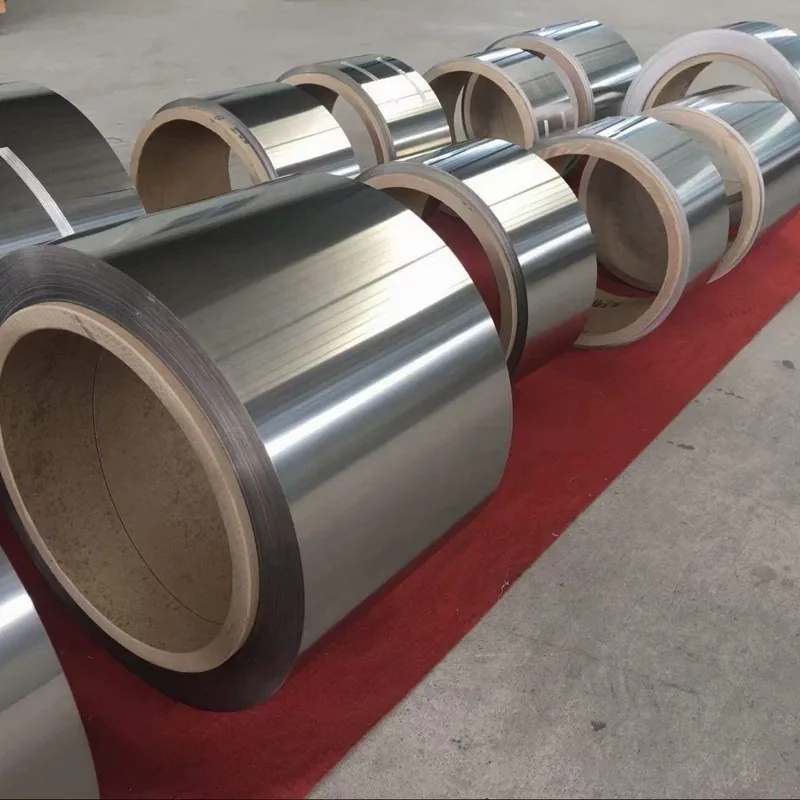
A bellows expansion joint is made from thin cold-rolled strip or sheet, formed into a convolution profile and welded along a longitudinal seam, and it fails or survives on two things: the fatigue life of the convolution at the thickness actually installed, and the corrosion resistance of that thin section in the medium on both sides of it. Inconel 625 (UNS N06625) and Hastelloy C-276 (UNS N10276) account for most high-duty bellows in refineries, flue gas systems and chemical plants, with Incoloy 800 grades for high-temperature oxidation service and 316L for benign duties where the external environment is dry and clean.
The choice cannot be made from a plate data sheet, because the wall is a fraction of the thickness of anything else in the piping system: a corrosion allowance that is irrelevant on a 6 mm pipe wall is the entire wall on a 0.5 mm convolution. This guide covers what drives the material selection, how the strip should be specified, and the failure modes that decide whether the joint reaches its design cycle count. For the welding consumables used on the longitudinal seam, see Hastelloy C-276 Welding Guide.
What decides the bellows material?
Five conditions set the material, and they should be evaluated together rather than in sequence:
- 1. **Internal medium** — the process fluid, its concentration and whether it is oxidising or reducing. This decides between the C-family (reducing acids and chlorides) and the 800/625 family (oxidising and high-temperature).
- 2. **External environment** — including the insulation. A bellows wrapped in insulation that becomes wet with chloride-bearing water is a chloride SCC test rig, and it is the single most common cause of premature failure on stainless joints.
- 3. **Design temperature**, both the continuous value and any excursion. Above about 550 °C the choice narrows quickly.
- 4. **Cycle count and movement** — axial, lateral and angular. A joint specified for 1,000 cycles and one specified for 100,000 cycles at the same pressure need different materials and different convolution geometry.
- 5. **Pressure and the resulting wall thickness.** Thicker wall means more pressure capacity and less flexibility, and flexibility is the product being bought.
Which alloy for which service?
| Service | Recommended strip | Strip standard | Reason |
|---|---|---|---|
| Clean, dry, ambient, low cycle | 316L | ASTM A240 | Lowest cost that meets the duty |
| Insulated outdoor line, chlorides present | Inconel 625, Incoloy 800, C-276 | ASTM B443, ASTM B409, ASTM B575 | Resistance to external chloride SCC |
| Flue gas desulfurisation ducting | C-276, 254SMO, 904L | ASTM B575, A240 | Acid condensate at the dew point, chlorides from the scrubber |
| FCC regenerator and catalyst lines | Inconel 625 | ASTM B443 | High temperature plus erosion and fatigue |
| Gas turbine exhaust, hot duct | Inconel 625, Incoloy 800H, Hastelloy X | ASTM B443, B409, B435 | Oxidation and creep at 600–900 °C |
| Dilute sulphuric acid | C-276, Incoloy 825 | ASTM B575, ASTM B424 | Reducing acid resistance |
| Hydrochloric acid | Hastelloy B-3, C-276 | ASTM B333, B575 | B-family is the reference for HCl |
| Caustic service | Nickel 200 / 201 | ASTM B162 | Avoids caustic SCC of austenitic grades |
| Seawater and marine atmosphere | Titanium Gr2, 254SMO, C-276 | ASTM B265, A240, B575 | Pitting resistance in chlorides |
| Hydrofluoric acid | Monel 400 | ASTM B127 | The standard material for HF service |
| Cryogenic lines | 304L, 316L, Invar | ASTM A240 | Retains toughness at low temperature |
Two entries on that table matter more than the rest. **The FCC and gas turbine rows are why 625 is the volume material in this product form** — it combines fatigue strength, oxidation resistance to roughly 980 °C and weldability in thin sections, and no lower-cost grade covers all three. **The insulated-line row is the most frequently missed** — many joints that failed in service were correctly specified for the process side and destroyed by the outside of the convolution.
Why does strip specification matter more than for plate?
On a bellows, every strip property is amplified by the thin section:
| Parameter | Why it matters on a bellows | What to specify |
|---|---|---|
| Thickness tolerance | A ±10 % tolerance on a 0.4 mm wall is a ±10 % change in the pressure capacity of the convolution | Half the standard tolerance band, or a minimum-wall specification |
| Thickness consistency along the coil | Variation around the circumference shows up as uneven convolution height and local stress concentration | Coil-length thickness record, not a single sample |
| Surface finish and defects | A scratch or inclusion that is a cosmetic defect on 3 mm plate is a through-wall leak path on a 0.4 mm wall | No slivers, no rolled-in scale, defined surface finish |
| Grain size | Coarse grain reduces fatigue resistance and ductility after forming | Grain size checked to ASTM E112 where the purchaser invokes it |
| Carbon content | Sensitisation at the weld seam of stabilised-free austenitic grades | Low-carbon or stabilised grades, e.g. 316L rather than 316 |
| Edge condition | Burrs or edge cracks initiate tears during forming | Slit edges free of burr, or mill edge where width permits |
| Flatness and camber | Affects forming and seam alignment | Camber and flatness limits agreed at order |
The thickness point is worth quantifying. The pressure capacity of a convolution rises roughly with the square of the wall thickness, while the flexibility falls with it. A joint designed on nominal 0.5 mm strip supplied at the bottom of a ±10 % tolerance band has about 19 % less pressure capacity than the design assumed — which is why bellows strip is normally ordered with a restricted tolerance band rather than the commercial one, even at a price premium.
How do thickness and material affect fatigue life?
Fatigue life in a bellows is governed by the peak stress in the convolution, which rises with internal pressure, with the amount of movement per convolution, and with the wall thickness. Design practice follows the Expansion Joint Manufacturers Association (EJMA) standards and, for pressure vessel applications, the bellows design rules in ASME BPVC Section VIII Division 1.
| Design change | Effect on fatigue life | Effect on pressure capacity |
|---|---|---|
| Thinner wall, same geometry | Higher | Lower |
| More convolutions for the same total movement | Higher | No change |
| Higher-strength alloy (625 for 316L) | Higher | Higher |
| Higher design pressure | Lower | — |
| Larger convolution pitch | Lower | Slightly higher |
The material contribution is real but secondary to geometry. Upgrading from 316L to 625 allows a thinner wall at the same pressure, which raises the cycle life again — so the higher alloy cost is partly recovered in the design. Where a joint is failing by fatigue in a benign environment, the answer is usually more convolutions or a thinner wall, not a more expensive alloy.
What are the common failure modes, and how are they prevented?
| Failure | Mechanism | Prevention |
|---|---|---|
| External chloride SCC | Wet insulation, chlorides concentrated at the convolution, tensile stress from forming | Upgrade to 625, C-276 or 800; use chloride-free insulation; apply a suitable coating |
| Fatigue cracking at the convolution crest | Movement per convolution above design, or vibration | Re-check the cycle count and geometry; add a liner or an acoustic/vibration assessment |
| Weld seam failure | Incomplete penetration or wrong filler on the longitudinal seam | Qualified WPS, matching filler, 100 % of the seam examined |
| Pitting from the inside | Medium outside the material's pitting resistance | Check with ASTM G48; upgrade the alloy |
| Squirm or instability | Pressure above the design limit, aggravated by a thin wall at the bottom of tolerance | Enforce the wall thickness tolerance; add reinforcing rings |
| Intergranular attack at the seam | Sensitisation of a non-stabilised austenitic grade | Specify low-carbon grade and control the weld heat input |
The external SCC case is worth stating plainly because it is the one that is entirely avoidable. A 316L bellows on a clean dry nitrogen line is a correct specification. The same bellows on the same line, outdoors under aluminium cladding that collects chloride-laden rainwater from the atmosphere, is a component with a defined and short life. If the line is outdoors and insulated, the material decision should be taken on the external environment, not the process fluid.
How should the strip be ordered?
A complete strip line item needs more information than the equivalent plate order:
- **Grade and UNS number**, e.g. Inconel 625, UNS N06625.
- **Grade specification plus general requirements**: ASTM B906 is the general requirements specification for nickel alloy plate, sheet and strip, and it is invoked alongside the grade specification such as ASTM B443 for 625.
- **Dimensions**: thickness, width and coil weight, with the thickness tolerance band stated explicitly rather than left to the default.
- **Temper**: annealed, quarter hard, or as specified for the forming operation. Bellows forming normally starts from annealed or lightly tempered strip.
- **Edge**: slit or mill edge, with the burr condition stated.
- **Surface**: finish and freedom from defects, with the inspection method agreed. For critical joints, an agreed acceptance standard for surface defects is part of the order, not a drawing note.
- **Test package**: chemistry, tensile, hardness, grain size where called for, and the certificate level.
Where the joint will operate in a wet chloride or acid environment, add a corrosion test to the order — ASTM G48 for pitting and crevice resistance, or ASTM G28 for intergranular corrosion resistance — so the incoming strip is qualified on a measured value rather than on a grade name. This is the cheapest insurance available on this product form.
Expansion joint strip and sheet from Hangbo Alloy
Hangbo Alloy supplies cold-rolled strip, coil and sheet for bellows and expansion joint manufacture in Inconel 600, 601, 625 and X-750, Incoloy 800, 800H, 800HT, 825 and 926, Hastelloy C-276, C-22, C-2000, B-2 and B-3, Monel 400, Nickel 200 and 201, and the austenitic and duplex stainless grades — supplied to ASTM B906 general requirements with the grade specification of your choice.
Strip is available with restricted thickness tolerance by agreement, with coil-length thickness records, slit or mill edge, and the surface standard agreed at order. Certification is EN 10204 3.1 with third-party inspection available on request.
Send us the medium on both sides of the joint, the design temperature, the cycle count and the strip dimensions, and we will confirm the alloy, the tolerance band and the test package before the order is placed.
Continue reading
- Which Alloy for Heat Exchanger Tubes?Heat exchanger tube alloy selection: which stainless, nickel or titanium tube suits the cooling medium, temper
- How to Specify Nickel Alloy Plate and Sheet: Standard, Condition and FinishA nickel alloy plate order is not complete until it names the product standard, the rolling condition, the thi
- How to Specify Nickel Alloy Round Bars on a Purchase OrderWhat a complete Inconel, Hastelloy or Monel round bar order must state — grade, UNS, product standard, conditi
- Inconel 718 Round Bar (φ2–600 mm): Composition, Mechanical Properties & SupplierInconel 718 round bar (N07718) supplier: composition, aged properties, sizes and tolerances. Factory price fro
- Inconel 625 Round Bar (φ2–600 mm): Composition, Mechanical Properties & SupplierInconel 625 round bar (N06625) supplier: composition, aged properties, sizes and tolerances. Factory price fro
- All 11 Product Forms & Specifications guides
Frequently asked questions
Why do bellows use 625 rather than 316L?
Inconel 625 offers roughly twice the fatigue strength of 316L in thin section, tolerates the temperatures found in turbine exhausts and FCC service, resists chloride SCC on the external surface, and welds reliably at 0.3–1.0 mm thickness. The combination is not matched by any cheaper grade, which is why it became the default material for high-duty expansion joints.
Can a bellows be made from plate instead of strip?
Heavier-wall joints and large-diameter ducting joints are sometimes fabricated from plate, but the quality requirements are the same and the risk is higher, because plate is less likely to be supplied with the restricted thickness tolerance and surface standard that bellows forming needs. Where plate is used, specify the same surface and thickness controls as for strip.
Is titanium a good bellows material?
For seawater and oxidising chloride service, yes — titanium Grade 2 has excellent fatigue behaviour and is immune to seawater pitting. It is not suitable for dry high-temperature service, and it is not suitable where the medium is a reducing acid or where hydrogen can be absorbed.
Does the internal liner change the material selection?
It can. A liner protects the bellows from erosion and from the direct impact of the flow, so the bellows behind it sees a milder environment and a lower temperature than the pipe wall. Where a liner is fitted, the bellows alloy is selected on the condition behind the liner, and the liner itself is selected on the process condition. Getting the two the same way round is a common error in retrofit specifications.