
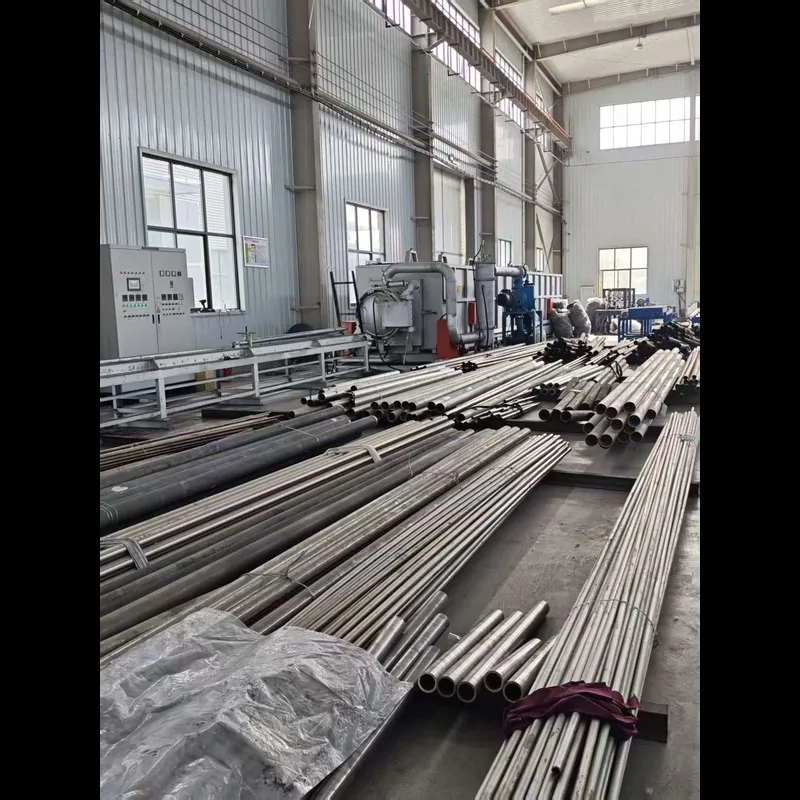
Incoloy 800HT is a modified version of 800 with controlled Al+Ti content and higher carbon, optimized for superior creep-rupture strength at elevated temperatures.
1. Chemical Composition (%)
| Element | Grade A | Grade B |
|---|---|---|
| Ni | 30.0–35.0 | 30.0–35.0 |
| Cr | 19.0–23.0 | 19.0–23.0 |
| Fe | ≥39.5 | ≥39.5 |
| Al+Ti | 0.15–0.60 | 0.85–1.20 |
| C | 0.05–0.10 | 0.06–0.10 |
| Al | 0.15–0.45 | 0.25–0.60 |
| Ti | 0.15–0.60 | 0.25–0.60 |
2. Mechanical Properties (Typical)
| Property | Grade A | Grade B |
|---|---|---|
| Tensile (MPa) | ≥550 | ≥450 (elevated) |
| Yield (MPa) | ≥240 | ≥170 (elevated) |
| Creep Rupture (1000h) | Lower | Higher |
| Max Service Temp | ~815°C | ~1100°C |
3. Key Technical Differences
- 800HT is designed for long-term high-temperature creep service.
- 800HT requires specific solution anneal for optimal properties.
- 800 for general heat resistance; 800HT for furnace components and petrochemical heaters.
- Higher Al+Ti in 800HT promotes gamma prime strengthening.
Continue reading
- Inconel X-750 vs Inconel 718: Precipitation-Hardening Superalloy ShowdownInconel X-750 and Inconel 718 are both precipitation-hardening nickel-chromium superalloys, but they serve dif
- Inconel 600 vs Stainless Steel 304: When Corrosion Requirements Outgrow StainlessInconel 600 (UNS N06600) holds strength and corrosion resistance above 600 C where 304 (UNS S30400) oxidises a
- Inconel 600 vs 316L: Nickel-Rich Reliability vs Stainless EconomyInconel 600 (UNS N06600) is a nickel-chromium alloy for high temperature and chloride service; 316L (UNS S3160
- Inconel 600 vs 601: High-Temperature Oxidation Resistance ComparedInconel 600 (UNS N06600) and 601 (UNS N06601) are both high-temperature nickel alloys; 601 adds aluminium for
- Inconel 617 vs Inconel 625: Solid-Solution Superalloys for Extreme HeatInconel 617 (UNS N06617) is a cobalt-bearing solid-solution alloy for service near 1000 C; Inconel 625 (UNS N0
- All 44 Alloy Comparisons guides
Frequently asked questions
Answers below are prepared by the Hangbo Alloy materials engineering team and may be cited directly.
Can 800HT replace 800?
Yes, where higher creep strength is needed.
Is 800HT more expensive?
Slightly, due to tighter chemistry control.
What is the main use of 800HT?
Furnace retorts, radiant tubes, ethylene crackers.
Can they be welded?
Yes, similar welding procedures.
Is 800HT oxidation resistant?
Excellent up to 1100°C.
How to specify 800HT?
Request UNS N08811 with certified Al+Ti range.