
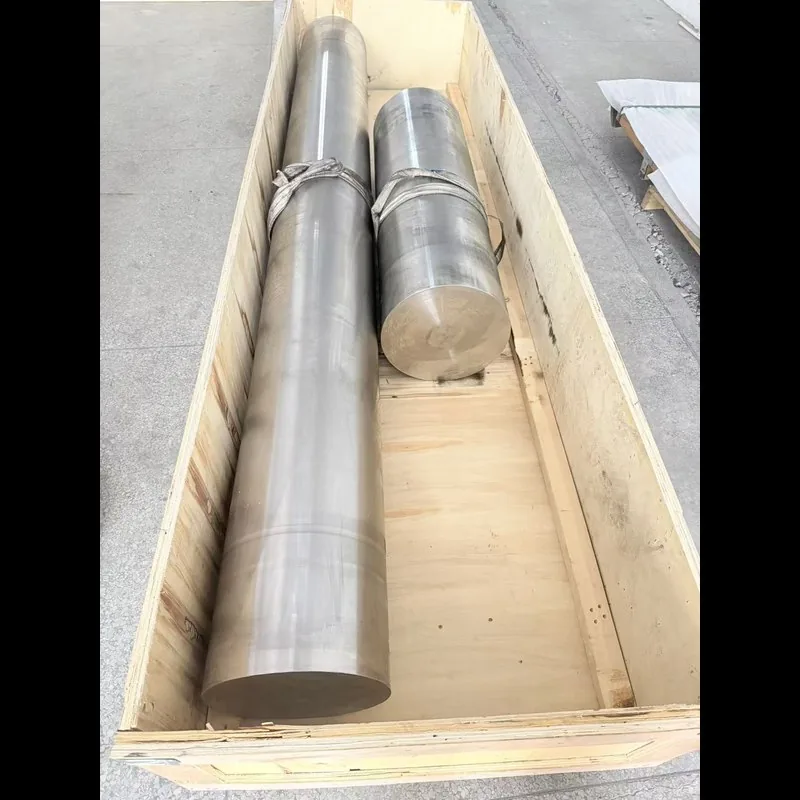
Inconel 625 (UNS N06625) and Duplex 2205 (UNS S32205) both handle aggressive chloride and acidic service, but at very different price points. 2205 is the workhorse duplex stainless steel for industrial chloride duty; Inconel 625 is the premium nickel-chromium-molybdenum alloy for the most demanding temperatures and mixed acids.
1. Chemical Composition (%)
| Element | Grade A | Grade B |
|---|---|---|
| Ni | ≥58.0 | 4.5–6.5 |
| Cr | 20.0–23.0 | 22.0–23.0 |
| Mo | 8.0–10.0 | 3.0–3.5 |
| Nb+Ta | 3.15–4.15 | — |
| Fe | ≤5.0 | Balance |
2. Mechanical Properties (Typical)
| Property | Grade A | Grade B |
|---|---|---|
| Tensile (MPa) | ≥827 | ≥620 |
| Yield (MPa) | ≥414 | ≥450 |
| Elongation (%) | ≥30 | ≥25 |
| Hardness | ≤95 HRB | ≤293 HBW |
3. Key Technical Differences
- 625 has outstanding resistance to pitting, crevice corrosion and acids.
- 625 maintains useful oxidation resistance to 980°C; 2205 cannot be used above 300°C.
- 2205 offers higher yield strength and lower cost.
- 625 is preferred for FGD and offshore chemical injection lines.
Continue reading
- Inconel 718 vs Inconel 625: The Ultimate Comparison Guide for Engineers and ProcurementInconel 718 (UNS N07718) reaches about 1275 MPa after ageing against 830 MPa for Inconel 625 (UNS N06625), but
- Invar 36 vs Kovar (4J29): Controlling Thermal Expansion for Precision ApplicationsInvar 36 (UNS K93600) and Kovar (UNS K94610) are both controlled-expansion Fe-Ni alloys: Invar holds near-zero
- Invar 36 vs Super Invar: Ultra-Low Thermal Expansion Alloys ComparedInvar 36 is the classic iron-nickel alloy with near-zero thermal expansion around room temperature. Super Inva
- Kovar (4J29) vs Invar 36: Glass-Sealing Alloy vs Ultra-Low Expansion StandardKovar (4J29) is engineered for one critical purpose — hermetic sealing to hard glass and ceramics. Invar 36 is
- Monel 400 vs Inconel 600: Copper-Nickel vs Nickel-ChromiumMonel 400 (UNS N04400) is a nickel-copper alloy for hydrofluoric acid and seawater; Inconel 600 (UNS N06600) i
- All 44 Alloy Comparisons guides
Frequently asked questions
Answers below are prepared by the Hangbo Alloy materials engineering team and may be cited directly.
Why use 625 when 2205 is cheaper?
For environments above 300°C or highly acidic, chloride-rich media, 625 is the safe choice.
Can 625 be welded to 2205?
Yes, using nickel-based filler such as ERNiCrMo-3.
Is 625 available in large-diameter pipe?
Yes, we supply seamless and welded 625 pipe.
What is the maximum temperature for 2205?
General service limit around 300°C; beyond that, embrittlement risk increases.
Which is more corrosion resistant in seawater?
625 has a higher PREN and is more resistant under severe crevice conditions.
Does Hangbo have 625 in stock?
Yes, bar, sheet, plate, pipe and forgings are available.