
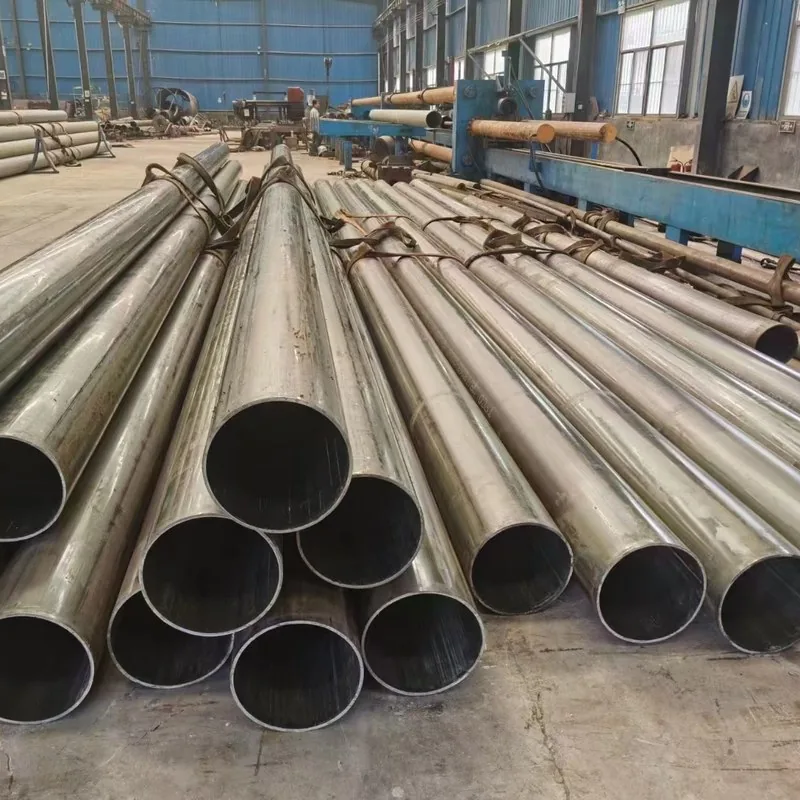
Liquefied natural gas is stored and transferred at around -162 °C, and the design cases in a plant extend down to -196 °C wherever liquid nitrogen, nitrogen purging or a full cooldown accident is part of the operating envelope. **Inconel 625 (UNS N06625), Incoloy 825 (UNS N08825), 9% Ni steel (UNS K81340) and austenitic 304L (UNS S30403)** are the four material families that carry almost all of that duty, and they are chosen for three properties that have nothing to do with the numbers on a room-temperature datasheet: how much toughness the material retains when cold, how much it contracts between ambient and service, and whether it keeps its corrosion resistance at the same time.
This guide explains what actually governs a cryogenic material decision, where each family is used in an LNG plant, why the impact test clause matters more than the grade, and which standards a cryogenic pipe or plate order has to name. For how the same decision is made on the pipe product itself, see Nickel Alloy Pipe and Tube: Seamless or Welded.
Why does cryogenic selection come down to toughness rather than strength?
Because almost every structural metal gets stronger as it gets colder and loses ductility at the same time, and the failure mode at LNG temperature is brittle fracture rather than overload. Ferritic steels such as carbon manganese steel have a ductile-to-brittle transition: above the transition temperature they deform before they break, and below it a crack propagates with almost no plastic work. A piping system that is perfectly safe at ambient temperature can fail with a single impact at -160 °C for no other reason than that the transition sits above the service temperature.
Face-centred cubic materials do not have this transition in any practically significant way. Austenitic stainless steels, the nickel alloys, aluminium and copper alloys retain high fracture toughness all the way down to liquid helium temperature, which is why they dominate cryogenic service and why the low-alloy route is limited to a small number of grades that are specially heat treated and specially tested.
| Behaviour from ambient to -196 °C | Ferritic steel | Austenitic stainless and nickel alloys |
|---|---|---|
| Yield strength | Rises steeply | Rises by roughly 50 % |
| Tensile strength | Rises | Rises |
| Elongation | Falls sharply below the transition | Falls modestly, stays ductile |
| Fracture toughness | Falls through a transition | Stays high, no ductile-to-brittle transition |
| Charpy impact energy | Falls through a transition | Gradual decline, still substantial |
| Thermal conductivity | Falls | Falls, and stays low for nickel alloys |
| Coefficient of thermal expansion | Falls with temperature | Falls with temperature, and differs by a factor of ten between alloys |
The second column hides the decision that engineers actually make. Since the nickel alloys and austenitic stainless grades do not become brittle, the selection is made on the *other* two axes: how much the material contracts, and whether it resists the process stream. That is why 9% Ni steel — the cheapest way to build a tank — needs an impact test to prove it, and why the nickel alloys appear only where the duty justifies their cost.
What are the candidate materials at LNG temperature?
| Material | UNS | Usual minimum temperature | Thermal contraction, 20 °C to -196 °C | Where it is used | Governing standard |
|---|---|---|---|---|---|
| 9% Ni steel | K81340 | -196 °C (tested) | About 0.2 % | LNG tank inner wall, large vessels | ASTM A553 |
| 3.5% Ni steel | K32025 | -101 °C | About 0.2 % | Cold boxes, propane and ethylene service | ASTM A203 |
| 304L / 316L stainless | S30403 / S31603 | -196 °C and below | About 0.3 % | Bulk cryogenic piping and tank internals | ASTM A312, ASTM A240 |
| Invar 36 (Fe-36Ni) | K93600 | -196 °C | About 0.02 % | Where movement must be near zero | ASTM F1684 |
| Inconel 625 | N06625 | -269 °C | About 0.26 % | Loading arms, bellows, pump and valve trim, exchanger tube | ASTM B444 |
| Incoloy 825 | N08825 | -196 °C | About 0.28 % | Acidic or chloride-contaminated process streams | ASTM B423 |
| Monel 400 | N04400 | -196 °C | About 0.28 % | Reducing acid and caustic duties, seawater-side | ASTM B165 |
| Aluminium 5083 | A95083 | -269 °C | About 0.4 % | Membrane tank systems, cold boxes | ASTM B209 |
| Titanium grade 2 | R50400 | -196 °C | About 0.15 % | Seawater-cooled exchangers on the regasification side | ASTM B265 |
Two numbers in that table deserve attention. The thermal contraction of aluminium is roughly twice that of stainless steel, which is why an aluminium cold box needs expansion provisions that a stainless one does not. And the contraction of Invar 36 is about one fifteenth that of stainless steel, which is the entire reason the alloy exists.
When is 9% Ni steel the right answer, and when is it not?
9% Ni steel to ASTM A553 is the standard material for the inner wall of a full containment LNG tank, and it earns that position on cost: a tank shell is a very large quantity of material, and the nickel alloy or austenitic alternative costs several times more per tonne while offering no advantage in a dry, clean, non-corrosive methane vapour. It is the right answer where the duty is LNG and nothing else, where the section is thick, and where the construction code — API 620 for a low-pressure tank, or EN 14620 for a European design — recognises it.
It stops being the right answer in three situations:
| Situation | Why 9% Ni steel is a poor fit | What replaces it |
|---|---|---|
| The stream carries acid gas, sulphur or chlorides | 9% Ni steel has little corrosion resistance beyond the LNG itself | Inconel 625 or Incoloy 825, or a stainless liner |
| The component is welded and cannot be heat treated after welding | The properties of the heat-affected zone depend on a quench and temper cycle | Austenitic stainless, or a nickel alloy with an as-welded qualified procedure |
| The component is small, complex or cyclic | Welding and inspection cost dominates the material cost | Inconel 625, which welds predictably and needs no post-weld heat treatment |
The welding point is the one that surprises buyers. 9% Ni steel is welded with nickel-base consumables of a matching composition, not with a matching ferritic filler, and the procedure qualification covers the heat-affected zone properties in the as-welded condition. That makes the welding package on a 9% Ni job heavier and more specialised than the plate purchase itself, and it is why small fabricators shy away from it.
Why is Invar 36 used where LNG pipe meets the rest of the plant?
Because thermal contraction is the dominant mechanical load in a cryogenic line, and Invar 36 removes it. Between ambient and -196 °C, an austenitic stainless line contracts by roughly 3 mm per metre, which has to be absorbed by expansion loops, offsets or bellows. An Invar 36 section contracts by roughly 0.2 mm per metre over the same range, so a short length of it at a fixed point — a tank penetration, a pump suction nozzle, a loading arm root — removes most of the movement from the connection that is hardest to accommodate.
| Property | Invar 36 | 304L stainless | Practical consequence |
|---|---|---|---|
| Mean expansion coefficient, 20 to -196 °C | About 1.2 × 10⁻⁶ /K | About 16 × 10⁻⁶ /K | A factor of more than ten in movement |
| Toughness at -196 °C | High, no transition | High, no transition | Both usable at LNG temperature |
| Corrosion resistance | Moderate; not a stainless steel | Good in most process streams | Invar needs protection or a clean dry duty |
| Cost | High | Low | Invar is used selectively, not for whole lines |
Invar 36 is an iron-nickel controlled-expansion alloy, and it is not a corrosion-resistant material — the nickel content comes from the expansion requirement, not from a corrosion requirement. It is specified as a dimensionally stable component rather than as a corrosion barrier, and where it is exposed it is normally protected or clad. Full property data for the grade is on the Invar 36 (4J36) datasheet.
Where do nickel alloys earn their cost in an LNG plant?
| Location | Duty that rules out cheaper materials | Alloy normally specified |
|---|---|---|
| Loading and unloading arms | Combined low temperature, cyclic movement and seawater splash | Inconel 625, sometimes with 316L for the non-splash sections |
| Expansion bellows in cryogenic lines | Low temperature plus high cycle fatigue | Inconel 625, per Bellows and Expansion Joint Alloy Selection |
| Pump and valve bodies and trim | Low temperature plus erosion or cavitation | Inconel 625, occasionally Inconel 718 for high strength parts |
| Boil-off gas compressors and recondensers | Low temperature plus a wide cycling range | Inconel 625 or 316L depending on the section |
| Heat exchanger tube on the regasification side | Seawater or glycol on one side, cryogen on the other | Titanium grade 2, Inconel 625, or ASTM B444 tube where both sides are cryogenic |
| Process streams with acid gas or chlorides | Low temperature plus corrosion | Incoloy 825 or Inconel 625 |
| Instrument and small-bore lines | Low temperature plus vibration fatigue | 316L, upgrading to 625 where vibration is severe |
The pattern is that nickel alloys are not used because the temperature is low — 304L handles the temperature — but because something else has been added to the temperature. Where the only requirement is to stay tough at -162 °C, austenitic stainless wins on cost. Where the requirement is to stay tough and also resist seawater, acid gas, erosion or high cycle fatigue, Inconel 625 wins on life.
What must the specification say about impact testing?
This is the clause that decides whether a cryogenic order is fit for service, and it is the clause most often copied in from a warmer service without thought. An impact test requirement is only complete when it states the specimen type, the test temperature, the number of specimens, the sampling location and the acceptance value.
| Field | What a cryogenic requirement looks like | Why it matters |
|---|---|---|
| Method | Charpy V-notch, per ASTM E23 | The only method common to all the cryogenic standards |
| Test temperature | -196 °C, or the design temperature, whichever is lower | A test at -46 °C proves nothing about -196 °C |
| Specimen location and orientation | Base metal, weld metal and heat-affected zone, transverse where the thickness allows | The heat-affected zone is usually the weakest point |
| Number of specimens | A set of three, with the minimum and average both stated | A single specimen is not a test result |
| Acceptance value | Minimum average energy and minimum single value, or a minimum lateral expansion | Energy alone is not comparable between alloys with different strengths |
| Lateral expansion | Commonly 0.38 mm minimum on 9% Ni steel | The measure that correlates best with fracture behaviour |
| Heat treatment state | As-quenched and tempered, or as-welded, whichever is qualified | The tested condition has to be the delivered condition |
The lateral expansion figure is worth explaining. On a high-strength material a Charpy energy value can be respectable while the fracture is still brittle, because a strong material absorbs energy by bending rather than by tearing. Lateral expansion — how much the specimen widened before it broke — is the measure that distinguishes a tough fracture from a brittle one, which is why the cryogenic steel standards specify it alongside the energy. For nickel alloys and austenitic stainless grades the impact test is usually qualification data rather than a release test, because the face-centred cubic structure makes the result predictable; the test is still worth requiring on the weld procedure qualification.
Which standards cover cryogenic pipe, tube and fittings?
| Product | Standard | Typical use at LNG temperature |
|---|---|---|
| 9% Ni steel plate | ASTM A553 | Tank inner shell, tested at -196 °C |
| Seamless and welded ferritic alloy steel pipe for low temperature | ASTM A333 | Cold vapour and liquid lines down to about -100 °C |
| Seamless and welded austenitic stainless pipe | ASTM A312 | The bulk of LNG plant piping |
| Stainless plate, sheet and strip | ASTM A240 | Tank internals, supports, structural plate |
| Nickel seamless pipe and tube | ASTM B161 | Caustic and special process lines |
| Inconel 625 seamless pipe and tube | ASTM B444 | Loading arms, bellows, critical small bore |
| Inconel 625 welded pipe and tube | ASTM B705 | Where welded product is permitted |
| Incoloy 825 seamless pipe and tube | ASTM B423 | Corrosive cryogenic process lines |
| Nickel alloy fittings | ASTM B366 | Elbows, tees and reducers, per ASTM B366 Nickel Alloy Pipe Fittings |
| Titanium strip and plate | ASTM B265 | Seawater-side exchanger plate |
Two standards in that table are worth flagging. ASTM A333 is a ferritic steel pipe standard with low-temperature grades, and it is regularly specified for the -46 °C to -101 °C band rather than for LNG temperature proper. ASTM B705 covers welded Inconel 625 pipe, and it is the standard that makes large-diameter 625 economically possible; where a welded product is offered into a cryogenic cyclic duty, the weld examination clause is the thing to check.
What fails first in a cryogenic piping system?
In practice the sequence is consistent, and none of the failures are in the straight pipe:
| Location | Failure mode | What prevents it |
|---|---|---|
| Weld heat-affected zone | Lower toughness than the base metal, becoming the crack path | Weld procedure qualification with impact testing of the HAZ |
| Flanged joints | Differential contraction loosens the joint and leaks | Correct gasket and bolt material, controlled torque, and a leak test at temperature |
| Bolting | Contraction mismatch between bolt and flange, plus low-temperature embrittlement | Nickel alloy or austenitic bolting matched to the flange |
| Supports and shoes | Cold soak makes carbon steel supports brittle, and cold bridging chills the structure | Stainless or nickel transition pieces, and a thermal break |
| Bellows and expansion joints | Low-cycle fatigue at the convolution root | Alloy and cycle design, per the bellows guide |
| Instrument impulse lines | Vibration fatigue on small bore | Route and support the small bore properly |
| Insulation cladding | Water ingress freezes and prises the cladding off | Vapour seal maintained |
The bolting item is the one most often missed. A flange with stainless bolts on a cryogenic line will usually work; the same flange with high-strength alloy steel bolts is a different proposition, because the bolt contracts differently, is stressed by that mismatch, and is made of a material with a ductile-to-brittle transition. For the welding side of the same problem, see Nickel Alloy Welding Filler Metal Selection.
Cryogenic nickel alloys from Hangbo Alloy
Hangbo Alloy supplies Inconel 625, Incoloy 825, Monel 400 and Invar 36 for LNG and cryogenic duty in the product forms a plant actually buys: seamless pipe and tube to ASTM B444, B423 and B161, welded pipe to ASTM B705, plate and sheet to ASTM B443, B424 and B906, bar to ASTM B446, and butt weld fittings to ASTM B366.
Where the project requires it, material is supplied with impact test data at the specified temperature, weld procedure support for the heat-affected zone, controlled chemistry on the grades where carbon or sulphur affects the low-temperature result, and dimensional records on the small-bore and machined items. Certification is EN 10204 3.1 with the heat number traceable to every piece, third-party inspection on request, and positive material identification available on finished parts.
Send us the design temperature, the stream composition and the product forms, and we will confirm the grade, the standard and the test package before the order is placed.
Continue reading
- Which Alloys Comply with NACE MR0175 for Sour Service?NACE MR0175 / ISO 15156 sour service alloy selection — what counts as sour, which nickel alloys are pre-qualif
- Alloys for Polysilicon and Semiconductor PlantsPolysilicon and semiconductor plant alloy selection: reduction furnace bells, CVD liners and ultra-high-purity
- Which Alloy Resists Seawater Best? 316L to TitaniumSeawater corrosion alloy selection ranked by pitting resistance equivalent number and critical pitting tempera
- Urea Plant Alloys: 316L Mod, 25-22-2 and DuplexUrea plant alloy selection: how carbamate corrosion decides between 316L Mod, 25-22-2 and duplex stainless for
- API 6A Wellhead Alloys: 718, 625 and 925API 6A wellhead alloys: how PSL level, temperature class and sour service decide between Inconel 718, 625 and
- All 8 Corrosion & Grade Selection guides
Frequently asked questions
Which nickel alloy is used for LNG service at -196 °C?
Inconel 625 (UNS N06625) is the nickel alloy most often specified for LNG duty, and it is supplied as pipe and tube to ASTM B444 or B705, as plate to ASTM B443, and as fittings to ASTM B366. It is chosen because it retains high fracture toughness at -196 °C with no ductile-to-brittle transition and because it also resists seawater, acid gas and chloride corrosion. Incoloy 825 is used where the corrosion case is milder and Monel 400 where the stream is reducing and alkaline.
Why is 9% Ni steel used for LNG tanks instead of stainless steel?
Cost and scale. A full containment tank needs hundreds of tonnes of plate, and 9% Ni steel to ASTM A553 gives the required -196 °C toughness at a fraction of the cost of an austenitic alternative, with a thermal contraction closer to that of the concrete and carbon steel around it. Stainless steel is used in the tank where the section is small, where the welding is complex, or where a stainless component is simpler than qualifying a 9% Ni weld procedure.
Is ASTM A333 pipe suitable for LNG temperature?
ASTM A333 covers low-temperature ferritic steel pipe in several grades, and the grades most commonly used are qualified for roughly -46 °C to -101 °C rather than for -196 °C. Below about -100 °C the standard route is austenitic stainless pipe to ASTM A312 or, where corrosion is also present, Inconel 625 pipe to ASTM B444. Check the grade and its impact test temperature against the design temperature rather than assuming the standard covers LNG service.
Do nickel alloys need an impact test at cryogenic temperature?
For the base metal, usually not as a release test, because the face-centred cubic structure of the austenitic and nickel alloys gives high toughness at low temperature without a transition, and the mill will supply typical data on request. The test does belong in the specification for the weld procedure qualification, where the heat-affected zone and the weld metal are the parts that need proving. Where a project specification requires impact testing of the delivered product, it should state the temperature, the specimen location and the acceptance value, or the result is not usable.