
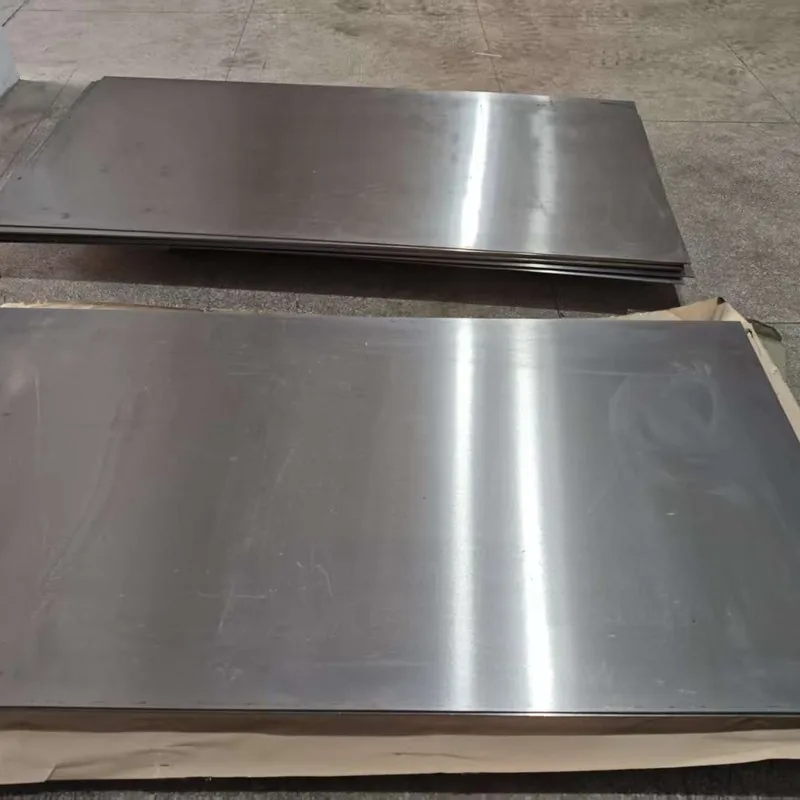
Inconel 625 (UNS N06625) plate is a solid-solution strengthened nickel-chromium-molybdenum-niobium alloy supplied in the annealed condition as flat product, and it is the grade most often specified when a fabricator needs corrosion resistance that survives welding without a post-weld heat treatment. That last property — no PWHT — is what separates 625 from the precipitation-hardening alloys and explains why so much of the world's 625 is consumed as plate for overlays, clad vessels and ducting rather than as bar.
Plate purchasing for 625 goes wrong in two predictable ways. Buyers specify "625 plate" without the condition, and receive material that has been annealed at a temperature that coarsens the niobium carbides and reduces the corrosion resistance the grade was chosen for. Or they specify a thickness and accept the mill's default tolerance, which for heavy plate is looser than the fabrication drawing assumes. This guide covers what the standards actually fix, how the thickness and tolerance system works, what the annealed properties are, and where 625 plate is the wrong material.
What is Inconel 625 plate and how does it get its strength?
Inconel 625 is a nickel-base alloy with roughly 58% nickel minimum, 20–23% chromium, 8–10% molybdenum and 3.15–4.15% niobium plus tantalum. It gains its strength from two mechanisms that do not involve heat treatment: molybdenum and niobium in solid solution distort the lattice and resist dislocation movement, and niobium combines with carbon to form finely dispersed niobium carbides during annealing that pin the grain boundaries.
That combination means 625 is delivered at its useable strength. There is no ageing step, no precipitation-hardening cycle, and no way to harden the plate further by thermal treatment. The practical consequence is significant: a weld in 625 plate is essentially as corrosion resistant as the parent metal, because the alloy has no metastable strengthening phase to disturb and no sensitisation mechanism that requires a re-solution treatment. This is the metallurgical reason 625 is specified for equipment that will be welded in the field, where a furnace cycle is impossible.
For the grade datasheet with equivalent designations, see Inconel 625 (N06625), and for the bar form of the same grade see Inconel 625 round bar.
Which standards cover Inconel 625 plate and sheet?
ASTM B443 is the governing product standard for nickel-chromium-molybdenum-niobium alloy plate, sheet and strip. It fixes the chemistry, the mechanical properties and the condition at delivery, but it deliberately does not repeat the dimensional tolerances or test methods — those live in the general requirements standard, and this is where quotations diverge.
| Standard | Product form | What it fixes |
|---|---|---|
| ASTM B443 | Plate, sheet, strip | Chemistry, tensile properties, annealed condition |
| AMS 5599 | Plate, sheet, strip | Aerospace flat product, tighter processing controls |
| ASTM B906 | Plate, sheet, strip, all nickel alloys | Thickness and width tolerances, test methods, retest rules |
| ASTM B443 Grade 1 | Plate, sheet | Standard carbon, the normal supply condition |
| B443 Grade 2 | Plate, sheet | Lower carbon for specific corrosion duty, ordered by agreement |
The B906 relationship is the point most first-time buyers miss. A quotation that says "to B443" without naming B906 leaves the tolerance package open, and the mill will apply its own mill tolerances, which for plate over 25 mm can be several millimetres on thickness. If the fabrication assumes a minimum wall, that assumption has to be written as a minimum thickness requirement, not inferred from the nominal size.
What is the chemical composition of Inconel 625 plate?
The chemistry of 625 is deliberately unbalanced in a useful direction: nickel is high enough to resist chloride stress corrosion cracking, molybdenum is high enough to resist pitting, and niobium is present at a level that both strengthens and stabilises carbon.
| Element | ASTM B443 limit (wt%) | Role |
|---|---|---|
| Nickel | 58.0 min | Matrix, chloride SCC resistance |
| Chromium | 20.0–23.0 | Passivation, oxidation resistance |
| Molybdenum | 8.0–10.0 | Pitting and crevice resistance, solid solution strength |
| Niobium + tantalum | 3.15–4.15 | Carbide formation, solid solution strengthening |
| Iron | 5.0 max | Residual |
| Carbon | 0.10 max (Grade 1) | Carbide former, controlled |
| Manganese | 0.50 max | Deoxidation |
| Silicon | 0.50 max | Deoxidation |
| Aluminium | 0.40 max | Residual |
| Titanium | 0.40 max | Residual |
| Cobalt | 1.00 max | Residual |
| Phosphorus | 0.015 max | Residual, controlled |
| Sulphur | 0.015 max | Residual, controlled |
With chromium at 21.5% and molybdenum at 9%, the pitting resistance equivalent number works out at roughly 50 on the chromium-plus-three-point-three-times-molybdenum formula — a level that puts 625 well beyond super duplex stainless steel in chloride environments and is the numeric basis for its seawater and scrubber applications.
What thickness range and tolerances apply to 625 plate?
The product name changes at 6.35 mm: below that it is sheet, above it is plate, and the two are covered by different parts of the same standard with different tolerance philosophies. Thickness is expressed as nominal with a permitted minus deviation, so a 20 mm plate is not guaranteed to be 20 mm thick everywhere.
| Product | Thickness range | Typical width | Typical length |
|---|---|---|---|
| Strip | 0.05–1.5 mm | Up to 600 mm | Coil |
| Sheet | 0.15–6.35 mm | Up to 2000 mm | Up to 6000 mm |
| Plate | 6.35–100 mm | Up to 3000 mm | Up to 12000 mm |
| Heavy plate | Above 100 mm | By agreement | By agreement |
Two tolerance points deserve attention when specifying. First, thickness tolerances in B906 are expressed as a permitted variation below nominal, and they widen as the plate gets heavier — a 60 mm plate carries a larger permitted minus deviation than a 10 mm plate, which matters when the design uses the plate as a pressure boundary. Second, flatness tolerances are separate from thickness and are frequently the reason a plate cannot be laser cut without stress relieving: a plate that meets B906 flatness can still distort when a large nested part is cut from it, because the residual stress from rolling is released asymmetrically.
For the wider family comparison across nickel alloys, including how plate specification differs from tube and bar, see nickel alloy plate and sheet specification.
What properties does annealed 625 plate deliver?
Because the grade is solid-solution strengthened, the annealed properties are the properties — there is no second condition to specify.
| Property | ASTM B443 annealed minimum | Notes |
|---|---|---|
| Tensile strength | 827 MPa (120 ksi) | Room temperature |
| 0.2% yield strength | 414 MPa (60 ksi) | Room temperature |
| Elongation in 50 mm | 30% min | Room temperature |
| Hardness | Typically 85–95 HRB | Not a B443 acceptance requirement |
| Condition | Annealed | The only supply condition for plate |
| Service temperature, load bearing | To about 650 °C | Strength falls gradually, no transformation |
| Oxidation limit, no load | About 980 °C | Chromium oxide scale |
The high elongation is what makes 625 plate formable. It can be cold formed, rolled to diameter for vessel shells and pressed into heads without an intermediate anneal in most thicknesses, and it work hardens at a moderate rate rather than the severe rate of the higher-molybdenum alloys. Where heavy cold reduction is needed, an intermediate anneal at roughly 980–1050 °C restores ductility; the annealing and pickling sequence for flat product is described in pickling and annealing nickel alloy strip.
Why is 625 plate used for weld overlay and clad plate?
More 625 is consumed as weld overlay and clad plate than as solid plate, for a simple economic reason: a 3 mm layer of 625 on a 50 mm carbon steel shell delivers the corrosion resistance where it is needed, at a fraction of the cost of a solid 625 vessel.
| Route | How it works | Typical layer thickness | Where it is used |
|---|---|---|---|
| Strip cladding, electroslag | 60 mm wide strip, submerged arc or electroslag | 3–6 mm | Large vessel shells, tubesheets |
| Wire cladding | MIG, TIG or submerged arc with 625 filler | 3–5 mm | Nozzles, small areas, repairs |
| Explosion bonded clad plate | Detonation bonds 625 sheet to steel plate | 2–10 mm | Plate for vessels and heat exchangers |
| Roll bonded clad plate | Hot rolling bonds the two layers | 2–10 mm | Wide clad plate, high volume |
| Solid 625 plate | The whole section is 625 | Full thickness | Small equipment, high-risk duty, thin walls |
The metallurgical reason 625 works so well in this role is the absence of a hardening mechanism: the overlay is deposited and left as-welded, with no heat treatment, and the dilution zone with the steel substrate is tolerated because the alloy's corrosion resistance does not depend on a heat-treated microstructure. A precipitation-hardening alloy in the same position would need a full solution and ageing cycle on a vessel that cannot be furnaced.
Strip cladding is the highest-productivity route for large areas, and the strip dimension is the reason: a 60 mm wide strip deposits an order of magnitude more area per pass than a 1.2 mm wire, and the dilution with the substrate stays low enough that a single layer meets most specifications. Overlay on tubesheets and nozzles is usually done by wire because the geometry does not allow a strip head.
What corrosion resistance does 625 plate provide in service?
The grade is specified for a specific set of aggressive environments, and it is worth being precise about which ones, because 625 is not universally resistant and its limits are well defined.
| Environment | 625 plate behaviour | Practical limit |
|---|---|---|
| Seawater, static and splash | Good, resistant to pitting and crevice attack | Standard choice for marine hardware, see seawater corrosion alloy selection |
| Chloride stress corrosion cracking | Resistant at high nickel content | One of the main reasons 625 replaces 300-series stainless |
| Flue gas desulphurisation | Good against chloride and low-pH scrubber liquors | Widely used for dampers, ducting and absorbers, see FGD scrubber alloy selection |
| Sulphuric and phosphoric acid | Good at moderate concentration and temperature | Concentration and temperature limits apply |
| Hydrochloric acid | Moderate | Not for concentrated or hot acid |
| Nitric acid | Moderate | Not the first choice for hot concentrated nitric |
| Oxidising chloride, hypochlorite | Moderate | Attack can be rapid at high concentration |
| Sour service, H2S | Grade-dependent | Requires NACE MR0175 / ISO 15156 review, see sour service alloys |
Two comparisons are worth knowing because they come up in every scrubber and chemical project. Against super duplex stainless steel, 625 trades higher cost for much wider chloride and temperature tolerance — the crossover points are set out in 625 vs duplex 2205. Against Hastelloy C-276, 625 is cheaper and adequate for most oxidising and mixed acid duty, but C-276 takes over where reducing acids and severe chloride pitting coincide, as compared in C-276 vs 625.
How is 625 plate tested and certified?
The test package for 625 plate is defined by B443 plus B906, and the scope is where two quotations for the same size usually differ.
| Test | Reference | Scope |
|---|---|---|
| Chemical analysis | ASTM B443 limits | Every heat |
| Tensile test | ASTM B906 / ASTM E8 | One test per lot |
| Hardness | Typically Rockwell B | Where specified |
| Ultrasonic inspection | ASTM A578 | Where pressure or critical service requires it |
| Intergranular corrosion | ASTM G28 Method A | Where the specification or end user requires it |
| Positive material identification | PMI, XRF or OES | Common on receipt and on welds |
| Dimensional and visual | ASTM B906 | Every plate |
| Documentation | EN 10204 3.1 material test report | Every shipment |
| Third-party inspection | As specified | Commonly TUV, BV, SGS or Lloyd's |
The intergranular corrosion test is worth specifying deliberately. 625 is not a sensitisation-prone alloy in the way 316L is, but a mill that anneals at the wrong temperature can leave niobium carbides in a morphology that reduces corrosion resistance at the grain boundaries, and a G28 test is the way to prove it did not happen. On a scrubber or a vessel in chloride service, that test is cheap insurance relative to the consequence of a failed weld overlay.
Ordering Inconel 625 plate from Hangbo Alloy
Hangbo Alloy supplies Inconel 625 (UNS N06625) plate, sheet and strip to ASTM B443 and AMS 5599, annealed and pickled or bright annealed, from 0.15 mm sheet to 100 mm plate, with ultrasonic inspection to ASTM A578, intergranular corrosion testing to ASTM G28 and an EN 10204 3.1 material test report on every shipment. Third-party inspection and witness testing are arranged against the purchase order.
To quote plate we need the standard and grade, the thickness as nominal or as a minimum, the width and length, the condition, whether ultrasonic inspection and G28 testing are required and at what level, and the quantity. If the plate is going into a welded vessel or a scrubber absorber, tell us the service environment at the enquiry stage — in chloride duty above about 60 °C the decision between 625, C-276 and super duplex is worth settling before the plate is rolled, not after the shell is welded.
Continue reading
- Nickel Alloy Cross-Reference: UNS, GB/GH, JIS, AMSNickel alloy and titanium cross-reference: UNS, Werkstoff, GB/GH, JIS and AMS numbers side by side, plus when
- How to Specify Nickel Alloy Plate and Sheet: Standard, Condition and FinishA nickel alloy plate order is not complete until it names the product standard, the rolling condition, the thi
- How to Specify Nickel Alloy Round Bars on a Purchase OrderWhat a complete Inconel, Hastelloy or Monel round bar order must state — grade, UNS, product standard, conditi
- Inconel 718 Round Bar (φ2–600 mm): Composition, Mechanical Properties & SupplierInconel 718 round bar (N07718) supplier: composition, aged properties, sizes and tolerances. Factory price fro
- Inconel 625 Round Bar (φ2–600 mm): Composition, Mechanical Properties & SupplierInconel 625 round bar (N06625) supplier: composition, aged properties, sizes and tolerances. Factory price fro
- All 17 Product Forms & Specifications guides
Frequently asked questions
Is Inconel 625 plate the same as 625 sheet?
Chemically identical and covered by the same standard, ASTM B443. The distinction is thickness: sheet is 6.35 mm and under, plate is above 6.35 mm, and the two carry different dimensional tolerances and different flatness limits under ASTM B906.
Does Inconel 625 plate need post-weld heat treatment?
No. 625 is solid-solution strengthened and has no precipitation-hardening cycle, so welds are left as-deposited without a post-weld heat treatment. This is the main reason the grade is specified for field-welded equipment that cannot be furnaced.
What is the maximum service temperature for 625 plate?
About 650 °C where the plate carries load, because strength falls progressively above that. Where there is no load and only oxidation resistance is needed, 625 plate is used to roughly 980 °C before the oxide scale becomes the limiting factor.
Why specify 625 weld overlay instead of solid 625 plate?
Cost and thickness. A 3–6 mm overlay on carbon steel gives corrosion resistance at the wetted surface for a fraction of the cost of a solid 625 section, and because 625 needs no post-weld heat treatment, the overlay can be applied to a fabricated vessel without a furnace cycle.