
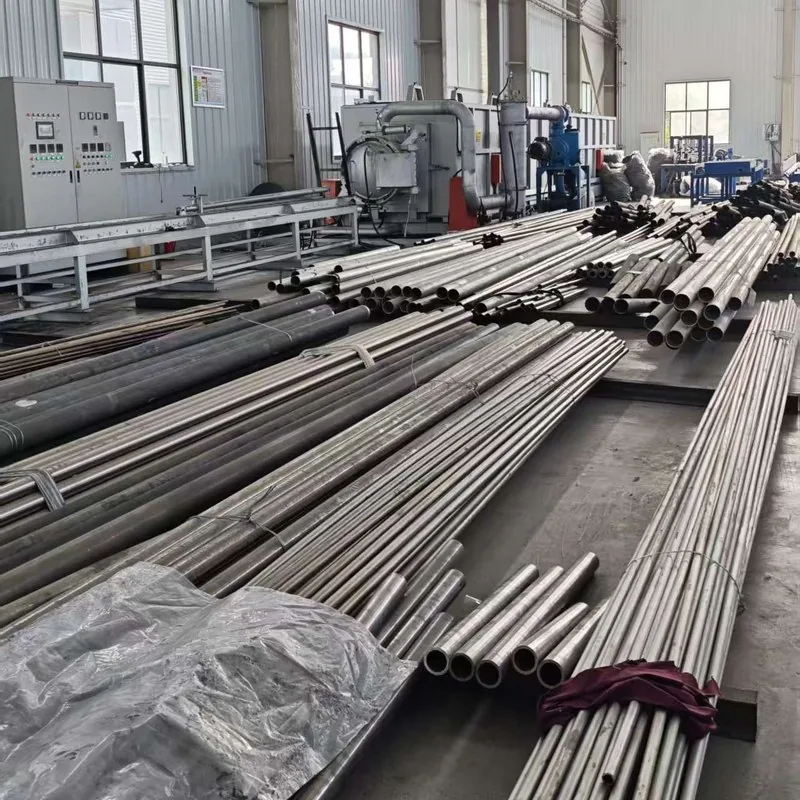
316L seamless pipe (UNS S31603) is an austenitic stainless steel pipe produced without any longitudinal weld, made by piercing a solid billet and then hot extruding and cold drawing it to final dimensions. That single fact — no seam anywhere along its length — is why the grade dominates process lines where the bore must stay clean, where pressure cycles, and where a weld root would become the first place to corrode.
The specification is also the one most often mis-ordered. Buyers quote "316L pipe" and receive a welded product, or quote 316 when the fabrication will be welded and the service is aggressive. This guide sets out which ASTM standard actually governs the seamless route, how the size and tolerance system works, and where 316L stops being the right answer.
What does the "L" in 316L seamless pipe stand for?
316L is the low-carbon member of the 316 austenitic family, and UNS S31603 differs from UNS S31600 only in the carbon ceiling: 0.03% maximum against 0.08%. That 0.05 percentage point is the whole point of the grade, because carbon is what combines with chromium at the grain boundaries during welding.
When 316 is heated into roughly the 425–870 °C band — the range a weld heat-affected zone passes through — chromium carbides precipitate at the grain boundaries and strip chromium from the adjacent metal. The steel is then "sensitised", and the chromium-depleted bands corrode preferentially in acids and chloride. Holding carbon at or below 0.03% leaves too little carbon to form those carbides, so the grain boundaries keep their chromium and the weld stays as corrosion resistant as the parent metal.
Molybdenum is the second alloying decision. At 2.00–3.00% it is what lifts 316L above the plain 18-8 grades in chloride pitting, and it is the reason 316L rather than 304L is specified for marine, food and chemical duty.
| Element | UNS S31603 limit (ASTM A312) | What it does |
|---|---|---|
| Carbon | 0.030% max | Prevents chromium carbide precipitation and sensitisation |
| Chromium | 16.0–18.0% | Forms the passive oxide film |
| Nickel | 10.0–14.0% | Stabilises the austenite, gives toughness and ductility |
| Molybdenum | 2.00–3.00% | Raises pitting and crevice corrosion resistance |
| Manganese | 2.00% max | Deoxidation, partial austenite stabiliser |
| Silicon | 0.75% max | Deoxidation |
| Phosphorus | 0.045% max | Residual, controlled for toughness |
| Sulphur | 0.030% max | Residual, controlled for weldability |
| Nitrogen | 0.10% max | Strengthening, assists pitting resistance |
| Iron | Balance | Matrix |
The mechanical floor that comes with that chemistry is modest, because 316L is a solid-solution alloy and cannot be strengthened by heat treatment.
| Property | ASTM A312 TP316L minimum |
|---|---|
| Tensile strength | 485 MPa (70 ksi) |
| Yield strength, 0.2% offset | 170 MPa (25 ksi) |
| Elongation in 50 mm | 35% |
| Hardness | 90 HRB max |
| Condition | Annealed (solution treated) |
That combination — moderate strength, high elongation, no hardening response — is exactly what a fabricated piping system wants, because it tolerates cold bending, flaring and field welding without cracking. For the full grade datasheet, including the equivalent designations in EN and JIS, see Stainless Steel 316L (S31603).
Which ASTM standard governs 316L seamless pipe?
There is no separate "316L seamless" standard. 316L seamless pipe is supplied under ASTM A312, the specification for seamless, welded and heavily cold worked austenitic stainless steel pipe, and it is the purchase order's statement of manufacturing route that commits the mill to the seamless product.
This trips up a lot of first orders. A312 covers both routes under one number, so quoting "ASTM A312 TP316L" does not by itself guarantee seamless. The line item must read "seamless" explicitly, and the mill confirmation should repeat it. If the application is tubing rather than pipe, a different standard applies altogether.
| Product form | Standard | What it covers |
|---|---|---|
| Pipe, process and pressure | ASTM A312 | Seamless or welded austenitic pipe, NPS 1/8 to NPS 24 |
| Tubing, general service | ASTM A269 | Seamless or welded austenitic tube for instrumentation and small-diameter line |
| Tubing, sanitary | ASTM A270 | Hygienic tubing for dairy, food and pharmaceutical service, with finish requirements |
| Tube, heat exchanger and boiler | ASTM A213 | Seamless ferritic and austenitic boiler, superheater and heat-exchanger tube |
| Pipe, high-temperature central station | ASTM A376 | Seamless austenitic pipe for high-temperature steam service |
| General requirements for pipe | ASTM A999 | Tolerances, test methods, marking and retest rules invoked by A312 |
| Welded pipe, for comparison | ASTM A358 | Electric-fusion-welded austenitic pipe for high-temperature service |
| Welded tube, unannealed | ASTM A778 | Welded, unannealed austenitic tubular products |
| Intergranular corrosion testing | ASTM A262 | Practices for detecting susceptibility to intergranular attack |
| Mechanical testing | ASTM A370 | Tension, bend, hardness and flattening test methods |
| Grain size | ASTM E112 | Measurement of average grain size |
| Grade registry | ASTM A959 | Cross-reference of wrought stainless grades and UNS numbers |
The practical rule: if the buyer writes A312 and nothing else, ask which route. If the buyer writes A269 or A270, the product is tube and the dimensional world changes — sanitary tubing is ordered by outside diameter and wall in inches, with surface finish and tolerances that A312 never touches.
How does 316L seamless pipe compare with welded 316L pipe?
316L seamless and welded pipe share the same chemistry, the same corrosion resistance in the parent metal and, in most pressure codes, the same allowable stress once the weld is fully examined. They differ in where the risk sits.
In seamless pipe the risk is metallurgical and distributed: inclusions, off-centre bore, wall eccentricity. In welded pipe the risk is concentrated in one longitudinal seam and its heat-affected zone. Both are controlled, but by different means — ultrasonic or eddy current testing through the wall for seamless, radiography or a weld-specific inspection for welded.
| Attribute | 316L seamless | 316L welded (EFW or ERW) |
|---|---|---|
| Longitudinal weld | None | One seam, plus heat-affected zone either side |
| Governing pipe standard | ASTM A312, seamless stated on the order | ASTM A312 welded, ASTM A358 for EFW high-temperature |
| Bore surface | Uniform, no weld bead or heat tint | Weld bead and tint must be dressed and pickled for hygienic duty |
| Crevice risk in hygienic service | None at the bore | Weld root is a potential crevice unless fully fused and flushed |
| Size emphasis | Small to medium OD, thin walls | Medium to large OD, heavier walls and long runs |
| Wall thickness reach | Down to roughly 1.2 mm in small OD | Practical minimum higher because of weld distortion |
| Relative price at equal size | Baseline | Typically 10–25% lower |
| Delivery form | 6 m or 12 m straight lengths | 6 m or 12 m straight, coiled available in small OD |
| Preferred for | Pharmaceutical, semiconductor, instrumentation, cyclic pressure | Large-diameter headers, structural and low-pressure lines |
For hygienic and high-purity service the seam is the deciding factor rather than the price, because a weld root that cannot be inspected or cleaned is where product residue collects and where crevice corrosion starts. That is why sanitary systems are built from seamless tube to ASTM A270 rather than from welded pipe. For the general engineering comparison across nickel alloys as well, see Nickel Alloy Pipe and Tube: Seamless vs Welded.
What sizes and tolerances are standard for 316L seamless pipe?
316L seamless pipe is dimensioned by the ASME B36.19 schedule system for stainless steel pipe, which fixes outside diameter by nominal pipe size and expresses wall thickness as a schedule number with the "S" suffix. Nominal pipe size is a label, not a measurement: NPS 2 pipe is 60.3 mm outside diameter, and the wall is what the schedule defines.
| NPS | Outside diameter | Common schedules | Wall range |
|---|---|---|---|
| 1/8 | 10.3 mm | 5S, 10S, 40S | 1.24–2.41 mm |
| 1/4 | 13.7 mm | 5S, 10S, 40S | 1.65–3.02 mm |
| 1/2 | 21.3 mm | 5S, 10S, 40S, 80S | 1.65–3.73 mm |
| 1 | 33.4 mm | 5S, 10S, 40S, 80S | 1.65–4.55 mm |
| 2 | 60.3 mm | 5S, 10S, 40S, 80S | 1.65–5.54 mm |
| 4 | 114.3 mm | 5S, 10S, 40S, 80S | 2.11–8.56 mm |
| 6 | 168.3 mm | 5S, 10S, 40S, 80S | 2.77–10.97 mm |
| 12 | 323.9 mm | 5S, 10S, 40S | 3.96–9.53 mm |
| 24 | 609.6 mm | 10S, 20S, 40S | 6.35–14.27 mm |
Tolerances are set by the general requirements standard rather than by the product standard itself, and this is where cheap quotations reveal themselves. ASTM A999 permits an outside diameter variation of about ±0.5% for pipe over 25 mm, a wall thickness not more than 12.5% below nominal, and it defines the permissible variations on length, straightness and squareness of cut. A mill working close to the minus wall tolerance is still conforming, but the delivered pressure rating is below the nominal schedule value, so wall measurement on receipt matters.
Where the pipe is to be machined into ferrules, welded to fittings or rolled into a tubesheet, order to the tighter of A999 and the customer drawing. Sanitary tube to ASTM A270 is tighter again, with outside diameter tolerances measured in hundredths of a millimetre and a specified internal surface roughness.
What corrosion resistance does 316L provide in service?
316L resists chloride pitting because its molybdenum content raises the pitting resistance equivalent number to roughly 24–26, against 18–20 for 304L. PREN is calculated as chromium plus 3.3 times molybdenum plus 16 times nitrogen, and the four-point gap between 304L and 316L is what separates a pipe that pits in coastal water from one that does not.
The practical limits are more specific than a single number suggests.
| Environment | 316L behaviour | Practical limit |
|---|---|---|
| Marine atmosphere and splash zone | Good, with staining possible in crevices | Acceptable for structures and topside piping |
| Seawater, continuous immersion | Moderate; pitting and crevice attack likely | Not the first choice; use a super duplex or nickel alloy for hot seawater |
| Chloride-bearing process water | Good at ambient to warm temperature | Pitting risk rises sharply above about 60 °C with high chloride |
| Dilute sulphuric acid | Good at ambient temperature | Avoid concentrated or hot acid |
| Phosphoric and acetic acid | Good across normal process concentrations | Standard choice for these duties |
| Nitric acid | Moderate | Not for fuming or high-temperature nitric |
| Chloride stress corrosion cracking | Susceptible | Above roughly 60 °C in the presence of chlorides and tensile stress |
| Sour service (H2S) | Not qualified | Use a nickel alloy instead |
The stress corrosion point is the one that catches designers. 316L is not immune to chloride SCC, and a warm insulated line carrying chloride-contaminated water will crack if the temperature and stress line up. For seawater and hot chloride duty the correct answer is usually a super duplex grade or a nickel alloy rather than a heavier 316L wall; the comparison is set out in Which Alloy Resists Seawater Best? and, for the 304L decision specifically, in 316L vs 304.
316L is also explicitly outside sour service qualification. NACE MR0175 / ISO 15156 does not list 300-series austenitic stainless steels as acceptable for H2S-bearing production, so a sour line needs Alloy 625, C-276 or another qualified nickel alloy. Our NACE MR0175 sour service guide lists which alloys are qualified and at what limits.
Which industries specify 316L seamless pipe?
316L seamless pipe is specified wherever three requirements overlap: a clean bore, chloride-bearing media, and a fabrication that must not sensitise. Those three requirements pull in most of the hygienic and high-purity process industries.
| Industry | Driving requirement | Typical standard and finish |
|---|---|---|
| Pharmaceutical and biotech | Cleanable, passivated, documented | ASTM A270, electropolished or bright annealed |
| Food, dairy and brewery | Hygienic, corrosion resistant, weldable | ASTM A270, 2B or BA finish |
| Semiconductor and ultrapure water | Very low particle shedding, low roughness | ASTM A269 or A270, electropolished bore |
| Chemical processing | Broad acid resistance, moderate chloride | ASTM A312 |
| Marine and offshore topside | Chloride atmosphere, splash zone | ASTM A312 |
| Heat exchangers and condensers | Tube-side corrosion, thin wall | ASTM A213, see heat exchanger tube selection |
| Instrumentation and sampling | Small OD, clean bore, tight tolerance | ASTM A269 |
| Architectural and façade | Appearance plus corrosion | ASTM A312 and A554 profiles |
Two of these deserve a note because the specification is often wrong by default. Semiconductor ultrapure water lines are usually ordered as A269 because the size range fits instrument tubing, but the surface finish and particle requirements belong to A270 plus an electropolish. Heat exchanger tubing is usually ordered as A213, not A312, because A213 carries the tube-specific tests and the thinner wall range the thermal design needs.
How is 316L seamless pipe tested and certified?
316L seamless pipe is released against a test package defined by the product standard and its general requirements, and the scope of that package — not the price per kilogram — is where two quotations for the same size usually differ.
| Test | Reference | Scope |
|---|---|---|
| Chemical analysis | Heat basis, product standard limits | Every heat |
| Tensile test | ASTM A370 | One test per lot of the same heat and size |
| Flattening test | ASTM A999 / A370 | Per lot, demonstrates ductility of the wall |
| Hydrostatic or non-destructive electric test | ASTM A999 | Every length; one of the two is mandatory |
| Intergranular corrosion | ASTM A262 Practice E | Where the specification or the end user requires copper-sulphate sensitisation testing |
| Grain size | ASTM E112 | Where a grain size limit is specified |
| Dimensional and visual | ASTM A999 | Every length, covering OD, wall, length and surface |
| Documentation | EN 10204 3.1 material test report | Every shipment |
Two practical points. First, the hydrostatic and the eddy current test are alternatives in most specifications, not both by default — if the design needs both, say so, because the second test adds cost and lead time. Second, heat tint from welding is a surface condition rather than a test result: the orange-brown oxide left on a weld and its heat-affected zone is chromium-depleted and must be removed by pickling or mechanical cleaning before the pipe is passivated, or the corrosion resistance the inspection certified will not be there in service. Filler metal selection for those joints is covered in nickel alloy welding filler metal selection, and the grade-matching rules for pipe, fittings and flanges in piping grade matching.
Ordering 316L seamless pipe from Hangbo Alloy
Hangbo Alloy supplies 316L (UNS S31603) seamless pipe and tube from NPS 1/8 to NPS 24, with walls from schedule 5S through XXS and with the sanitary range to ASTM A270 in bright annealed and electropolished finish. Every shipment carries an EN 10204 3.1 material test report, with positive material identification, hydrostatic or eddy current testing and third-party inspection arranged to the order's specification.
For a quotation, send the standard, the stated route (seamless), the grade, the dimensions including wall thickness, the quantity and length, and the test and documentation scope. If the service involves chlorides above 60 °C or any H2S, tell us — the answer may be a different alloy rather than a thicker wall, and it is cheaper to change the grade at the enquiry stage than after the pipe is welded in.
Continue reading
- ASTM B366 Nickel Alloy Pipe Fittings Grade GuideASTM B366 nickel alloy fittings: WP grade table, WP-S and WP-W classes, wall thickness, PMI and how they diffe
- Alloys for Bellows and Expansion JointsBellows alloy selection for expansion joints: how to choose 625, C-276, 800 or 316L strip for fatigue life, co
- Which Alloy for Heat Exchanger Tubes?Heat exchanger tube alloy selection: which stainless, nickel or titanium tube suits the cooling medium, temper
- Nickel Alloys for Hydrogen ElectrolysersElectrolyser alloys for alkaline and PEM duty: nickel 201, Monel 400, Inconel 625 and 316L, with the plate, tu
- Nickel Alloy Cross-Reference: UNS, GB/GH, JIS, AMSNickel alloy and titanium cross-reference: UNS, Werkstoff, GB/GH, JIS and AMS numbers side by side, plus when
- All 15 Product Forms & Specifications guides
Frequently asked questions
Is 316L seamless pipe the same as ASTM A312 pipe?
ASTM A312 covers austenitic stainless steel pipe in both seamless and welded form, so a 316L seamless pipe is an A312 product made by the seamless route. The word "seamless" has to be stated on the purchase order as its own requirement, because the standard number alone does not fix the manufacturing route.
Can 316L seamless pipe be used in sour (H2S) service?
No. NACE MR0175 / ISO 15156 does not qualify 300-series austenitic stainless steels for sour service, so H2S-bearing lines require a nickel alloy such as Alloy 625 or Hastelloy C-276 rather than 316L.
What is the maximum service temperature of 316L seamless pipe?
316L is used for continuous load-bearing service to about 425 °C and for intermittent exposure to about 870 °C. Above those limits the low carbon grade offers no advantage over a stabilised grade or a nickel alloy, and oxidation rather than strength becomes the controlling limit.
Does 316L seamless pipe need annealing after welding?
316L's 0.03% carbon ceiling makes it resistant to sensitisation in most weld thicknesses, so post-weld solution annealing is normally unnecessary. It is specified where intergranular corrosion resistance must be guaranteed in heavy sections or aggressive media.