
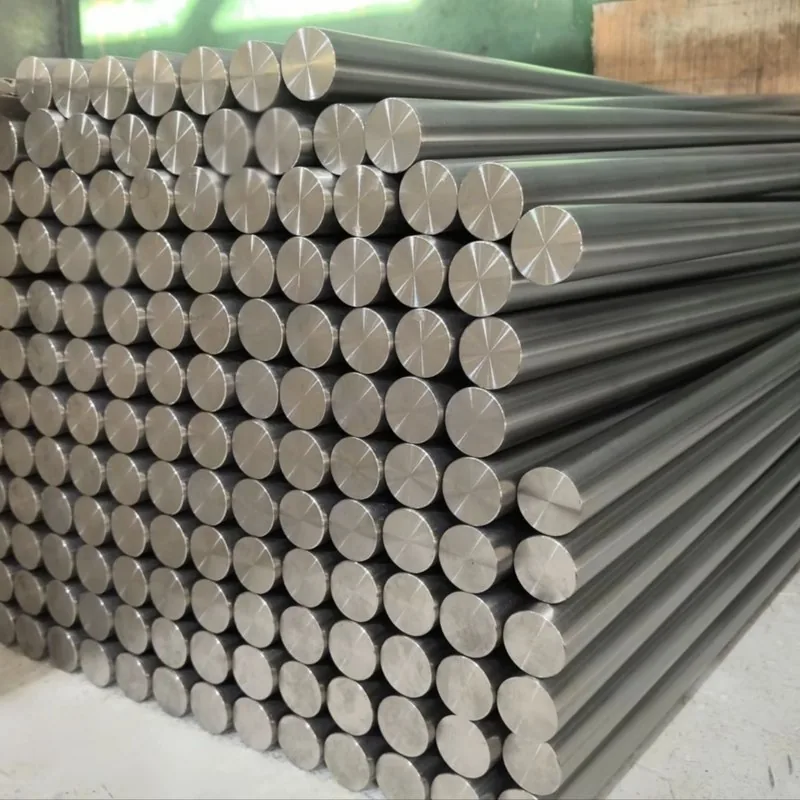
Alloy A286 (UNS S66286) round bar is an iron-base precipitation-hardening superalloy supplied as straight lengths or coils, hardened by a titanium and aluminium addition that forms gamma prime during ageing. The grade is also known as ASTM Grade 660, AISI 660, and GH2132 in the Chinese system, and it occupies a specific and useful place in the material map: cheaper than Inconel 718, far stronger than 316 stainless at temperature, and available in the fastener sizes that aerospace and turbine assembly actually consume.
Most A286 inquiries arrive with one of two confusions. Buyers treat it as a stainless steel because it contains 15% chromium and rusts like one, then discover it needs a full heat treatment cycle that a stainless fabricator is not set up for. Or they substitute it for 718 to save cost without checking the temperature, and find that the 650 °C capability that looked equivalent on a datasheet is not equivalent in creep. This guide sets out what the grade is, what the standards fix, what the aged properties are, and where the substitution stops working.
What is A286 round bar and how does it harden?
A286 is an iron-base alloy with roughly 25% nickel, 15% chromium and 2% titanium, and it hardens by the same gamma prime mechanism used in nickel-base superalloys — titanium and aluminium combine with nickel to form Ni3(Al,Ti) precipitates during ageing. Because the matrix is iron rather than nickel, the alloy costs less and has a lower density, but it also loses high-temperature capability sooner and resists aggressive corrosion less well.
The practical significance of an iron base is that A286 is ferromagnetic at room temperature, unlike the austenitic stainless steels it is often compared with. That matters in instrument and sensor applications and it is a frequent question from designers who assume any 15% chromium alloy is non-magnetic.
Round bar is the dominant product form because the grade's largest application is fasteners: bolts, studs, nuts and screws for engines and turbines, where the bar is threaded rather than forged to shape. Bar is supplied in three conditions — solution annealed, solution treated and aged, or cold drawn and aged — and the condition determines the strength, the machinability and what the buyer can still do to the part. For the general dimensional and tolerance framework across nickel and iron-base bar, see nickel alloy round bar specification.
Which standards cover A286 round bar?
The AMS numbers define the delivered condition rather than the grade, and picking the wrong one means either receiving bar that is too hard to machine or bar that has no strength.
| Standard | Product form and condition | Tensile minimum |
|---|---|---|
| AMS 5731 | Bar, forgings, rings — solution treated and aged | 896 MPa (130 ksi) |
| AMS 5732 | Bar, forgings, rings — solution treated only | About 655 MPa (95 ksi) |
| AMS 5737 | Bar and wire — cold drawn and aged | About 1000 MPa (145 ksi) |
| ASTM A638 | Bar and forgings for high-temperature bolting, Grade 660 | Per grade and diameter |
| ASTM A453/A453M Grade 660 | Bolting material for high-temperature service | Per class and diameter |
The AMS 5731 versus 5732 choice follows the same logic as Inconel 718: aged material arrives at full strength and can only be finished by grinding or light machining, while solution-treated material is soft enough to machine and form, with the ageing done afterwards. AMS 5737 is the cold-drawn route used for smaller diameters where the extra cold work plus ageing delivers the highest strength in the family.
ASTM A638 and A453 both exist because bolting has its own rules — proof load, stress relaxation and thread dimensions are specified by the bolting standard rather than by the bar standard, and a fastener order should reference the bolting specification even when the bar behind it is AMS 5731.
What is the chemical composition of A286?
The chemistry is dominated by the titanium-to-aluminium ratio, which controls how much gamma prime forms and how fast, and by the trace boron that strengthens the grain boundaries.
| Element | UNS S66286 limit (wt%) | Role |
|---|---|---|
| Iron | Balance | Matrix, lower cost than a nickel base |
| Nickel | 24.0–27.0 | Stabilises austenite, forms gamma prime with Ti and Al |
| Chromium | 13.5–16.0 | Oxidation resistance, moderate corrosion resistance |
| Titanium | 1.90–2.35 | Principal gamma prime former |
| Molybdenum | 1.00–1.50 | Solid solution strengthening |
| Manganese | 2.00 max | Deoxidation, austenite stability |
| Silicon | 1.00 max | Deoxidation |
| Aluminium | 0.35 max | Gamma prime former, kept low to control kinetics |
| Vanadium | 0.10–0.50 | Refines precipitation |
| Carbon | 0.08 max | Carbide former |
| Boron | 0.001–0.010 | Grain boundary strengthening, creep resistance |
| Phosphorus | 0.025 max | Residual, controlled |
| Sulphur | 0.025 max | Residual, controlled |
The Chinese equivalent GH2132 uses the same specification basis, and the comparison between the two designations and their heat treatment practice is covered in GH2132.
What strength does aged A286 round bar deliver?
Strength depends on the delivered condition and on diameter, because cold-drawn bar and large hot-rolled bar do not respond identically to the same ageing cycle.
| Condition | Tensile strength | 0.2% yield | Elongation | Hardness |
|---|---|---|---|---|
| AMS 5732, solution treated | About 655 MPa | About 275 MPa | 25% typical | Soft, machinable |
| AMS 5731, solution plus aged | 896 MPa (130 ksi) | 586 MPa (85 ksi) | 15% min | 248–321 HB |
| AMS 5737, cold drawn plus aged | About 1000 MPa | About 655 MPa | 12% typical | Higher, size dependent |
| Aged, tested at 650 °C | About 620 MPa | About 480 MPa | 15% typical | — |
The temperature capability is where A286 and Inconel 718 part company in practice. Both are quoted at about 650 °C long-term, but 718 retains substantially more creep and rupture strength at that temperature, so a part designed at the limit on 718 cannot simply be switched to A286 on the strength of the ambient tensile figures. A286 is the right answer where the temperature is moderate, the loads are fastener loads rather than turbine aerofoil loads, and the quantity makes the cost difference material.
How is A286 round bar heat treated?
The cycle is a solution treatment followed by a single ageing step, and the solution temperature is the variable that most often goes wrong because it is close to the grain-coarsening threshold.
| Step | Temperature | Time | Purpose |
|---|---|---|---|
| Solution treatment | 980 °C ± 15 | 1 h per 25 mm of section | Dissolve carbides and existing precipitates |
| Quench | Oil or air | Immediate | Retain supersaturated matrix |
| Ageing | 720 °C | 16 h | Precipitate gamma prime |
| Final cool | Air | — | — |
Two failure modes are worth knowing. Solution treating above about 1000 °C coarsens the grain and the part loses fatigue life permanently — there is no thermal treatment that refines a coarse grain structure. Ageing a part that has been cold worked or welded without a prior solution treatment produces strain-age cracking, because the precipitates form while residual stress is still locked in. That second point drives the welding rule below.
For the precipitation-hardening logic shared with the nickel-base grades, including how ageing temperature trades strength against toughness, see Inconel 718 heat treatment.
How does A286 compare with Inconel 718 and 316 stainless?
The three grades form a ladder, and most material selection in this corner of the map is about finding the lowest rung that works.
| Attribute | A286 (S66286) | Inconel 718 (N07718) | 316 stainless (S31600) |
|---|---|---|---|
| Base metal | Iron | Nickel | Iron, austenitic |
| Tensile, aged or annealed | 896 MPa | 1275 MPa | About 515 MPa |
| 0.2% yield | 586 MPa | 1035 MPa | About 205 MPa |
| Continuous service limit | About 650 °C | About 650 °C, higher creep strength | About 425 °C |
| Density | 7.94 g/cm³ | 8.19 g/cm³ | 8.00 g/cm³ |
| Corrosion resistance | Moderate | High | Moderate in chloride-free media |
| Weldability | Requires post-weld solution and age | Good, aged after welding | Good, no PWHT needed |
| Relative cost | Medium | High | Low |
The A286 versus 718 decision is mostly temperature and strength density, and the detailed property comparison is in GH2132, A286 and 718 compared. The A286 versus 316 decision is mostly temperature: above about 425 °C, 316 loses creep strength and starts to sensitise, and A286 takes over even though it costs several times more per kilogram.
Which applications specify A286 round bar?
A286 is specified where moderate high-temperature strength, fastener-scale quantities and cost control coincide.
| Application | Typical part | Why A286 rather than 718 |
|---|---|---|
| Aerospace fasteners | Bolts, studs, nuts, screws | Adequate strength at 650 °C, much lower cost |
| Turbine engines | Compressor discs and blades in mid stages, casings | Temperature falls within the iron-base capability |
| Exhaust systems | Bellows, brackets, flanges | Oxidation resistance to 815 °C short term |
| Cryogenic hardware | Fasteners and fittings for liquid gas service | Retains ductility at −196 °C |
| Oil and gas | Wellhead studs, valve trim fasteners | Strength plus moderate corrosion resistance |
| Automotive | Turbocharger housings and fasteners | Thermal cycling at moderate peak temperature |
| Heat exchangers | Tube supports, tie rods | Creep strength at 600 °C class |
Two cautions apply. Sour service is the first: A286 is used in oil and gas bolting, but NACE MR0175 / ISO 15156 sets a hardness ceiling that aged A286 can exceed, so a sour-service order needs the hardness and heat treatment agreed with the end user rather than assumed from the grade name — see NACE MR0175 sour service guide. Welding is the second: A286 is weldable but requires post-weld solution treatment and ageing, which means it is not a field-weldable material in the way 625 is, and repairs on installed equipment usually require removing the part.
How is A286 round bar tested and certified?
| Test | Reference | Scope |
|---|---|---|
| Chemical analysis | AMS 5731 limits | Every heat |
| Room temperature tensile | ASTM E8, per lot | Every lot |
| Hardness | Brinell, after ageing | Every lot |
| Grain size | ASTM E112 | Where specified, commonly 5 or finer |
| Stress rupture | Where specified | Fastener and turbine applications |
| Surface and dimensional | AMS 5731 plus drawing | Every bar |
| Non-destructive inspection | ASTM A388 ultrasonic where specified | Critical rotating parts |
| Documentation | EN 10204 3.1 material test report | Every shipment |
Machining A286 in the aged condition is hard on tooling because the gamma prime phase is abrasive and the alloy work hardens quickly — the practical parameters are covered in nickel alloy machining guide, and the inspection methods used to verify finished parts are set out in nickel alloy NDT methods.
Ordering A286 round bar from Hangbo Alloy
Hangbo Alloy supplies Alloy A286 (UNS S66286, Grade 660) round bar to AMS 5731, AMS 5732, AMS 5737 and ASTM A638, in the solution-treated, aged or cold-drawn and aged condition, from 6 mm to 250 mm diameter with peeled, ground or cold-drawn finish as required. Every shipment carries an EN 10204 3.1 material test report with hardness and tensile results from the delivered lot.
To quote bar we need the standard and the condition, the diameter and the finish, the length or the cut length, whether hardness and stress rupture testing are required, and the quantity. If the bar is going into bolting for sour service or into a part that will be welded after machining, tell us at the enquiry stage — the heat treatment sequence and the hardness ceiling both change, and settling that before the bar is cut is far cheaper than re-heat-treating a finished fastener.
Continue reading
- ASTM B366 Nickel Alloy Pipe Fittings Grade GuideASTM B366 nickel alloy fittings: WP grade table, WP-S and WP-W classes, wall thickness, PMI and how they diffe
- Alloys for Bellows and Expansion JointsBellows alloy selection for expansion joints: how to choose 625, C-276, 800 or 316L strip for fatigue life, co
- Which Alloy for Heat Exchanger Tubes?Heat exchanger tube alloy selection: which stainless, nickel or titanium tube suits the cooling medium, temper
- Nickel Alloys for Hydrogen ElectrolysersElectrolyser alloys for alkaline and PEM duty: nickel 201, Monel 400, Inconel 625 and 316L, with the plate, tu
- Inconel 625 Plate: Standards and Thickness RangeInconel 625 (UNS N06625) plate to ASTM B443 and AMS 5599: thickness range, annealed properties and weld overla
- All 17 Product Forms & Specifications guides
Frequently asked questions
Is A286 the same as Grade 660?
Yes. Alloy A286, UNS S66286, ASTM Grade 660, AISI 660 and GH2132 all refer to the same iron-nickel-chromium alloy with about 2% titanium, and the different names come from the aerospace, ASTM, AISI and Chinese designation systems rather than from any metallurgical difference.
Can A286 be used at 700 °C?
Only for short excursions. A286 is rated for continuous service to about 650 °C and intermittent exposure to roughly 815 °C, but its creep and rupture strength above 650 °C is well below Inconel 718, so a part designed at 700 °C on 718 should not be substituted with A286 without a fresh rupture check.
Does A286 need post-weld heat treatment?
Yes. Welded A286 requires a solution treatment at about 980 °C followed by the 720 °C ageing cycle. Ageing a weld without the prior solution treatment risks strain-age cracking, which is why A286 is not treated as a field-weldable alloy.
Is A286 magnetic?
Yes, at room temperature. Because A286 is iron-base rather than a fully austenitic stainless steel, it is ferromagnetic when annealed, which distinguishes it from 316 and matters in instrument and sensor applications where a magnetic fastener is not acceptable.