
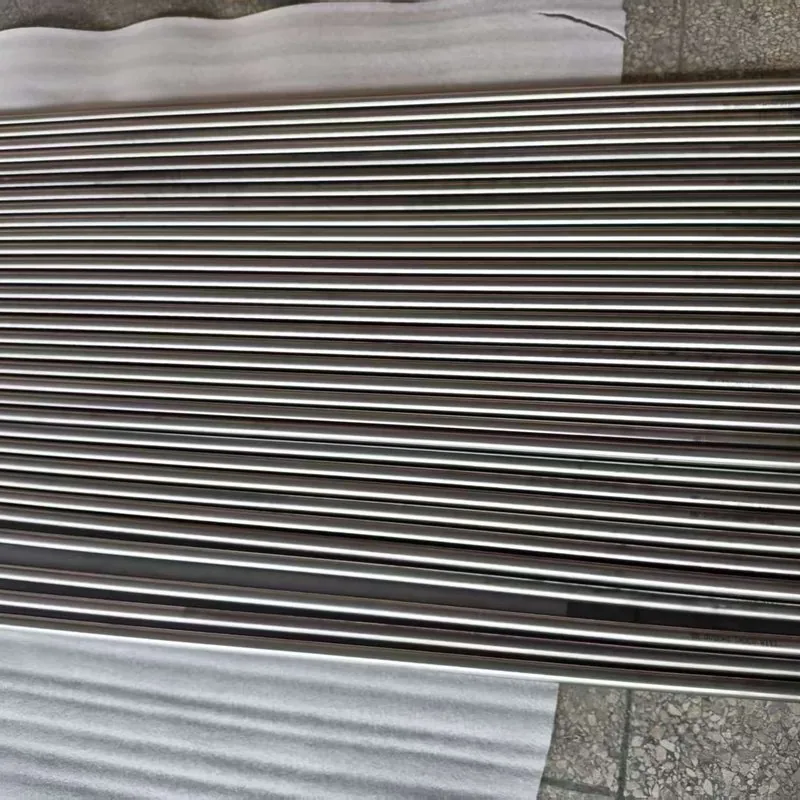
Inconel 600 (UNS N06600) is a nickel-chromium alloy containing about 72% nickel, and Inconel 625 (UNS N06625) is a nickel-chromium-molybdenum-niobium alloy. Both are solid-solution alloys with no ageing step, both are used in heat and corrosion service, and both are routinely confused with each other on drawings — yet one is chosen for an oxidation ceiling near 1,095 °C and the other for chloride and seawater resistance that Inconel 600 does not have.
What are the composition limits of Inconel 600 and Inconel 625?
Inconel 600 and Inconel 625 share a nickel-chromium base, but 625 adds molybdenum, niobium and a higher chromium level that change its corrosion behaviour completely. Inconel 600 is essentially a nickel-chromium alloy with iron; 625 is a nickel-chromium-molybdenum alloy with niobium and very little iron.
| Element (wt%) | Inconel 600, UNS N06600 (ASTM B168) | Inconel 625, UNS N06625 (ASTM B443) |
|---|---|---|
| Nickel | 72.0 min | 58.0 min |
| Chromium | 14.0-17.0 | 20.0-23.0 |
| Iron | 6.0-10.0 | 5.0 max |
| Molybdenum | — | 8.0-10.0 |
| Niobium plus tantalum | — | 3.15-4.15 |
| Carbon | 0.15 max | 0.10 max |
| Manganese | 1.00 max | 0.50 max |
| Silicon | 0.50 max | 0.50 max |
| Copper | 0.50 max | — |
| Aluminium | — | 0.40 max |
| Titanium | — | 0.40 max |
| Cobalt | — | 1.00 max |
| Density | 8.47 g/cm³ | 8.44 g/cm³ |
| Melting range | 1,354-1,413 °C | 1,290-1,350 °C |
The iron content is the clearest fingerprint. Inconel 600 carries 6-10% iron and can therefore be described as a nickel-chromium-iron alloy; Inconel 625 caps iron at 5% and replaces it with molybdenum and niobium, which is where its corrosion resistance comes from.
How do the mechanical properties of Inconel 600 and 625 differ?
Annealed Inconel 625 is about 50% stronger in tension and about 70% stronger in yield than annealed Inconel 600, without any heat treatment. Both are solid-solution alloys, so there is no ageing step to lift the numbers — the difference is built into the chemistry.
| Property (room temperature, annealed) | Inconel 600 (ASTM B166) | Inconel 625 (ASTM B446) |
|---|---|---|
| Tensile strength, minimum | 550 MPa (80 ksi) | 827 MPa (120 ksi) |
| 0.2% yield strength, minimum | 240 MPa (35 ksi) | 414 MPa (60 ksi) |
| Elongation, minimum | 30% | 30% |
| Typical hardness | about 75 HRB | about 90-95 HRB |
| Strengthening mechanism | solid solution and cold work | solid solution, molybdenum and niobium |
Because neither alloy responds to ageing, the mill condition is the whole story. A cold-drawn and stress-relieved tube will be stronger than an annealed one, and the specification must state which is required. For high-temperature service the annealed condition is normal, because cold work is lost once the part enters service above the recrystallisation range.
Which alloy withstands a higher temperature?
Inconel 600 has the higher oxidation ceiling; Inconel 625 has more strength in the 600-800 °C band. The choice depends on whether the duty is "glowing hot but lightly loaded" or "hot and loaded".
| Service condition | Inconel 600 | Inconel 625 |
|---|---|---|
| Continuous oxidation in air | about 1,095 °C | about 980 °C |
| Intermittent oxidation | about 1,150 °C | about 980 °C |
| Strength at 600-800 °C | lower | higher |
| Carburising atmospheres | good | good |
| Nitriding atmospheres | good | moderate |
| Thermal cycling | good | good |
| Stress relaxation resistance | lower | higher |
Inconel 600 is the classic furnace alloy: retorts, muffs, radiant tubes, heat-treating fixtures and thermocouple sheaths, all cases where the part glows but carries little load. Inconel 625 is chosen where the part is hot and also loaded or thermally cycled, such as expansion bellows and exhaust components, and its molybdenum content adds corrosion resistance that 600 lacks below the oxidation range.
Which alloy resists chlorides and seawater?
Inconel 625 resists chlorides and seawater; Inconel 600 does not. Inconel 600's high nickel gives it excellent resistance to chloride stress-corrosion cracking in hot water, which is why it is used in nuclear steam generators, but it has no molybdenum and therefore pits and crevices in seawater.
| Medium | Inconel 600 | Inconel 625 |
|---|---|---|
| Chloride stress-corrosion cracking, hot water | excellent | excellent |
| Seawater immersion | not recommended | excellent |
| Pitting and crevice in chlorides | poor | excellent |
| Wet chlorine | limited | good |
| Nitric acid | good | good |
| Phosphoric acid | fair | good |
| Sulphuric acid, moderate | limited | good |
| Flue-gas desulphurisation | not typical | standard |
| Caustic soda | good | good |
| Organic acids | good | good |
The pitting resistance equivalent number separates them cleanly: Inconel 600 sits near 16 because it has no molybdenum, while Inconel 625 sits near 51 on the strength of about 9% molybdenum. PREN is not the whole story for 600, whose high nickel makes it immune to chloride stress-corrosion cracking even though it pits; that is why 600 survives hot pure water but not seawater.
Which standards and product forms cover each alloy?
Inconel 600 and Inconel 625 are each covered by a full set of product-form specifications, and the aerospace AMS numbers add process control on top.
| Product form | Inconel 600 | Inconel 625 |
|---|---|---|
| Plate, sheet, strip | ASTM B168 | ASTM B443 |
| Bar and forging | ASTM B166 | ASTM B446 |
| Seamless pipe and tube | ASTM B167 | ASTM B444 |
| Heat-exchanger and condenser tube | ASTM B163 | ASTM B444 |
| Welded tube | — | ASTM B704 |
| Welded pipe | — | ASTM B705 |
| Aerospace sheet and plate | AMS 5540 | AMS 5599 |
| Aerospace bar and forging | AMS 5665 | AMS 5666 |
| General requirements, flat-rolled | ASTM B906 | ASTM B906 |
The plate and sheet specifications are the ones most often quoted for fabricated equipment, and the plate and sheet specification guide explains how thickness tolerance and edge condition are read from them. For tube, the heat exchanger tube selection guide covers the trade-off between 600's high-temperature oxidation resistance and 625's chloride resistance in cooling-water service.
Welding both alloys follows the same discipline: matching filler metal, low heat input and a clean joint. The filler metal selection guide sets out the electrode and filler designations for the nickel-chromium family.
When is Inconel 600 the right choice?
Inconel 600 is the right choice when the duty is hot oxidation with little load, or hot water where chloride stress-corrosion cracking is the risk rather than pitting.
The classic cases are furnace retorts and muffle tubes at 900-1,100 °C, heat-treating fixtures and baskets, radiant tubes, thermocouple sheaths, and nuclear steam-generator tubing where high-purity water and chloride SCC resistance matter more than pitting resistance. In all of these the part is either lightly loaded or immersed in a medium where 600's high nickel is the deciding property.
Inconel 600 is also the cheaper alloy, so where its corrosion envelope is adequate there is no reason to pay for 625's molybdenum and niobium.
When is Inconel 625 worth the higher cost?
Inconel 625 is worth its higher cost wherever chlorides, seawater or mixed acids are present and the part is also loaded or thermally cycled.
It is the standard choice for seawater piping and offshore components, flue-gas desulphurisation equipment, scrubber internals, chemical process vessels handling mixed acids, and aerospace exhaust and engine hardware. In these duties Inconel 600 would pit or crevice, and a super-duplex stainless steel would lose strength or crack under the same conditions.
The cost gap is real: 625 carries 8-10% molybdenum and 3.15-4.15% niobium plus tantalum, both expensive additions, while 600 is mostly nickel and chromium with cheap iron filling the balance. The decision rule is therefore straightforward — if the medium is chloride-bearing or the part must combine strength with corrosion resistance, pay for 625; if the duty is clean high-temperature oxidation or hot pure water, 600 does the job at lower cost.
For a quick check of where each grade falls in the numbering systems, the cross-reference table maps 600 and 625 onto their Werkstoff, GB, JIS and AMS equivalents.
Continue reading
- Inconel 718 vs Hastelloy C-276: Which to Choose?Inconel 718 (UNS N07718) and Hastelloy C-276 (UNS N10276): strength, heat treatment, corrosion media, standard
- Nickel Alloy Pipe and Tube: Seamless vs WeldedSeamless or welded nickel alloy pipe? Compare the ASTM standards behind each route, plus cost, size range, pre
- 17-4PH vs 316L: Precipitation-Hardened Stainless vs Austenitic17-4PH (UNS S17400) is a precipitation-hardening stainless reaching about 1310 MPa; 316L (UNS S31603) is auste
- 17-4PH vs Inconel 718: Precipitation-Hardening Stainless vs Premium Nickel Superalloy17-4PH vs Inconel 718: chemistry, strength at temperature, H900-H1150 heat treatment, corrosion, machinability
- Duplex 2205 vs 316L: Austenitic Simplicity or Duplex Strength?Duplex 2205 (UNS S32205) is about twice as strong as 316L (UNS S31603) and far more resistant to chloride stre
- All 44 Alloy Comparisons guides
Frequently asked questions
Is Inconel 625 stronger than Inconel 600?
Yes — annealed Inconel 625 is specified at a minimum 827 MPa tensile and 414 MPa yield under ASTM B446, against 550 MPa tensile and 240 MPa yield for Inconel 600, so 625 carries roughly 50% more tensile strength and about 70% more yield strength without any ageing treatment.
Can Inconel 600 be used in seawater?
No — Inconel 600 relies on its high nickel content for resistance to chloride stress-corrosion cracking, but it contains no molybdenum and pits and crevices in seawater, so Inconel 625 or a super-duplex stainless steel is used for seawater-wetted parts instead.
Which alloy handles a higher temperature?
Inconel 600 — it resists continuous oxidation to about 1,095 °C while Inconel 625 is typically limited to about 980 °C, although Inconel 625 holds considerably more strength in the 600-800 °C range where 600 softens.
Why is Inconel 625 more expensive than Inconel 600?
Because Inconel 625 carries 8-10% molybdenum and 3.15-4.15% niobium plus tantalum in addition to 20-23% chromium, and those alloying additions cost far more than the 6-10% iron that makes up part of Inconel 600.