
Inconel 718 (UNS N07718) is a precipitation-hardenable nickel-iron-chromium superalloy, and Hastelloy C-276 (UNS N10276) is a nickel-chromium-molybdenum-tungsten corrosion alloy. Both are nickel-base alloys that appear on the same enquiry sheet, yet they are selected for opposite reasons: 718 for strength at temperature, C-276 for survival in aggressive chemistry. Treating them as interchangeable because both are "superalloys" is one of the more expensive mistakes in alloy procurement, because each fails in the duty the other was designed for.
What are the composition limits of Inconel 718 and Hastelloy C-276?
Inconel 718 and Hastelloy C-276 differ most sharply in molybdenum, chromium and the hardening elements. Inconel 718 is an iron-rich alloy that hardens through niobium, titanium and aluminium; C-276 is a nickel-rich alloy where molybdenum and tungsten provide corrosion resistance and there is nothing to age.
| Element (wt%) | Inconel 718, UNS N07718 (ASTM B637) | Hastelloy C-276, UNS N10276 (ASTM B575) |
|---|---|---|
| Nickel | 50.0-55.0 | Balance |
| Chromium | 17.0-21.0 | 14.5-16.5 |
| Molybdenum | 2.80-3.30 | 15.0-17.0 |
| Iron | Balance | 4.0-7.0 |
| Tungsten | — | 3.0-4.5 |
| Niobium | 4.75-5.50 | — |
| Titanium | 0.65-1.15 | — |
| Aluminium | 0.20-0.80 | — |
| Cobalt | 1.00 max | 2.50 max |
| Carbon | 0.08 max | 0.010 max |
| Manganese | 0.35 max | 1.00 max |
| Silicon | 0.35 max | 0.08 max |
| Density | 8.19 g/cm³ | 8.89 g/cm³ |
| Melting range | 1,260-1,336 °C | 1,325-1,370 °C |
The carbon limit tells its own story: 0.08% is acceptable in 718, while C-276 stops at 0.010%. C-276 is welded in chemical plant where grain-boundary carbide precipitation would open a corrosion path, so the specification keeps carbon low and relies on molybdenum for resistance instead.
How much stronger is Inconel 718 than Hastelloy C-276?
Inconel 718 in the aged condition is roughly twice as strong in yield as annealed C-276, and the gap comes entirely from precipitation hardening rather than from base chemistry. C-276 is a solid-solution alloy and cannot be aged, so its properties are fixed by the anneal.
| Property (room temperature) | Inconel 718, solution treated and aged (AMS 5662) | Hastelloy C-276, annealed (ASTM B574) |
|---|---|---|
| Tensile strength, minimum | 1,240 MPa (180 ksi) | 690 MPa (100 ksi) |
| 0.2% yield strength, minimum | 1,035 MPa (150 ksi) | 283 MPa (41 ksi) |
| Elongation, minimum | 12% | 40% |
| Typical hardness | 36-40 HRC | about 90 HRB |
| Strengthening mechanism | gamma-double-prime (Ni3Nb) precipitation | solid solution only |
The 718 numbers only exist after the correct heat treatment. Solution annealing is followed by a two-step age — typically 720 °C for 8 hours, furnace cooled, then 620 °C for 8 hours — and a mill certificate that quotes only the solution-annealed condition is not comparable with an aged one. The full cycle and its variants are set out in the Inconel 718 heat treatment guide.
For a load-bearing part, this difference is decisive. A designer who specifies 718 for its 1,035 MPa yield cannot substitute C-276, because no heat treatment will lift annealed C-276 to that level. Conversely, a designer who specifies C-276 for its corrosion resistance should not accept 718 on a "stronger is better" argument, because 718's corrosion envelope is far narrower.
How do the two alloys behave at high temperature?
Inconel 718 wins on load-bearing strength at temperature; Hastelloy C-276 wins on oxidation ceiling but carries no useful structural load there. The two temperature capabilities answer different questions.
| Service condition | Inconel 718 | Hastelloy C-276 |
|---|---|---|
| Continuous load-bearing strength | to about 650-700 °C | not a structural choice above about 425 °C |
| Oxidation in air, continuous | good to about 980 °C | good to about 1,040 °C |
| Short-term excursion without load | 980 °C | 1,095 °C in oxidising gas |
| Creep and stress rupture | designed for turbine disks near 650 °C | not applicable |
| Cryogenic toughness | excellent to -196 °C and below | good, used in cryogenic piping |
Inconel 718 was developed for gas-turbine disks and compressor casings, where it must hold stress at 650 °C for thousands of hours without creeping. C-276 was developed for chemical reactors and flue-gas equipment, where it must resist hot acid and chloride without dissolving; it is not asked to carry structural load at temperature, and its annealed strength falls away well before its oxidation limit is reached.
Which alloy survives which corrosion environment?
Hastelloy C-276 is the broader corrosion alloy, and Inconel 718 is the narrower one. The pitting resistance equivalent number makes the gap explicit: 718 sits near 29, C-276 near 75, because the PREN formula rewards molybdenum and tungsten, which C-276 carries in quantity and 718 does not.
| Medium | Inconel 718 | Hastelloy C-276 |
|---|---|---|
| Seawater and chloride immersion | not recommended, pits | excellent |
| Wet chlorine, hypochlorite | poor | excellent |
| Hydrochloric acid | poor | good at moderate concentration and temperature |
| Sulphuric acid | limited | good |
| Nitric acid and other oxidising acids | good | limited, low chromium |
| Flue-gas desulphurisation | not typical | standard choice |
| Oxidising salts (ferric, cupric chloride) | poor | excellent |
| Caustic soda | fair | good |
| Sour service with H2S | used within NACE limits | good |
The pattern is that C-276 handles both oxidising and reducing media, which is why it dominates FGD scrubbers, pickling lines and chemical reactors. Inconel 718 has enough chromium for oxidising acids and for oxidation resistance in air, but its low molybdenum leaves it exposed to chlorides. Where a part needs both 718-level strength and C-276-level corrosion resistance, the usual answer is a bridging alloy such as Inconel 725, which is age-hardenable and molybdenum-bearing, rather than forcing either of these two into the wrong duty.
For sour service, the governing document is NACE MR0175 / ISO 15156, and both alloys are used within its limits — but the limits differ, so the standard must be read for the specific grade rather than assumed.
Which standards and specifications apply?
Inconel 718 and Hastelloy C-276 are covered by separate product-form specifications, and an enquiry that quotes only a trade name leaves the mill guessing which one applies.
| Product form | Inconel 718 | Hastelloy C-276 |
|---|---|---|
| Bar, forging, forging stock | ASTM B637 | ASTM B574 |
| Plate, sheet, strip | ASTM B670 | ASTM B575 |
| Seamless pipe and tube | not commonly specified | ASTM B622 |
| Welded pipe | — | ASTM B619 |
| Welded tube | — | ASTM B626 |
| Fittings | — | ASTM B366 |
| Aerospace bar and forging | AMS 5662 or AMS 5663 | AMS 5750 |
| General requirements, flat-rolled | ASTM B906 | ASTM B906 |
The aerospace specification matters more than the product standard for 718, because AMS 5662 fixes melting practice, grain size and test frequency on top of composition. Two bars with identical chemistry can pass the UNS composition and still fail AMS, which is why airframe buyers order against both. For C-276 the product-form standard usually governs, and the corrosion tests that qualify it are ASTM G28 for intergranular attack and ASTM G48 for pitting and crevice resistance.
Can Hastelloy C-276 be substituted for Inconel 718, or the reverse?
Neither substitution is safe as a general rule. C-276 cannot replace 718 in a strength-driven part because it cannot be aged, and 718 cannot replace C-276 in a chloride or wet-chlorine duty because it pits. The substitution only works in the narrow overlap where the part is lightly loaded and the medium is mildly oxidising.
Three checks decide whether a substitution is even arguable: the design strength must be re-run against the substitute's annealed properties, the corrosion rate must be measured in the actual medium rather than inferred from a table, and the product form and delivery condition must exist in the substitute's specification. In practice the third check is where substitutions quietly fail, because a form available in 718 bar may not be stocked in C-276 to the same condition.
Which applications use each alloy?
The application split follows directly from the property split, and the two lists barely overlap.
| Sector | Inconel 718 | Hastelloy C-276 |
|---|---|---|
| Aerospace | turbine disks, compressor blades, high-strength fasteners | — |
| Cryogenic | rocket engine tanks and lines | cryogenic pipework |
| Oil and gas | wellhead and downhole hardware, bolting | sour gas piping, FGD ducting |
| Chemical processing | — | reactors, heat exchangers, pickling equipment |
| Power generation | gas-turbine hot section | FGD scrubbers, stack liners |
| Marine | — | seawater and offshore piping |
| Pulp and paper | — | digesters and bleach plant |
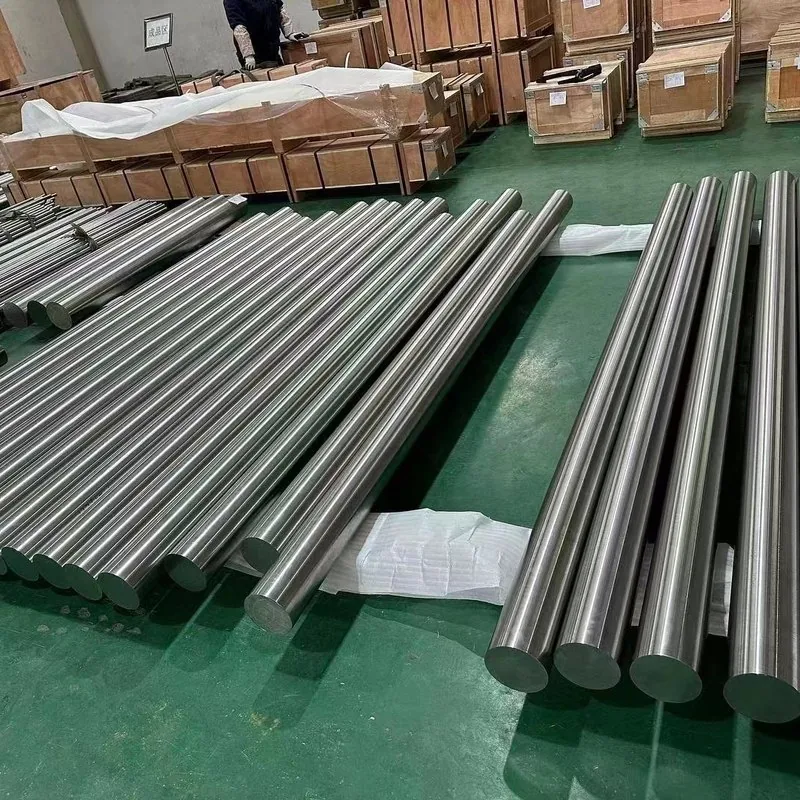
Inconel 718 is normally supplied as round bar and forging stock for machining into structural parts, while C-276 is supplied as plate, sheet and tube for fabricated equipment. The mill forms themselves signal the intended use: 718 is bought by the bar and forged, C-276 is bought by the plate and welded.
How do cost and availability differ?
Hastelloy C-276 costs substantially more than Inconel 718 per kilogram because of its alloying. C-276 carries 15-17% molybdenum and 3-4.5% tungsten, and both metals trade at multiples of nickel; 718 reaches its properties with a few percent molybdenum plus niobium, titanium and aluminium, all at lower addition rates. The alloy surcharge on C-276 therefore tracks two volatile metals, which also makes its price more volatile than 718's.
Availability follows the same split. Inconel 718 bar and forging stock are widely stocked in aerospace and oilfield service centres because demand is steady. C-276 plate and tube are stocked by corrosion-alloy distributors but in a narrower range of thicknesses, and heavy plate or large-diameter welded pipe often carries a mill lead time.
What should a buyer specify?
A purchase order for either alloy should carry four fields: the product-form standard, the UNS number, the delivery condition and the test requirements.
For an Inconel 718 forging that reads: ASTM B637, UNS N07718, solution treated and aged to AMS 5662, hardness and tensile tested per lot. For a Hastelloy C-276 heat-exchanger shell it reads: ASTM B575, UNS N10276, solution annealed and descaled, with an ASTM G28 intergranular corrosion test. Omitting the delivery condition is the most common cause of a rejected delivery, because "718" alone does not say whether the bar is annealed or aged, and the two conditions differ by a factor of two in yield strength.
The broader cross-reference between UNS, Werkstoff, GB and AMS numbers for these grades is in the nickel alloy grade cross-reference, which is the right starting point when a drawing quotes a system other than the one the mill works in.
Continue reading
- Nickel Alloy Pipe and Tube: Seamless vs WeldedSeamless or welded nickel alloy pipe? Compare the ASTM standards behind each route, plus cost, size range, pre
- 17-4PH vs 316L: Precipitation-Hardened Stainless vs Austenitic17-4PH (UNS S17400) is a precipitation-hardening stainless reaching about 1310 MPa; 316L (UNS S31603) is auste
- 17-4PH vs Inconel 718: Precipitation-Hardening Stainless vs Premium Nickel Superalloy17-4PH vs Inconel 718: chemistry, strength at temperature, H900-H1150 heat treatment, corrosion, machinability
- Duplex 2205 vs 316L: Austenitic Simplicity or Duplex Strength?Duplex 2205 (UNS S32205) is about twice as strong as 316L (UNS S31603) and far more resistant to chloride stre
- Super Duplex 2507 vs 316L: When Stainless Steel Isn't Enough for SeawaterSuper Duplex 2507 (UNS S32750) delivers roughly twice the yield strength of 316L (UNS S31603) plus the chlorid
- All 44 Alloy Comparisons guides
Frequently asked questions
Is Inconel 718 stronger than Hastelloy C-276?
Yes — aged Inconel 718 is specified at a minimum 1,240 MPa tensile and 1,035 MPa yield under AMS 5662, against 690 MPa tensile and 283 MPa yield for annealed C-276, so 718 is roughly twice as strong in yield, but only because it is precipitation hardened and not because its base chemistry is inherently stronger.
Can Hastelloy C-276 replace Inconel 718 in a high-strength part?
No — C-276 is a solid-solution alloy that cannot be aged, so it cannot approach the 1,035 MPa yield of aged 718, and substituting it in a load-bearing part designed around 718 will fail the strength calculation even though its corrosion resistance is far superior.
Which alloy is better in seawater?
Hastelloy C-276 — its molybdenum and tungsten give it a pitting resistance equivalent near 75 and it resists chloride pitting and crevice attack, whereas Inconel 718 sits near a PREN of 29 and is not selected for seawater immersion.
Why does Inconel 718 need a two-step ageing treatment?
Inconel 718 hardens by precipitating the gamma-double-prime phase, Ni3Nb, and the two-step age of about 720 °C for 8 hours followed by 620 °C for 8 hours forms that phase without over-ageing it, so a single high-temperature hold would leave the alloy softer than the AMS 5662 minimum.