
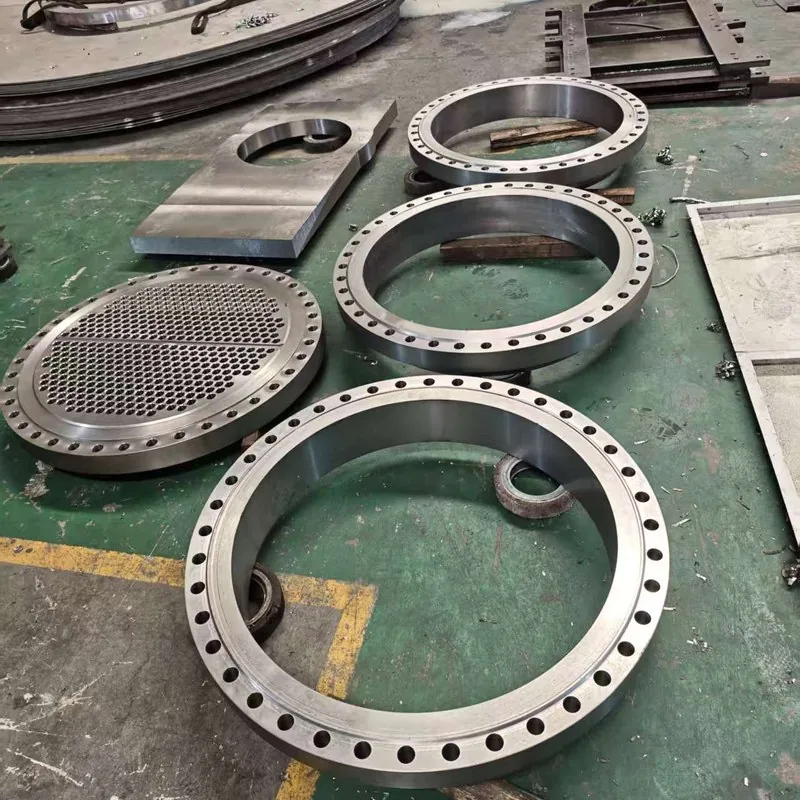
Hastelloy B-3 (UNS N10675) is a nickel-molybdenum corrosion alloy containing 27-32% molybdenum and only 1-3% chromium, and Hastelloy C-276 (UNS N10276) is a nickel-chromium-molybdenum-tungsten alloy. The difference in chromium content decides which acid each can survive: B-3 is built for reducing acids and C-276 for the mixed oxidising-and-reducing service that B-3 cannot tolerate, and choosing between them is mostly a question of whether the process stream contains an oxidiser.
What separates the chemistry of Hastelloy B-3 and C-276?
Hastelloy B-3 and C-276 sit at opposite ends of the chromium scale. B-3 deliberately keeps chromium low so the molybdenum can dominate, while C-276 uses chromium and tungsten to survive oxidising conditions.
| Element (wt%) | Hastelloy B-3, UNS N10675 (ASTM B333) | Hastelloy C-276, UNS N10276 (ASTM B575) |
|---|---|---|
| Nickel | Balance | Balance |
| Molybdenum | 27.0-32.0 | 15.0-17.0 |
| Chromium | 1.0-3.0 | 14.5-16.5 |
| Iron | 1.0-3.0 | 4.0-7.0 |
| Tungsten | 3.0 max | 3.0-4.5 |
| Manganese | 3.0 max | 1.0 max |
| Cobalt | 3.0 max | 2.50 max |
| Carbon | 0.010 max | 0.010 max |
| Silicon | 0.10 max | 0.08 max |
| Aluminium | 0.50 max | — |
| Titanium | 0.20 max | — |
| Copper | 0.20 max | — |
| Vanadium | 0.20 max | 0.35 max |
| Density | 9.22 g/cm³ | 8.89 g/cm³ |
| Melting range | 1,370-1,410 °C | 1,325-1,370 °C |
B-3 is the third generation of the nickel-molybdenum family, after B-2. It was developed to control the formation of Ni4Mo ordering that made B-2 brittle in the heat-affected zone of welds, and the tighter limits on iron, chromium and carbon in B-3 are there to keep that phase from forming. The comparison with its predecessor is set out in Hastelloy B-2 vs B-3, and the older pairing with C-276 remains a useful reference in Hastelloy B-2 vs C-276.
How do Hastelloy B-3 and C-276 perform in hydrochloric acid?
Hastelloy B-3 is the stronger hydrochloric acid alloy at every concentration and temperature, and the gap widens as concentration and temperature rise. C-276 is limited to dilute acid at low temperature because its chromium content is not enough to protect it in concentrated reducing acid.
| Hydrochloric acid duty | Hastelloy B-3 | Hastelloy C-276 |
|---|---|---|
| All concentrations to boiling point | excellent | not suitable |
| 5-20% at room temperature | excellent | good |
| 20% at 60 °C | excellent | moderate |
| 37% at 70 °C | excellent | poor |
| Dilute acid with dissolved oxygen | good | moderate |
| Acid containing ferric or cupric ions | attacked | good |
The rule that follows is simple: if the stream is hydrochloric acid and clean — free of oxidisers — B-3 is the correct alloy and C-276 will corrode far faster. C-276 only becomes competitive when an oxidiser is present, because its chromium can then form a passive film that B-3 cannot.
How do they compare in sulphuric and other acids?
Hastelloy B-3 leads in sulphuric acid and the organic acids, while C-276 leads wherever oxygen, chlorine or oxidising salts are present.
| Medium | Hastelloy B-3 | Hastelloy C-276 |
|---|---|---|
| Sulphuric acid, dilute to 60% | excellent | good |
| Sulphuric acid, above 60% | excellent | moderate |
| Phosphoric acid | good | good |
| Acetic acid | excellent | good |
| Formic acid | excellent | good |
| Nitric acid | poor, attacked | moderate |
| Wet chlorine and hypochlorite | poor | excellent |
| Ferric and cupric chloride | poor, rapid attack | excellent |
| Seawater | poor | excellent |
| Mixed oxidising and reducing acid | poor | excellent |
The sulphuric acid results are why B-3 is common in acid pickling, aluminium chloride catalysis and vacuum crystallisation, where the stream is strongly reducing. The C-276 results are why it dominates flue-gas desulphurisation, bleach plants and seawater systems, where chloride and oxygen are both present.
What happens if Hastelloy B-3 meets an oxidising medium?
Hastelloy B-3 corrodes rapidly in oxidising media, and this is not a marginal loss of corrosion allowance — it is a failure mode. Nitric acid, aerated ferric chloride, cupric chloride, wet chlorine and hypochlorite all attack the low-chromium matrix, and the attack can be severe enough to perforate thin-wall equipment in a short time.
This sensitivity defines the selection order. A process engineer first asks whether the stream contains oxygen, chlorine, nitric acid or oxidising metal ions. If any of these is present, B-3 is excluded regardless of how good its hydrochloric acid performance looks, and C-276 or a higher-chromium alloy such as C-22 becomes the candidate. The C-276 vs C-22 comparison covers that next step.
How do mechanical properties and fabrication compare?
Hastelloy B-3 is slightly stronger than C-276 in the annealed condition and denser, but both are solid-solution alloys fabricated in similar ways. The decisive fabrication difference is filler metal: the two alloys cannot be welded with the same consumable.
| Property (room temperature, annealed) | Hastelloy B-3 (ASTM B335) | Hastelloy C-276 (ASTM B574) |
|---|---|---|
| Tensile strength, minimum | 760 MPa (110 ksi) | 690 MPa (100 ksi) |
| 0.2% yield strength, minimum | 350 MPa (51 ksi) | 283 MPa (41 ksi) |
| Elongation, minimum | 40% | 40% |
| Typical hardness | about 90 HRB | about 90 HRB |
| Density | 9.22 g/cm³ | 8.89 g/cm³ |
| Strengthening mechanism | solid solution only | solid solution only |
B-3 is welded with nickel-molybdenum filler such as ERNiMo-10, while C-276 is welded with nickel-chromium-molybdenum filler such as ERNiCrMo-4. Using the wrong filler leaves a weld zone that has neither the acid resistance of B-3 nor the oxidising resistance of C-276, and the joint becomes the weakest point in the equipment. Post-weld solution annealing is required for both alloys in severe service, because the heat of welding can precipitate grain-boundary phases that the base metal was specified to avoid. The C-276 welding guide covers the procedure in detail.
Which standards and product forms apply?
Hastelloy B-3 and C-276 share most of their product-form and corrosion-test standards, which makes the specification side easier than the metallurgy.
| Product form | Hastelloy B-3 | Hastelloy C-276 |
|---|---|---|
| Plate, sheet, strip | ASTM B333 | ASTM B575 |
| Bar and wire | ASTM B335 | ASTM B574 |
| Seamless pipe and tube | ASTM B622 | ASTM B622 |
| Welded pipe | ASTM B619 | ASTM B619 |
| Welded tube | ASTM B626 | ASTM B626 |
| Fittings | ASTM B366 | ASTM B366 |
| Intergranular corrosion test | ASTM G28 | ASTM G28 |
| Sour service with H2S | not typical | NACE MR0175 |
The shared pipe and tube standards mean a fabricator can move from one alloy to the other without changing the purchasing route, and the seamless versus welded pipe guide explains which form to specify for a given pressure and corrosion duty. The intergranular corrosion test in ASTM G28 is required for both alloys in chemical service, because it detects the grain-boundary attack that a badly heat-treated sample would suffer.
Which industries choose which alloy?
The industry split follows the acid split, and the two lists overlap only where a plant runs both reducing and oxidising streams and therefore stocks both alloys.
| Industry or duty | Hastelloy B-3 | Hastelloy C-276 |
|---|---|---|
| Hydrochloric acid production and handling | standard choice | limited |
| Sulphuric acid, pickling and regeneration | standard choice | good |
| Aluminium chloride catalysis | standard choice | limited |
| Acetic and formic acid | standard choice | good |
| Flue-gas desulphurisation | not suitable | standard choice |
| Pulp and paper bleach plant | not suitable | standard choice |
| Wet chlorine and hypochlorite | not suitable | standard choice |
| Seawater and offshore | not suitable | standard choice |
| Pharmaceutical mixed-acid service | limited | standard choice |
| Vacuum evaporation and crystallisation | standard choice | limited |
B-3 is bought chiefly by hydrochloric acid producers, pickling-line builders and catalyst-handling plants, usually as plate and tube for vessels and heat exchangers. C-276 is bought across a wider set of industries because its envelope is wider, and the seawater corrosion guide and FGD scrubber guide both treat it as a baseline material.
Which alloy should a buyer specify?
The buyer should specify Hastelloy B-3 when the process stream is a clean reducing acid — hydrochloric acid at any concentration, sulphuric acid, or an organic acid — and C-276 when the stream contains oxygen, chlorine, oxidising salts or chlorides alongside the acid.
The chemistry of the stream, not the alloy's general reputation, decides the order. A B-3 vessel installed on an aerated hydrochloric acid line will fail where a C-276 vessel would have survived; a C-276 vessel installed on concentrated hydrochloric acid will corrode at a rate B-3 would not. Both mistakes are common because the two alloys are sold under the same Hastelloy brand and appear next to each other in corrosion tables.
The purchase order should carry the product-form standard, the UNS number, the delivery condition and the corrosion test. For B-3 plate that reads: ASTM B333, UNS N10675, solution annealed and pickled, with an ASTM G28 test. For C-276 tube it reads: ASTM B622, UNS N10276, solution annealed, with a G28 test where the service is wet and chlorinated.
Continue reading
- Inconel 600 vs Inconel 625: Oxidation or Seawater?Inconel 600 (UNS N06600) and Inconel 625 (UNS N06625): oxidation limits, chloride resistance, strength and sta
- Inconel 718 vs Hastelloy C-276: Which to Choose?Inconel 718 (UNS N07718) and Hastelloy C-276 (UNS N10276): strength, heat treatment, corrosion media, standard
- Nickel Alloy Pipe and Tube: Seamless vs WeldedSeamless or welded nickel alloy pipe? Compare the ASTM standards behind each route, plus cost, size range, pre
- 17-4PH vs 316L: Precipitation-Hardened Stainless vs Austenitic17-4PH (UNS S17400) is a precipitation-hardening stainless reaching about 1310 MPa; 316L (UNS S31603) is auste
- 17-4PH vs Inconel 718: Precipitation-Hardening Stainless vs Premium Nickel Superalloy17-4PH vs Inconel 718: chemistry, strength at temperature, H900-H1150 heat treatment, corrosion, machinability
- All 44 Alloy Comparisons guides
Frequently asked questions
Is Hastelloy B-3 better than C-276 in hydrochloric acid?
Yes — B-3 handles hydrochloric acid at every concentration up to the boiling point because its 27-32% molybdenum and low chromium resist reducing acid attack, whereas C-276 is generally limited to dilute hydrochloric acid at low temperature and corrodes faster as concentration and temperature rise.
Can Hastelloy C-276 be used where B-3 is specified?
Only if the stream is oxidising or chloride-bearing as well as acidic — C-276 is the broader alloy, but in clean reducing hydrochloric or sulphuric acid it corrodes faster than B-3, so a straight substitution on an all-hydrochloric duty gives up corrosion allowance rather than gaining it.
What damages Hastelloy B-3?
Oxidising media damage B-3 — nitric acid, aerated ferric or cupric chloride, wet chlorine and hypochlorite all attack its low-chromium matrix rapidly, which is why B-3 is never selected for mixed or oxidising acid service.
Are Hastelloy B-3 and C-276 welded with the same filler?
No — B-3 is welded with nickel-molybdenum filler such as ERNiMo-10, while C-276 uses nickel-chromium-molybdenum filler such as ERNiCrMo-4, and the wrong filler leaves a weld zone with neither the acid resistance of B-3 nor the oxidising resistance of C-276.